Civil Procedure Code, 1908 (CPC) — Section 89 — Compromise Decree — Interpretation of — Memorandum of Settlement (MOS) forming basis of decree — Clause (xiii) specifying conditional obligations for exchange of immovable properties or payment of guideline value upon failure to transfer — Held, obligation to pay monetary compensation triggered by failure to transfer agreed ‘B Schedule’ land, not discretionary option.

2026 INSC 434

SUPREME COURT OF INDIA

DIVISION BENCH

NANDI INFRASTRUCTURE CORRIDOR ENTERPRISES LTD. AND ANOTHER

Vs.

B. GURAPPA NAIDU AND OTHERS

( Before : Aravind Kumar and N.V. Anjaria, JJ. )

Civil Appeal No.1388 of 2013 with Civil Appeal No. 1354 of 2013

Decided on : 30-04-2026

A. Civil Procedure Code, 1908 (CPC) — Section 89 — Compromise Decree — Interpretation of — Memorandum of Settlement (MOS) forming basis of decree — Clause (xiii) specifying conditional obligations for exchange of immovable properties or payment of guideline value upon failure to transfer — Held, obligation to pay monetary compensation triggered by failure to transfer agreed ‘B Schedule’ land, not discretionary option. [Paras 7(f), 9, 10, 11]

B. Karnataka Stamp Act, 1957 — Guideline Value Determination — Notification dated 17.04.2007 — Application of Special Instructions — Clause 1(c) relating to industrial purpose, Clause 2 for properties abutting State Highway, and Clause 6 for industrial areas where no specific guideline value notified — Held, Executing Court’s interpretation of Rs. 1,000 per sq. ft. by applying base value of Rs. 800 for converted sites and adding 25% for abutting State Highway, with Clause 6 being inapplicable as specific rates were notified, was a plausible interpretation. [Paras 17, 19.2, 20.2, 21.3, 37]

C. Constitution of India, 1950 — Article 227 — Supervisory Jurisdiction of High Court — Scope and Limits — High Court cannot act as appellate court, re-appreciate evidence, or substitute its own judgment for subordinate court’s — Interference restricted to grave dereliction of duty, flagrant violation of law or justice, or perverse findings of fact — Held, High Court exceeded jurisdiction by impleading State, accepting State’s interpretation of notification, and substituting its view for Executing Court’s plausible interpretation. [Paras 30-36, 36.3.1-36.4]

D. Land Acquisition Act, 1894 — Karnataka Stamp Act, 1957 — Valuation of Land — Guideline Value vs. Market Value — Guideline value fixed by State is a statutory benchmark and does not depend on factual considerations like developmental potential or extent of development, unlike market value determination in acquisition proceedings — Held, reliance on guideline value determined as per compromise decree, not on potentiality as agricultural land, is appropriate. [Paras 39.2]

E. Civil Procedure Code, 1908 (CPC) — Section 89 — Compromise Decree — Interest on Delayed Payment — Absence of stipulation for interest in decree — Held, party cannot claim interest as a matter of right unless stipulated — However, where High Court passed specific order granting interest at 6% per annum on appeal, that order would be binding subject to further adjudication, if any. [Paras 39.3]

F. Civil Procedure Code, 1908 (CPC) — Section 89 — Compromise Decree — Enforcement — Determination of compensation based on guideline value — Executing Court’s order determining value at Rs. 1,000 per sq. ft. restored — Judgment Debtors directed to pay balance amount with interest at 6% per annum as per High Court’s prior order. [Paras 41(a), 41(b), 41(c), 41(d)]

JUDGMENT

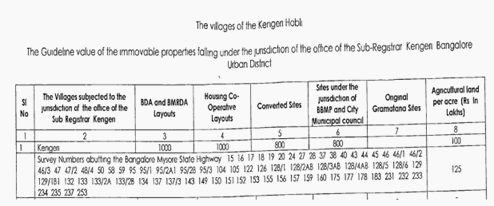
Aravind Kumar, J. – The Judgment Debtors, namely Nandi Infrastructure Corridor Enterprises (N.I.C.E.) and Nandi Economic Corridor Enterprises[1], and the Decree Holders, namely Sri B. Gurappa Naidu and Smt. Sunitha[2], are before this Court in Civil Appeal No. 1388 of 2013 and Civil Appeal No. 1354 of 2013, respectively, assailing the judgment dated 12.09.2012 passed by the High Court of Karnataka[3] in Writ Petition. No. 21068 of 2012[4]. By the impugned judgment, the High Court modified the order dated 31.05.2012 passed by the V Additional City Civil Judge, Bengaluru[5], in Execution Petition No. 2237 of 2009[6], whereby the value of the property bearing Survey No. 122 (New Survey No. 272/2) of Kengeri Village, Kengeri Hobli, Bengaluru South Taluk, measuring 3 acres 6 guntas out of a total extent of 6 acres 10 guntas[7], which had been determined at Rs.1,000/-per square feet came to be reduced to Rs.500/- per square feet.

[1] Both the Judgment Debtors are together hereinafter referred to as the ‘N.I.C.E’.

[2] Hereinafter referred to as the Decree Holders.

[3] Hereinafter referred to as the ‘High Court’.

[4] Hereinafter referred to as the ‘Impugned Judgment’.

[5] Hereinafter referred to as the ‘Executing Court’.

[6] Hereinafter referred to as the ‘Execution Petition’.

[7] 3 Acre 6 guntas out of 6 Acre 10 guntas of Survey No. 122 (New Survey No. 272/2), of Kengeri Village, Kengeri Hobli, Bengaluru South Taluk i.e. the Property for which the guideline value has been determined is hereinafter referred to as the ‘Schedule Land’ or ‘AA Schedule property’.

2 . Civil Appeal No. 1388 of 2013, filed by Nandi Infrastructure Corridor Enterprises (N.I.C.E.), assails the determination of compensation payable in respect of the schedule land at the rate of Rs.500/- per square foot and seek for reduction. On the other hand, Civil Appeal No. 1354 of 2013, preferred by the Decree Holders, challenges the fixation of compensation at Rs.500/- per square foot and seeks restoration of the valuation as fixed by Executing Court at Rs.1,000/- per square feet, on the basis of the guideline value determined under the Karnataka Stamp Act, 1957.[8]

[8] Hereinafter referred to as the ‘Guideline Value’.

PART-I

BRIEF FACTS:

3. As the case involves a lengthy history, it is discussed in brief in this section under various sub-heads forming a part of this section, which as under:

A. THE ALLOTMENT OF LAND TO N.I.C.E FOR EXECUTION OF BANGALORE – MYSORE INFRASTRUCTURE CORRIDOR PROJECT (BMICP):

4. A Framework Agreement was executed between Nandi Infrastructure Corridor Enterprises (N.I.C.E.) and the Government of Karnataka for the execution of the Bangalore Mysore Infrastructure Corridor Project (hereinafter referred to as “the BMICP”) under an agreement dated 03.04.1997. Among the several parcels of land allotted to N.I.C.E. for implementation of the said project, the lands belonging to the Decree Holders, namely the schedule land admeasuring 3 acres 6 guntas out of a total extent of 6 acres 10 guntas in Survey No. 122 (New Survey No. 272/2), Kengeri Village, Kengeri Hobli, Bengaluru South Taluk was also allotted to N.I.C.E by the Government. The said land was earmarked for the construction of a ramp of Interchange No. 5/7 on Mysore Road, and construction activities in that regard were initiated in the year 2006.

5. Though the schedule land was initially classified as agricultural land, the same was subsequently converted for industrial use on an application made by the owner, pursuant to an order dated 05.11.2004 passed by the competent authority.

B. THE SUIT FILED BY N.I.C.E AGAINST THE DECREE HOLDERS AND THE COMPROMISE ENTERED BETWEEN THE PARTIES.

6. Alleging interference with the implementation of the BMICP, N.I.C.E instituted a suit in O.S. No.4691 of 2006[9] before the City Civil Court, Bengaluru against the Decree Holders seeking the prayer of permanent injunction restraining the Decree Holders from interference with the implementation of BMIC project. The parties to the Suit, later entered into a Memorandum of Settlement dated: 10.08.2007[10].

[9] Hereinafter referred to as ‘the Suit’.

[10] Hereinafter referred to as the ‘Memorandum of Settlement’ or ‘MOS’ or ‘Settlement’.

7. As per the MOS, the parties agreed as follows:

a) Decree Holder No. 2 i.e. Smt. Sunitha, was acknowledged as the absolute owner in possession of the Schedule ‘A’ property comprising of 6 acres 10 guntas in Survey No. 122 (New Survey No. 272/2), Kengeri Village, Kengeri Hobli, Bengaluru South Taluk and the N.I.C.E expressly relinquished all right, title, and interest therein.

b) However, to facilitate completion of the Bangalore-Mysore Infrastructure Corridor Project, particularly the ramp of Interchange No. 5/7 on Mysore Road (SH-17). Decree Holder No. 2 permitted N.I.C.E to enter upon and utilize the schedule land i.e. 3 acres 6 guntas of the Schedule ‘A’ land and the same was referred to Schedule ‘AA’ for interchange development, while retaining possession and enjoyment of the remaining portion i.e. 3 acre 4 guntas which was referred to as Schedule ‘AAA’ property.

c) In consideration thereof, the N.I.C.E agreed to convey, by way of exchange, an extent of 6 acres 10 guntas in land bearing Sy Nos 164/4, 164/5 & Sy No 165 of Kengeri Village, Bangalore South Taluk which was described in Schedule ‘B’ to Decree Holder No.2. N.I.C.E agreed to bear all stamp duty and registration charges, and to ensure access and infrastructure facilities, subject to detailed conditions relating to conveyance, possession, contingencies, and timelines.

d) The settlement records that N.I.C.E had already acquired title to an extent of 4 acres 34 guntas forming part of Sy. Nos. 164/4 and 164/5 of Kengeri Village through KIADB under a registered sale deed dated 11.05.2004. They further undertook to obtain conveyance of the remaining extent of 1 acre 16 guntas in Sy. No. 165 from the Government under a registered instrument. In the event of failure to secure such conveyance, the plaintiffs bound themselves to convey an equivalent extent of land in any other survey number of Kengeri Village at Interchange No. 5/7, Mysore Road, having road frontage and access to all amenities. Upon securing full title, the N.I.C.E, agreed to convey the entire Schedule ‘B’ property to Decree Holder No. 2 by way of exchange and to place her in possession within a period of 24 months, followed by execution of a formal deed of exchange vesting absolute title of Schedule ‘A’ property in the plaintiffs and Schedule ‘B’ property in Defendant No. 2.

e) It was further agreed that, in consideration of the exchange option, the plaintiffs paid a sum of Rs. 25,00,000/- to Defendant No. 2 towards the value of existing trees, horticultural crops, structures, and appurtenances, subject to realization of the cheque, and Defendant No. 2 waived any future claim for compensation or alteration of structures thereafter.

f) The settlement provided detailed contingencies: one among which was clause (xiii) which is as follows:

“(xiii) In the event of the Plaintiffs not being able to acquire title to 6 Acres and 10 Guntas of land in one block and to convey the same to the Second Defendant under a deed of Exchange, the second defendant shall continue to retain the ownership of the land described in schedule AAA and shall be entitled to develop the same and continue to enjoy the same as absolute owner thereof in the manner she likes. In such an event, the Plaintiffs shall pay to the second defendant the value of the property described in the Schedule AA at the guideline value fixed by the Government as on today[11] and shall obtain conveyance of the same from the second defendant at the cost of the plaintiffs.”

g) In such an event, Decree Holder No. 2 would refund Rs. 12,50,000/- out of the compensation amount, retaining the balance. The agreement also safeguarded title by obligating Decree Holder No. 2 to resolve third-party claims over specified portions, failing which the plaintiffs were entitled to proportionately reduce the extent of Schedule ‘B’ land to be conveyed, thereby ensuring enforceability of the exchange arrangement.

[11] The State of Karnataka notification dated: 17.04.2007 was prevalent at that point in time, which had fixed the Guideline value of the immovable property.

8. The suit was disposed of in terms of the aforesaid settlement vide Judgment and Decree dated: 20.08.2007. Though the terms of the settlement have not been reproduced verbatim except for clause (xiii), the substance thereof has been indicated. Reference to the specific terms of the settlement shall be made, wherever necessary, for the purpose of adjudication of the present dispute.

C. AFTERMATH OF THE COMPROMISE: EXECUTION PETITION AND THE LEGAL BATTLES BETWEEN THE PARTIES.

9. The Decree Holders filed an Execution Petition before the Executing Court contending that Despite having initially acquired only 4 acres 34 guntas and undertaking to secure and convey the balance 1 acre 16 guntas so as to make up the agreed 6 acres 10 guntas of Schedule B land at Kengeri Village, the judgment debtors failed to obtain, convey, or develop the entire land within the stipulated period. Consequently, under the decree, they became liable to pay the guideline value of 3 acres 6 guntas retained by them in Sy. No. 122 (New Sy. No. 272/2) i.e. Schedule Land, after adjusting Rs. 12,50,000/- from the Rs. 25,00,000/- already paid; although notices demanding compliance were issued and acknowledged.

9.1. The Decree Holders further contended that the judgment debtors expressed their inability to convey land at Kengeri and instead proposed alternate land at Kommaghatta Village which according to the Decree Holders was contrary to the decree. As the Schedule Land stood converted for non-agricultural industrial use and was assessed to municipal tax, the Decree Holders contended that they are entitled to the guideline value of the property which according to them was Rs. 1,000/- per square feet, aggregating to Rs. 13,72,14,000/-, and the decree holders, alleging default by the judgment debtors, sought recovery of the said amount along with interest at 12% per annum.

10. After the service of summons, the Judgment Debtors i.e. N.I.C.E entered their appearance and filed their objections contending that the execution petition was misconceived, not maintainable, and an abuse of process, as the compromise decree dated 20.08.2007 did not contain any direction for payment of any monetary amount or interest and merely records reciprocal, conditional obligations for exchange of immovable properties, which the Executing Court cannot convert into a money decree. They assert that their obligation to convey Schedule ‘B’ land was contingent upon securing title to Sy. No. 165, which could not be obtained due to circumstances beyond their control, and that the option under Clause (xiii) to pay guideline value was discretionary and never exercised, giving rise to no enforceable monetary claim.

10.1. It was further contended that the decree holders themselves breached the settlement by delaying withdrawal of the criminal complaint and adopting a mala fide interpretation of the compromise, while the judgment debtors, without prejudice, express readiness and willingness to convey an alternative contiguous extent of 6 acres 10 guntas in Kengeri Village in full satisfaction of the decree.

11. The Executing Court, by order dated 19.03.2010, dismissed the Execution Petition filed by the Decree Holders on the ground that the compromise decree was not a money decree. Aggrieved thereby, the Decree Holders preferred Civil Revision Petition No. 166 of 2010 before the High Court. The High Court, by judgment and order dated 09.12.2010, set aside the order of dismissal and directed restoration of the Execution Petition, accepting the contention of the Decree Holders that, since the Judgment Debtors had already utilised the schedule land, they were liable to pay the guideline value as indicated in the Memorandum of Settlement (MoS) in terms of Clause (xiii) thereof. The High Court further directed the Executing Court to determine the guideline value payable to Decree Holder No. 2 by Judgment Debtors in accordance with Clause (xiii) of the MOS.

12. Upon restoration of the Execution Petition, the Judgment Debtors sought further time to execute the decree. The said request was declined by the Executing Court by order dated 25.02.2012, whereupon N.I.C.E. assailed the same before the High Court by filing W.P. No. 7521 of 2012. The High Court, by order dated 08.03.2012, disposed of the said writ petition, once again directing the parties to assist the Executing Court in determining the guideline value of the property.

13. The Judgment Debtors assailed the order passed by the High Court in C.R.P. No. 166 of 2010 before this Court by filing S.L.P. (C) No. 10633 of 2012. This Court, by order dated 09.04.2012, dismissed the said Special Leave Petition with the following observation:

“In the course of submissions, Mr Dushyant Dave, learned senior counsel for the petitioners, submitted that the petitioners shall pay to the respondent No 2 (second defendant) the value of the property described in Schedule AA at the guideline value fixed by the Government as on the date of compromise deed as provided in clause (xiii) in the Memorandum of Settlement.

Let the executing court determine the value of the land in terms of clause (xiii) of the Memorandum of Settlement as expeditiously as may be possible. The petitioners shall pay the amount so determined within eight weeks from the date of determination by the executing court.

If any amount has been paid as per the agreement to the respondent No 2, the same shall be adjusted in the amount that may be determined by the executing court.”

14. The aforesaid observation of this Court constituted the final determination on the entitlement of the Decree Holders to the amount payable, which was required to be determined by the Executing Court in accordance with the guideline value of the schedule land as fixed by the Government and prevailing on the relevant date, namely, the date on which the parties had entered into an amicable settlement.

PART-II

THE GUIDELINE VALUE DETERMINATION: THE GOVERNING NOTIFICATION FOR DETERMINATION OF GUIDELINE VALUE, THE ARGUMENTS ADVANCED BY THE PARTIES REGARDING THE CALCULATION OF THE GUIDELINE VALUE BEFORE THE EXECUTING COURT, THE JUDGMENT OF THE EXECUTING COURT AND THE HIGH COURT.

15. In the previous section, we have reproduced the factual background which is relevant for the determination of the current issue; now, before we proceed to record the submission of the parties raised before this Court and analyse the correctness of the impugned order, we deem it proper to dwell upon the notification governing the determination of the guideline value – which forms the basis to determine the amount to which the Decree Holders would be entitled to, the submissions regarding the guideline value raised before the Executing Court requires to be noted to understand the stand of each party with reference to the guideline value.

A. THE GOVERNING NOTIFICATION:

16. The parties, while entering into the settlement, agreed that in the event of default by the Judgment Debtors in transferring the ‘B Schedule’ land in favour of Decree Holder No. 2, as agreed, the Judgment Debtors would compensate Decree Holder No. 2 by payment of an amount equivalent to the guideline value prevailing at the time of the settlement in respect of the ‘AA Schedule’ land, namely, 3 acres 6 guntas out of a total extent of 6 acres 10 guntas in Survey No. 122 (New Survey No. 272/2), Kengeri Village, Kengeri Hobli, Bengaluru South Taluk. In that regard, both parties placed reliance on the notification dated 17.04.2007[12] issued by the Government of Karnataka for determination of the value of the land.

[12] Hereinafter referred to as ‘the Notification’.

17. The said notification fixes the guideline value for properties situated in Survey No. 122 of Kengeri Village, wherein the schedule land is located which is as follows:

18. Along with the guideline value as mentioned above, the notification also had some Special Instructions which was also supposed to be considered for the determination of the guideline value as mentioned in those particular instructions. Some of the important Special Instructions are as follows:

“1. The following rate has to be fixed in the case the property, which has been converted but not been fully developed is alienated in favour of third parties:

a

for residential purpose

50% of the land value

b

for Commercial purpose

60% of the land value

c

for Industrial purpose

25% of the land value


2. For the properties which have not been specified in the Rates List and abutting to the National and State Highway, the value to be fixed at 50% and 25% respectively more than the value of the other properties.

6. The rate for residential sites has to be followed for the industrial areas as already been notified in the guideline Excluding this area, for all other industrial sites, 50% of the residential sites value has to be fixed.”

B. ARGUMENTS OF THE PARTIES BEFORE THE EXECUTING COURT REGARDING DETERMINATION OF GUIDELINE VALUE OF THE SCHEDULE LAND:

19. After examining the notification governing the determination of the guideline value, The Decree Holders before the Executing Court contended as follows:

19.1. It was contended on behalf of the decree holders that the entire land bearing Sy. No. 272/2, including the extent of 3 acres 6 guntas in respect of which the judgment debtors were stated to be liable, stood converted for non-agricultural industrial purposes and had been assessed to municipal tax by the Town Municipal Council, Kengeri, which later fell within the jurisdiction of the BBMP. On that basis, the decree holders asserted that the guideline value fixed by the Government was Rs. 1,000/- per square foot and that the total amount payable worked out to Rs. 13,72,14,000/- for an extent of 1,37,214 square feet, together with interest at 12% per annum from the date it became payable, as already demanded by notice. It was urged that the execution petition had been filed for recovery of the said amount on the footing that the land was urban in character, industrially developed, and equipped with all civic amenities.

19.2. In support of the said contention, the decree holders relied upon licences issued by the then City Municipal Council, Kengeri, permitting industrial activity and construction with financial assistance from UCO Bank, power connections granted by BESCOM, and tax assessments made by BBMP. A detailed memo of calculation was placed on record to show that, as per the Government Notification dated 17.04.2007, the base value of Rs. 800/-per square feet applicable to properties within municipal limits and the same also attracted an addition of 25% of the base value as the property is abutting the state highway, thereby justifying the rate of Rs. 1,000/- per square foot which was claimed. It was also contended that upon conversion of land for non-agricultural purposes, the provisions of the Land Revenue Act ceased to apply and such lands were required to be treated as converted urban lands for the purpose of valuation, warranting fixation of value as claimed by the decree holders.

20. In reply to the stand taken by the Decree Holders, the Judgment Debtors appeared before the Executing Court and contended as follows:

20.1. That as per the notification, the judgment debtors relied upon paragraph 1 of the special instructions to the notification relating to fixation of guideline value issued by the competent authority and submitted that the appropriate guideline value of the land in question ought to be Rs. 1,56,25,000/- per acre. It was contended that paragraph 1 of the guideline value notification specifically dealt with fixation of land rates in respect of agricultural lands which had been converted for residential, commercial, or industrial purposes but had not been fully developed. The relevant provision stipulated that where such converted but undeveloped land was alienated in favour of third parties, the rate to be applied would be 50% of the land rate for residential purpose, 50% for commercial purpose, and 25% for industrial purpose.

20.2. On the basis of the said provision, the judgment debtors stand was that the land in question was originally an agricultural land, converted for industrial use in the year 2004, but had never been developed in fact. It was asserted that the land lacked civic amenities such as water supply and drainage, no layout of sites had been formed, and even the surrounding areas within a radius of about one kilometre remained undeveloped. It was further submitted that the Government had fixed the guideline value for agricultural lands abutting the State Highway at Rs. 1.25 crore per acre, and by adding 25% thereto under Special Instruction paragraph 1(c) of the guidelines on account of industrial conversion, the value would come to Rs. 1,56,25,000/- per acre which would be, approximately Rs. 350/- per square foot.

C. ORDER PASSED BY THE EXECUTION COURT:

21. The Executing Court, upon examination of the material available on record and on consideration of the aforesaid notification, held that the Decree Holders were entitled to compensation at the rate of Rs. 1,000/- per square foot in respect of the schedule land; however, it declined to grant interest on the said amount. The Executing Court recorded the said conclusion for the following reasons:

21.1. Firstly, the Executing Court held that Clause (xiii) of the Memorandum of Settlement, recorded under Section 89 CPC and incorporated into the compromise decree dated 20-08-2007, expressly required the judgment debtors to pay the value of Schedule ‘AA’ property strictly as per the Government guideline value prevailing on the date of settlement (10-08-2007). The court emphasized that neither party disputed the applicability of guideline value, and therefore the determination had to be confined to the official Government notification, not private estimates or subsequent market fluctuations.

21.2. Secondly, the court examined the character and location of the Schedule ‘AA’ land and found that it was not agricultural land as claimed by the judgment debtors. Evidence showed that the land was converted for non-agricultural/industrial use and was situated within the limits of Kengeri City Municipal Council (later BBMP) and the Decree Holders had an industrial licence, power connection, building permission, tax assessments, and access to civic amenities, and abutted a State Highway. In light of these factors, the court rejected valuation on a per-acre agricultural basis and treated the land as urban, converted property, justifying valuation on a per-square-foot basis as fixed under the Notification.

21.3. Thirdly, the Executing Court relied on the Karnataka Gazette Notification dated 17-04-2007, which prescribed Rs. 800 per sq. ft. as the base guideline value for converted land within City Municipal Council limits, with an additional enhancement of 25% where the land was converted and situated in urban municipal areas. Applying this statutory enhancement, the Court mathematically arrived at the value of the land @ Rs. 1,000 per sq. ft. and held that this rate squarely fell within Column 6 of the Gazette notification applicable as on the date of compromise. The court specifically rejected the judgment debtors’ attempt to apply rates fixed for agricultural land at per-acre valuation as being contrary to the notification.

21.4. Finally, the court reasoned that equity and contractual fairness required acceptance of the Rs. 1,000 per sq. ft. rate. The decree holder had permanently lost valuable land under the compromise, while the judgment debtors an experienced infrastructure company had full knowledge of the land’s potential and guideline framework at the time of settlement. The court observed that, had the judgment debtors developed and sold the land as sites, they would have realized even higher value. Their prolonged delay in payment since 2007 further weighed against them. Accordingly, the court concluded that Rs. 1,000 per sq. ft. represented the correct, lawful, and just compensation, fully aligned with the Government guidelines and the intent of the compromise decree.

D. THE IMPUGNED ORDER

22. The Judgment Debtors challenged the order of the Executing Court before the High Court by filing a Writ Petition. No. 21068 of 2012, raising similar contentions which were raised before the Executing Court. During the pendency of the Writ Petition before the High Court, the High Court vide order dated: 01.08.2012 impleaded the State of Karnataka, represented by its Revenue Secretary holding that the Notification does not fix a guideline value for a land that has been converted for industrial use and therefore only the State can clarify regarding the guideline value of such a property. The High Court further directed the Govt. Advocate appearing for the State to make his submissions regarding the issue of fixation of guideline value on obtaining instructions.

23. Pursuant to the above direction, the State of Karnataka filed its Statement of Objections as follows:

23.1. It was contended that pursuant to the directions of the High Court, the State was impleaded to place the valuation of the land on record. In compliance with the Court’s order, the Inspector General of Stamps directed a spot inspection, which was carried out by the District Registrar, Jayanagar.

23.2. On inspection, it was reported that the land measuring 3 acres 6 guntas in Sy. No. 122/New No. 272/2 at Kengeri Village, though was converted for industrial use, the land was undeveloped, lacked civic amenities, and abutted the State Highway. Relying on the relevant valuation notification dated 17.04.2007, State contended that where no specific guideline value was prescribed for industrial sites, the value had to be fixed at 50% of the applicable residential site rate, with an additional 25% if the land abutted a State Highway. Applying these instructions, the guideline value was worked out at Rs. 500 per sq. ft., and it was asserted that higher values reflected in letters issued by the Sub-Registrars were contrary to the notification.

24. The High Court after examination of all the above material, disposed of the Writ Petition filed by N.I.C.E and accepted the valuation as given by the State by fixing the market value of the land to be Rs. 500 per sq. foot of the land. The High Court disposed of the Writ Petition with the following reasons:

24.1. Firstly, the High Court found that the Executing Court committed a fundamental error by misapplying the Government Guideline Value Notification dated 17.04.2007. While the Executing Court fixed the value at Rs. 1,000 per sq. ft., it did so by selectively applying Column 6 (converted sites) and Instruction No.2 (25% increase for lands abutting a State Highway), but failed to apply Instruction No.6, which mandates that where no specific industrial rate is provided, industrial land must be valued at 50% of the residential site rate. This omission amounted to a clear non-application of mandatory statutory instructions, rendering the valuation legally unsustainable.

24.2. Secondly, the High Court held that the reasoning of the Executing Court was internally contradictory and legally flawed. On one hand, the Executing Court stated that valuation should be based on Column 8 (agricultural land at Rs. 1.25 crore per acre), and in the very next breath concluded that Column 6 (Rs. 1,000 per sq. ft.) applied. The High Court observed that such mutually inconsistent reasoning showed lack of judicial application of mind, since valuation could not simultaneously be based on two incompatible columns of the same notification.

24.3. Thirdly, the High Court rejected the Executing Court’s reliance on equitable considerations, such as the decree holders having “lost valuable land” or the judgment debtors allegedly delaying payment. It emphasized that an Executing Court cannot travel beyond the decree or substitute legal valuation with notions of fairness or sympathy. Execution proceedings are confined strictly to enforcing the decree in accordance with law, and equity based reasoning cannot override statutory valuation rules contained in the guidance notification.

24.4. Finally, the High Court placed significant weight on the clarification issued by the State Government itself, which explained the correct method of applying the guidance value and the special instructions. Accepting this clarification, the Court concluded that the correct valuation required: (i) taking the residential site rate of ?800 per sq. ft., (ii) adding 25% due to the land abutting a State Highway (?1,000 per sq. ft.), and (iii) applying Instruction No.6 to fix the industrial land value at 50% thereof, i.e., ?500 per sq. ft. Since the Executing Court failed to apply this mandatory reduction, its order required modification rather than outright affirmation.

24.5. It is this order that is challenged by both the decree holders and the judgment debtors before this Court.

PART-III:

ARGUMENTS OF THE PARTIES BEFORE THIS COURT

25. Shri. P. Vishwanatha Shetty, Learned Senior Advocate appearing for the decree holders submitted as follows:

25.1. The High Court had erred in interfering with the Executing Court’s determination of market value at Rs. 1,000 per sq. ft., which had been fixed strictly in accordance with the Government of Karnataka notification dated 17.04.2007 applicable on the date of the Memorandum of Settlement. It was emphasized that, in an earlier round of litigation, the Supreme Court had dismissed the SLP and had expressly directed the Executing Court to determine the value of the Schedule-AA property on the basis of the guideline value prevailing as on the date of the compromise, with payment to follow within the stipulated period. Applying the notification, the property being within municipal limits, already converted for industrial use, and abutting a State Highway had rightly attracted a base guideline value of Rs. 800 per sq. ft. with a further 25% increase, resulting in Rs. 1,000 per sq. ft. This valuation was also stated to be corroborated by letters issued by the jurisdictional Sub-Registrar assessing the market value at Rs. 1,000 and later Rs. 1,500 per sq. ft., which were rejected without valid justification.

25.2. It was further contended that the High Court had wrongly applied Special Instruction No. 6 to reduce the value by 50%, even though that instruction applied only to lands outside BBMP or municipal limits and, in any event, its first part mandated residential value for properties already declared as industrial zones. The reliance placed on a belated and unauthorised spot inspection by the State was assailed as untenable, especially when the High Court itself noted that no such inspection had been directed and that possession had been handed over years earlier. He further urged that the property was being used as a toll plaza generating substantial daily revenue and that compensation had been unjustly delayed despite the 2007 settlement.

25.3. He further contended that the High Court’s approach i.e. interpretation of guideline values and impleadment of the Government at a belated stage, the High Court essentially acted as an appellate court while exercising the jurisdiction under Article 227 of the Constitution, which is not permissible. He further contended that, High Court’s reliance on an allegedly collusive and inaccurate report had vitiated the impugned judgment in law.

26. Mr. Anil Kaushik, Learned Senior Advocate appearing for N.I.C.E submitted as follows:

26.1. That the High Court failed to appreciate that compensation was required to be paid strictly in terms of the government-fixed guideline value as prevailing in August 2007 and as applicable to the subject land in the condition in which it existed on the date of the Memorandum of Settlement. It was contended that the applicable provision was para 1 of the guideline value and not para 6, since para 1 specifically governed agricultural lands converted for residential, commercial, or industrial use but not fully developed. The petitioners emphasized that the land was originally agricultural, converted for industrial use in 2004, remained wholly undeveloped with no civic amenities or layout, and even the affidavit of the State confirmed these facts after spot verification. On this basis, it was argued that the correct valuation ought to have been Rs. 1.56 crore per acre, arrived at by adding 25% to the agricultural guideline value of Rs. 1.25 crore per acre applicable to lands abutting a State Highway.

26.2. It was further urged that the High Court erred in relying entirely on the valuation suggested by the State, despite that affidavit itself was confirming that the land was not developed, making the application of para 6 of the guideline value ex facie erroneous. It was further contended that accepting State’s approach would lead to anomalous and contradictory results, effectively equating agricultural or converted lands within BBMP limits with fully developed lands on a square-foot basis. The High Court also faulted in treating the subject land as developed without proof, by erroneously adding 25% under para 2 by ignoring settled law that even developed land cannot be valued in entirety due to mandatory deductions for amenities and development costs. On these grounds, it was contended that the impugned judgment suffered from serious errors of law and misinterpretation of the guideline value framework.

PART-IV:

POINTS THAT ARISE FOR DETERMINATION:

27. Having heard the learned counsels appearing for the parties and on perusal of the entire material on record, the following points arise for our consideration:

i. Whether the High Court exceeded its jurisdiction conferred upon under Article 227 of the Constitution of India?

ii. Whether the High Court was justified in interfering with the findings recorded by the Executing Court?

28. Before proceeding to analyse the whole issue, it is necessary to first delineate the admitted and undisputed facts of the case:

28.1. Firstly, Decree Holder No. 2 being the owner in possession of the schedule land, which was originally an agricultural property.

28.2. Secondly, the schedule land was subsequently converted for industrial use pursuant to an order dated 05.11.2004 passed by the competent authority.

28.3. Thirdly, Nandi Infrastructure Corridor Enterprises (N.I.C.E.) and the Decree Holders entered into a compromise decree in a suit filed by N.I.C.E. against the Decree Holders, wherein N.I.C.E. agreed to compensate the Decree Holders in terms of the market value of the schedule land, determinable in accordance with the guideline value prevailing on the date of compromise, in the event N.I.C.E. failed to transfer the alternative land described in the ‘B Schedule’ of the compromise decree.

28.4. Fourthly, N.I.C.E. failed to transfer the ‘B Schedule’ property as agreed under the compromise decree and was, therefore, liable to compensate the Decree Holders in terms of Clause (xiii) thereof.

28.5. Fifthly, in the earlier round of litigation, which culminated before this Court, a specific direction was issued to the Executing Court to determine the guideline value in accordance with the terms of the compromise decree.

28.6. Lastly, the lis throughout remained between private parties, namely, N.I.C.E. and the Decree Holders, until the High Court impleaded the State Government in a writ petition filed under Article 227 of the Constitution at the instance of N.I.C.E.

29. Save and except the facts enumerated hereinabove, no other facts stand admitted by the parties. The learned Senior Counsel appearing on behalf of the Decree Holders has seriously assailed the manner in which the High Court dealt with the writ petition filed by Nandi Infrastructure Corridor Enterprises (N.I.C.E.) under Article 227 of the Constitution. We, therefore, proceed to examine this issue in the first instance.

PART-V: ANALYSIS

RE: POINT NO. I:

A. EXERCISE OF THE POWER BY HIGH COURT UNDER ARTICLE 227.

30. Before adverting to the factual matrix, it would be apposite to examine whether the High Court exceeded the jurisdiction vested in it under Article 227 of the Constitution of India?

31. The scope and ambit of the power of the High Court under Article 227 of the Constitution has been the subject matter of consideration before this Court in several judgments, and the law governing the exercise of such power now stands well settled. In exercise of its supervisory jurisdiction, the High Court cannot act as an appellate court, nor can it sit in appeal over the correctness of the orders passed by courts and tribunals over which it exercises the power of superintendence under Article 227.

32. This court in Shalini Shyam Shetty and Another v. Rajendra Shankar Patil[13], has held:

“35. Nasirullah Beg J. of the Allahabad High Court in a very well-considered judgment rendered in the case of Jodhey vs. State, reported in AIR 1952 All 788, discussed the provisions of Section 15 of the Indian High Courts Act of 1861, Section 107 of the Government of India Act 1915 and Section 224 of the Government of India Act 1935 and compared them with almost similar provisions of Article 227 of the Constitution. The learned judge considered the power of the High Court under Article 227 to be plenary and unfettered but at the same time, in paragraph 15 at page 792 of the report, the learned judge held that High Court should be cautious in its exercise. It was made clear, and rightly so, that the power of superintendence is not to be exercised unless there has been an (a) unwarranted assumption of jurisdiction, not vested in Court or tribunal, or (b) gross abuse of jurisdiction or (c) an unjustifiable refusal to exercise jurisdiction vested in Courts or tribunals. The learned judge clarified if only there is a flagrant abuse of the elementary principles of justice or a manifest error of law patent on the face of the record or an outrageous miscarriage of justice, power of superintendence can be exercised. This is a discretionary power to be exercised by Court and cannot be claimed as a matter or right by a party.

..

40. Same principles have been followed by this Court in the case of Mani Nariman Daruwala @ Bharucha (deceased) through Lrs. & others vs. Phiroz N. Bhatena and others etc. reported in (1991) 3 SCC 141, wherein it has been held that in exercise of its jurisdiction under Article 227, the High Court can set aside or reverse finding of an inferior Court or tribunal only in a case where there is no evidence or where no reasonable person could possibly have come to the conclusion which the Court or tribunal has come to. This Court made it clear that except to this ‘limited extent’ the High Court has no jurisdiction to interfere with the findings of fact (see para 18, page 149-150). In coming to the above finding, this Court relied on its previous decision rendered in the case of Chandavarkar Sita Ratna Rao vs. Ashalata S. Guram reported in (1986) 4 SCC 447. The decision in Chandavarkar (supra) is based on the principle of the Constitution Bench judgments in Waryam Singh v. Amanath and Another, reported in AIR 1954 SC 215 and Nagendra Nath Bora & Another vs The Commissioner of Hills Division and others, reported in AIR 1958 SC 398 discussed above.”

[13] (2010) 8 SCC 329

33. This court in the case of Estralla Rubber v. Dass Estate (P) Ltd.[14], has held that the power of the High Court in interfering with the order of the Court or Tribunal, would be restricted to cases of serious dereliction of duty and flagrant violation of fundamental principles of law or justice. It has been further held:

“6. The scope and ambit of exercise of power and jurisdiction by a High Court under Article 227 of the Constitution of India is examined and explained in number of decisions of this Court. The exercise of power under this Article involves a duty on the High Court to keep inferior courts and tribunals within the bounds of their authority and to see that they do duty expected or required by them in a legal manner. The High Court is not vested with any unlimited prerogative to correct all kinds of hardship or wrong decisions made within the limits of the jurisdiction of the courts subordinate or tribunals. Exercise of this power and interfering with the orders of the courts or tribunal is restricted to cases of serious dereliction of duty and flagrant violation of fundamental principles of law or justice, where if High Court does not interfere, a grave injustice remains uncorrected. It is also well settled that the High Court while acting under this Article cannot exercise its power as an appellate court or substitute its own judgment in place of that of the subordinate court to correct an error, which is not apparent on the face of the record. The High Court can set aside or ignore the findings of facts of inferior court or tribunal, if there is no evidence at all to justify or the finding is so perverse, that no reasonable person can possibly come to such a conclusion, which the court or Tribunal has come to.”

[14] (2001) 8 SCC 97.

34. This Court in a recent judgment of Garment Craft v. Prakash Chand Goel[15], had an occasion to again deal with the exercise of Jurisdiction under Article 227 of the Constitution of India and held that, High Court exercising supervisory jurisdiction would not act as a Court of First Appeal. It was also held:

“15. Having heard the counsel for the parties, we are clearly of the view that the impugned order is contrary to law and cannot be sustained for several reasons, but primarily for deviation from the limited jurisdiction exercised by the High Court under Article 227 of the Constitution of India. The High Court exercising supervisory jurisdiction does not act as a court of first appeal to reappreciate, reweigh the evidence or facts upon which the determination under challenge is based. Supervisory jurisdiction is not to correct every error of fact or even a legal flaw when the final finding is justified or can be supported. The High Court is not to substitute its own decision on facts and conclusion, for that of the inferior court or tribunal. The jurisdiction exercised is in the nature of correctional jurisdiction to set right grave dereliction of duty or flagrant abuse, violation of fundamental principles of law or justice. The power under Article 227 is exercised sparingly in appropriate cases, like when there is no evidence at all to justify, or the finding is so perverse that no reasonable person can possibly come to such a conclusion that the court or tribunal has come to. It is axiomatic that such discretionary relief must be exercised to ensure there is no miscarriage of justice.” (Emphasis supplied)

[15] (2022) 4 SCC 181.

35. In short, the principles laid down in the above matters is as follows:

(a) The power of superintendence under Article 227 is not to be exercised unless there has been an (a) unwarranted assumption of jurisdiction, not vested in Court or tribunal, or (b) gross abuse of jurisdiction or (c) an unjustifiable refusal to exercise jurisdiction vested in Courts or tribunals.

(b) It is also well settled that the High Court while acting under this Article cannot exercise its power as an appellate court or substitute its own judgment in place of that of the subordinate court to correct an error, which is not apparent on the face of the record.

(c) The High Court exercising supervisory jurisdiction does not act as a court of first appeal to reappreciate, reweigh the evidence or facts upon which the determination under challenge is based. Supervisory jurisdiction is not to correct every error of fact or even a legal flaw when the final finding is justified or can be supported. The High Court is not to substitute its own decision on facts and conclusion, for that of the inferior court or tribunal.

36. Applying the aforesaid principles to the facts of the present case, we are of the considered view that the High Court has exceeded the jurisdiction vested in it under Article 227 of the Constitution of India. We say so for the following reasons:

36.1. Firstly, the power of superintendence under Article 227 of the Constitution can be exercised where there is an unwarranted assumption of jurisdiction by a court not vested with such jurisdiction, or in cases of gross abuse of jurisdiction. In the present case, it is evident from the record that the Executing Court was duly vested with jurisdiction to deal with the matter, and no case of gross abuse of jurisdiction is made out. On this ground, the High Court could not to have exercised its jurisdiction under Article 227.

36.2. Secondly, the power of superintendence may be invoked where there is an unjustifiable refusal to exercise jurisdiction vested in a court. In the present case, the Executing Court did exercise the jurisdiction conferred upon it. Consequently, no occasion arose for the High Court to invoke its jurisdiction under Article 227 of the Constitution on this ground.

36.3. Thirdly, the High Court, while exercising jurisdiction under Article 227 of the Constitution, could not have acted as an appellate court or substitute its own judgment for that of the subordinate court to correct an error which was not apparent on the face of the record. In the present case, while considering the petition filed by N.I.C.E. under Article 227, the High Court ought to have borne in mind that this Court, in the earlier round of litigation, had specifically directed the Executing Court to determine the guideline value of the property and accordingly the Executing Court had determined the value of the land. In our considered opinion, the High Court travelled beyond the limits of its jurisdiction under Article 227 while adjudicating the writ petition filed by N.I.C.E. and we say so for the following reasons:

36.3.1. While exercising its jurisdiction under Article 227 of the Constitution, the High Court had a limited scope of interference with the order passed by the Executing Court. What the High Court has done in the present matter is precisely what may be characterised as acting in the capacity of an Appellate Court, which is impermissible in the exercise of supervisory jurisdiction under Article 227. Firstly, while exercising jurisdiction under Article 227, the High Court belatedly impleaded the State Government to resolve an issue relating to the interpretation of the manner in which the guideline value was to be determined. In our considered opinion, such impleadment ought not to have been resorted to, for the reason that the lis throughout was between private parties and arose solely out of a compromise decree.

36.3.2. Secondly, the High Court, in effect, called upon the State Government to file an affidavit seeking clarification on the interpretation of the notification. Although the High Court ultimately rejected the report submitted by the State, it nonetheless accepted the State’s clarification with regard to the interpretation of the notification and proceeded to act upon the same. In substance, the High Court permitted the State to interpret its own notification and thereby influence a lis exclusively between private parties. The State was thus placed in the position of being a rule-maker, interpreter, and adjudicator of its own notification simultaneously, all while the High Court was exercising its jurisdiction under Article 227 of the Constitution. Such an approach, in our considered view, is impermissible. The executive cannot be allowed to explain away or reinterpret a statutory instrument during the course of litigation to the prejudice of one of the parties.

36.3.3. Thirdly, the High Court accepted the interpretation advanced by the State solely on the ground that an alternative interpretation of the notification was possible. By doing so, the High Court substituted its own view for that of the Executing Court, thereby exhibiting the conduct of an Appellate Court rather than that of a court exercising supervisory jurisdiction under Article 227 of the Constitution.

36.3.4. Fourthly, at the very least, the interpretation, adopted by the Executing Court constituted a plausible and reasonable view. In such circumstances, the High Court could not, in exercise of its supervisory jurisdiction under Article 227 of the Constitution, supplant that view with another interpretation, merely because such an alternative view was also possible. By exercising jurisdiction under Article 227 solely to demonstrate that another view was possible, the High Court, in effect, acted as an appellate court, which is impermissible in law.

36.4. Therefore, in our considered opinion, the High Court, while exercising its jurisdiction under Article 227 of the Constitution, travelled beyond the limits of the narrow and circumscribed scrutiny permissible under the said provision, in direct contravention of the principles set out in paragraph 35 of this judgment.

RE: POINT NO. 2:

37. Having held that the High Court substituted its own interpretation merely because another interpretation was possible which was erroneous, we now proceed to examine whether the interpretation adopted by the Executing Court was a plausible interpretation or whether it was so perverse as to warrant interference in exercise of jurisdiction under Article 227 of the Constitution. A plain reading of the notification leaves no manner of doubt that the value prescribed for sites falling within the jurisdiction of the BBMP and City Municipal Councils, as reflected in Column No. 6, is Rs. 800/- per square foot. The schedule land, bearing Survey No. 122, is expressly covered under the said notification. Consequently, the base guideline value applicable to sites falling within Survey No. 122 is Rs. 800/-per square foot. Further, upon applying Instruction No. 2 of the notification, an additional 25% of the base value is required to be added. Accordingly, the computation would be Rs. 800/- plus 25% of Rs. 800/-, which works out to Rs. 1,000/- per square foot. Now, the crucial question, therefore, is whether Instruction No. 6 of the notification is applicable to the present case. On bare reading of Instruction No. 6, it can be seen that same is intended to operate only as a residual provision applicable to industrial layouts or industrial zones where no specific guideline value is prescribed. In the present case, the land falls within municipal urban limits, and the guideline notification itself prescribes a specific rate of Rs. 800 per square foot for such lands within such limits. Consequently, the opening limb of Instruction No. 6 “the rate for residential sites has to be followed for the industrial areas as already been notified in the guideline” stands satisfied, and the exclusionary phrase “excluding these areas” squarely applies. As a result, the fallback rule of fixing 50% of the residential site value never gets triggered. Applying Instruction No. 6 in the present factual matrix would lead to an anomalous and absurd outcome whereby converted urban land within BBMP limits is valued lower than agricultural land with conversion benefits, a result that courts have consistently cautioned against.

B. MERITS OF THE APPEALS FILED:

38. In view of the foregoing discussion, it is evident that the High Court exceeded the limits of its supervisory jurisdiction under Article 227 of the Constitution. Accordingly, we are of the view that the impugned order deserves to be set aside. However, for the sake of clarity and completeness, we proceed to consider the merits of the appeals preferred by the Decree Holders and the Judgment Debtors, independently.

39. Civil Appeal No. 1388 of 2013, filed by the Judgment Debtors/Nandi Infrastructure Corridor Enterprises (N.I.C.E.). The consistent stand taken by N.I.C.E. before the Executing Court, the High Court, and this Court has been that the land in question was originally agricultural land, converted for industrial use in the year 2004, but had never been developed in fact. It was contended that the land lacked civic amenities such as water supply and drainage, that no layout of sites had been formed, and that even the surrounding areas within a radius of approximately one kilometre remained undeveloped. On this basis, it was urged that the Government had fixed the guideline value for agricultural lands abutting the State Highway at Rs. 1.25 crore per acre, and that by adding 25% thereto under Special Instruction paragraph 1(c) of the guidelines, on account of industrial conversion, the value would work out to Rs. 1,56,25,000/- per acre, which is approximately Rs. 350/- per square foot. The aforesaid contention has been consistently rejected by both the Executing Court and the High Court, and, in our considered opinion, the said contention has been rightly rejected.

39.1. The Decree Holders produced material on record to demonstrate that developmental activities had been undertaken after the land was converted for industrial use. The Executing Court specifically recorded that the evidence established that the land was converted for non-agricultural/industrial purposes, was situated within the limits of the Kengeri City Municipal Council (later BBMP), and that the Decree Holders possessed an industrial licence, power connection, building permission, tax assessments, and access to civic amenities, and that the land abutted a State Highway. The High Court also rejected the aforesaid contention of N.I.C.E., and, in our considered view, such rejection was entirely justified.

39.2. The learned Senior Counsel appearing for Nandi Infrastructure Corridor Enterprises (N.I.C.E.) placed reliance on the decision of this Court in K.S. Shivadevamma and Others v. Assistant Commissioner and Land Acquisition Officer and Another[16] to contend that the fact that the land was not developed at the relevant point of time ought to be taken into consideration while fixing the guideline value. This submission, in our considered opinion, does not merit acceptance. The decision relied upon arose out of land acquisition proceedings, wherein this Court was concerned with the determination of the market value of acquired land. In such proceedings, factors such as the developmental potential of the land are undoubtedly relevant and material for determining market value. In the present case, however, we are concerned with the determination of the market value on the basis of the guideline value fixed by the State, which is a statutory benchmark and does not depend upon factual considerations such as the potentiality of the land, the extent of development undertaken, or other attendant circumstances. Further, the valuation of the schedule land in the present case arises out of a compromise decree entered into between the parties. At the time of entering into the compromise, both parties were fully conscious of the fact that the schedule land stood converted for industrial use. Having agreed to compensation on the basis of guideline value, N.I.C.E. cannot now be permitted to contend that the value ought to be determined by treating the land as agricultural. Consequently, the reliance placed by the Judgment Debtors on the decision of this Court in K.S. Shivadevamma is misplaced and does not advance their case.

[16] (1996) 2 SCC 62.

39.3. In so far as the submission of Nandi Infrastructure Corridor Enterprises (N.I.C.E.) with respect to interest is concerned, we do not find merit in the contention advanced by the learned Senior Counsel for N.I.C.E. that the Decree Holders are not entitled to interest on the amount determined. It is no doubt true that the compromise decree does not contain any clause stipulating payment of interest. The finding of the Executing Court, that the Decree Holders were not entitled to interest on the amount so determined had been assailed by the Decree Holders before the High Court in W.P. No. 25158 of 2012, which came to allowed in part by granting interest as under:

“Petition is partly allowed and the impugned order dated 31.5.2012 at Annexure-A on the file of V Addl. City Civil Judge at Bangalore City, in so far as not granting interest on the cost of the land, is quashed. Consequently, it is held that petitioners/Decree Holders are entitled for interest @ 6% per annum on the cost of the land from 20.8.2007 till the amount is paid or deposited. Respondents/Judgment Debtors are directed to deposit the interest on the cost of the land in Execution Case within weeks from today, failing which the Executing Court shall proceed to recover the same from the respondents/Decree Holders.” (Emphasis supplied by us)

The learned Senior Counsel for N.I.C.E. has placed reliance on the decision of this Court in Government of Tamil Nadu, represented by its Secretary, Transport Department and Others v. P.R. Jaganathan and Others[17]. The said decision clearly lays down that, in the absence of any stipulation regarding interest in a compromise decree, a party cannot claim interest as a matter of right. It would be apposite to take note of the order passed by this Court in SLP. (C) No. 10633/2012 on 09.04.2012, the extract of which has already been noted in Paragraph No. 13 @ supra, whereunder it has been clearly held that Petitioner’s therein (N.I.C.E) herein should pay the amount, so determined within 8 weeks from the date of determination by the Executing Court. In the instant case, the Executing Court determined the value of the land vide order dated: 31.05.2012, against which W.P. No. 21068 of 2012 came to filed and in the said petition a sum of Rs. 4,92,18,750 was deposited in the Registry of the High Court in the terms of the Order dated: 27.06.2012. This amount appears to have been determined based on the calculation made by the Judgement Debtors (N.I.C.E). When the order passed by this Court on 09.04.2012, referred to herein supra is clear and unequivocal namely ‘Petitioner shall pay the amount so determined within eight weeks from the date of determination by the Executing Court’ the Judgment Debtor (N.I.C.E), ought to have complied with the said order. It appears from the records that the amount determined by the Executing Court fixing the value of the land has not been fully deposited and only admitted (by N.I.C.E.) amount was deposited. That apart, the Decree Holders also having challenged the order of the Executing Court denying the interest for the belated payment in W.P. No. 25158 of 2012, seeking interest on the delayed payment ought to have been taken into consideration by the High Court while adjudicating the Writ Petition of the Judgment Debtors (N.I.C.E.) more particularly when it was brought to the notice of the High Court. It would be apt to note at this juncture itself, the Writ Petition No. 25158 of 2012 filed by the Decree Holders seeking interest on delayed payment came to be allowed in part and an interest @ 6% per annum on the cost of the land from the date of decree drawn in OS No.4691/2006 (20.08.2007) till the amount is paid or deposited was ordered to be paid by the Judgment Debtors. At the cost of repetition, it requires to be noticed that in W.P. No. 21068 of 2012 a sum of Rs. 4,92,18,750/- was deposited in terms of the order dated: 27.06.2012, since the issue of interest was seized in W.P. No. 25158 of 2018 and the said Writ Petition having not been taken up fort adjudication, along with W.P. No. 21068 of 2012, the present situation has arisen. On the one hand, the decree-holder contends that judgment debtors are liable to pay interest on the delayed payment, and on the other hand, the judgment debtors attempt to stave off the said claim. The fact remains that a determination has already been made by the High Court in W.P. No. 25158 of 2012, by order dated 11.06.2013, determining the rate of interest. None of the parties to the present proceedings have brought to our notice that the said order having been set aside, modified, or varied. It is also made clear that in the event of said order, having being challenged by either of the parties, it is needless to state that the order passed thereon would be binding on both the parties and the direction for payment of interest would be subject to the result of the said proceedings.

[17] 2025 SCC OnLine SC 2496.

40. Civil Appeal No. 1354 of 2013 has been filed by the Decree Holders seeking restoration of the order passed by the Executing Court. In view of the foregoing discussion, and having held that the High Court exceeded the limits of its jurisdiction while exercising power under Article 227 of the Constitution, the said appeal preferred by the Decree Holders deserves to be allowed.

PART VI:

CONCLUSION

41. In view of the above discussion, we pass the following order:

(a) Civil Appeal No. 1388 of 2013, filed by the Judgment Debtors/Nandi Infrastructure Corridor Enterprises (N.I.C.E.), is dismissed, and Civil Appeal No. 1354 of 2013, filed by the Decree Holders, is allowed.

(b) Consequently, the impugned judgment and order dated 12.09.2012 passed by the High Court of Karnataka in W.P. No. 21068 of 2012 is set aside, and the order passed by the V Additional City Civil Judge, Bengaluru, acting as the Executing Court, is restored.

(c) Accordingly, the value of the Schedule Land (AA Schedule Property), in terms of the Compromise Decree dated 20.08.2007, is determined at Rs. 1,000/- per square foot, aggregating to a total sum of Rs. 13,72,14,000/-.

(d) The judgment debtors (N.I.C.E) are directed to pay the balance amount, namely Rs.13,72,14,000/- minus Rs.4,92,18,750/- = Rs.8,79,95,250/- (Rupees Eight Crore Seventy Nine Lakh Ninety Five Thousand Two Hundred Fifty Only) with interest at the rate of 6% p.a. as ordered in W.P. No. 25158 of 2012 by order dated 11.06.2013 which would be subject to observations made in paragraph 39.3 hereinabove.

(e) Pending applications, if any, shall stand disposed of. The parties shall bear their own costs.

Civil Procedure Code, 1908 (CPC) — Order 1 Rule 10 — Impleadment of parties — Principles for impleadment — A necessary party is essential for effective order, while a proper party aids complete adjudication — In writ proceedings, a person directly affected by an interim order can be joined even if not an original party.

2026 INSC 335

SUPREME COURT OF INDIA

DIVISION BENCH

M/S CHOPRA HOTELS PRIVATE LIMITED

Vs.

HARBINDER SINGH SEKHON AND OTHERS

( Before : Vikram Nath and Sandeep Mehta, JJ. )

Civil Appeal Nos……….of 2026 (Arising Out of SLP (C) No(s). 9321-9322 of 2026)

Decided on : 08-04-2026

A. Civil Procedure Code, 1908 (CPC) — Order 1 Rule 10 — Impleadment of parties — Principles for impleadment — A necessary party is essential for effective order, while a proper party aids complete adjudication — In writ proceedings, a person directly affected by an interim order can be joined even if not an original party. [Paras 7-9]

B. Constitution of India, 1950 — Article 226 — Writ Proceedings — Nexus with interim orders — A party demonstrably affected by an interim order in writ proceedings cannot be shut out, especially when the order is being used against them by authorities, even if they were not an original party. [Paras 8-9]

C. Municipal Laws — Building Regulations — Punjab Unified Building Rules, 2025 — Effect of interim orders — An interim order suspending the operation of new rules can prevent their application and the consideration of plans submitted under them, until the interim order is modified or vacated. [Para 12]

D. Administrative Law — Procedural Fairness — Right to be heard — A party showing prejudice from an interim order cannot be denied an opportunity to be heard in the proceedings from which the prejudice arises, even if impleadment is refused. [Para 10]

E. Appeals — Interconnected Proceedings — Adjudication of related matters — Separate proceedings, though affected by a common interim order, can be heard and decided independently, unless one proceeding cannot be adjudicated without the other. [Paras 13-14]

F. Jurisdiction — High Court — Adjudication of appeals and revisions — A High Court can hear and decide appeals and revisions arising from independent orders, even if a broader challenge to the rules under which these orders were made is pending. [Para 14]

G. Remedies — Availability and Efficacy — Preventing illusory remedies — Courts should lean towards preserving available remedies and not making them illusory by postponing adjudication indefinitely due to pendency of other proceedings. [Para 15]

H. Case Management — Separate but linked proceedings — Interconnected proceedings should be handled judiciously to allow for independent adjudication while ensuring a balanced approach, preventing procedural exclusion and awaiting unnecessary outcomes. [Para 16]

JUDGMENT

Vikram Nath, J. – Leave granted.

2. The present appeals arise from the judgment and order dated 26.02.2026 passed by the High Court of Punjab and Haryana at Chandigarh[1] in C.M. No. 2967-CWP-2026 and C.M. No. 2968-CWP-2026 in CWP No. 38742 of 2025, whereby the High Court dismissed the applications filed by the Appellant seeking impleadment in the writ proceedings as well as clarification / modification of the interim order dated 24.12.2025 passed in the said writ petition.

[1] High Court

3. The facts giving rise to the present appeals are as follows:

3.1. The Appellant is the owner of property bearing No. B-XIII-294, Police Lines Road, Jalandhar. Change of land use from residential to commercial was granted in respect of the said property on 09.10.2006. Thereafter, on 28.04.2011, the Municipal Corporation, Jalandhar approved the building plan for construction of a hotel on the said property. On 31.07.2024, the Appellant applied for issuance of a completion certificate. During that process, a discrepancy relating to the front setback was pointed out. According to the Appellant, the discrepancy arose because the plot on site was trapezium shaped, whereas the sanctioned plan depicted it as rectangular.

3.2. On 15.12.2025, the State of Punjab notified the Punjab Unified Building Rules, 2025[2]. According to the Appellant, under the 2025 Rules the minimum front setback requirement for commercial buildings stood reduced to 10 per cent, and the building of the Appellant, which is stated to maintain a front setback of 15.37 per cent, became compliant with the said regime. The 2025 Rules were thereafter challenged before the High Court in CWP No. 38742 of 2025. By interim order dated 24.12.2025, the High Court directed that those provisions of the notification dated 15.12.2025 which were inconsistent with the earlier Rules and Regulations be kept in abeyance. The High Court further directed that violations which were qualified as violations under the previous Rules and Regulations be not regularized.

[2] 2025 Rules

3.3. According to the Appellant, the interim order dated 24.12.2025 thereafter came to be relied upon by the municipal authorities while proceeding against its building. On 05.02.2026, the premises on the said property were sealed. On 06.02.2026, a demolition order was issued by the Municipal Corporation, Jalandhar. The Appellant challenged the said action by filing CWP No. 4023 of 2026 before the High Court. By order dated 10.02.2026, the High Court declined to entertain the writ petition and relegated the Appellant to the statutory remedy available under Section 269 of the Punjab Municipal Corporation Act, 1976[3]. The Appellant then carried the matter in LPA No. 415 of 2026. By order dated 12.02.2026, the Division Bench disposed of the appeal while relegating the Appellant to the statutory remedy before the competent appellate forum and granted limited protection against precipitative action till 16.02.2026 or till the filing of the appropriate plea, whichever was earlier.

[3] 1976 Act

3.4. On 12.02.2026, the Appellant submitted a representation to the Municipal Corporation, Jalandhar asserting that the property stood on commercial land, that the building maintained a front setback of 15.37 per cent, and that it was compliant with the 2025 Rules. On 13.02.2026, the Appellant also submitted revised building plans seeking approval for use of the building as a commercial complex in terms of the 2025 Rules. The said requests came to be rejected by orders dated 13.02.2026 and 14.02.2026, which were communicated on 16.02.2026.

3.5. The Appellant also preferred an appeal under Section 269 of the 1976 Act before the Additional District Judge, Jalandhar against the demolition order dated 06.02.2026. By order dated 17.02.2026, notice was issued in the appeal, but interim protection was declined. Aggrieved thereby, the Appellant approached the High Court by filing CR No. 1728 of 2026. By order dated 18.02.2026, the High Court directed that till the decision of the statutory appeal no coercive action shall be taken against the Appellant in the matter.

3.6. Since the Appellant’s case was that the interim order dated 24.12.2025 passed in CWP No. 38742 of 2025 was being relied upon to deny to it the benefit of the 2025 Rules, the Appellant moved two applications in the said writ petition on 20.02.2026. By the first application, being C.M. No. 2967-CWP-2026, the Appellant sought impleadment in the writ petition. By the second application, being C.M. No. 2968-CWP-2026, the Appellant sought clarification/modification of the interim order dated 24.12.2025. It is also material to note that on 05.02.2026, the High Court had allowed an impleadment application filed by one KCB Infra LLP in the said writ petition.

3.7. The aforesaid applications filed by the Appellant in CWP No. 38742 of 2025 came to be dismissed by the High Court by the impugned order dated 26.02.2026. The High Court observed that the Appellant had no lis before that Court, that it was at liberty to agitate its grievance before the proper forum, and that it was not a necessary party to the case. On that reasoning, the application for impleadment was dismissed and the prayer for clarification of the order dated 24.12.2025 was also declined.

3.8. Aggrieved by the order dated 26.02.2026, the Appellant approached this Court by way of Special Leave Petition (Civil) Nos. 9321-9322 of 2026, out of which the present appeals arise. The matter was listed on 13.03.2026. On that date, this Court issued notice, and further directed that until further orders, the further proceedings in question pending before the High Court shall remain stayed.

3.9. In the meantime, since the Appellant’s request for treatment of the building as a commercial building under the 2025 Rules had been rejected, the Appellant filed CWP No. 5839 of 2026 before the High Court assailing the rejection of its representation and the refusal to consider the revised building plan under the 2025 Rules. By order dated 16.03.2026, the learned Single Judge dismissed the said writ petition. While doing so, the learned Single Judge held that once the operation of the 2025 Rules had been ordered to be kept in abeyance by the Division Bench by order dated 24.12.2025 passed in CWP No. 38742 of 2025, there was no occasion at that stage for consideration of the revised building plan dated 13.02.2026 submitted by the Appellant in accordance with the 2025 Rules seeking change of usage from a hotel building to a commercial building.

3.10. The Appellant assailed the order dated 16.03.2026 by filing LPA No. 760 of 2026 before the High Court. The later record shows that the said Letters Patent Appeal was listed before the Division Bench and stood adjourned to 24.03.2026.

3.11. Insofar as the statutory appeal under Section 269 of the 1976 Act is concerned, the said appeal came to be dismissed by the Additional District Judge, Jalandhar on 17.03.2026. The Appellant then approached the High Court by filing CR No. 2579 of 2026. In the proceedings of the said revision petition, the High Court recorded on 17.03.2026 that the order of the appellate court had been pronounced at 05:00 PM and that demolition had commenced at 05:30 PM. The High Court further recorded the statement of the learned Advocate General, on instructions from the Commissioner, Municipal Corporation, Jalandhar, that the demolition would be stopped immediately to await the hearing of the revision petition on the next day. The High Court made it clear that the State would remain bound by the said statement and that any demolition after 10:10 PM on 17.03.2026 would be in violation of its order passed on the same date.

3.12.On 18.03.2026, the High Court in CR No. 2579 of 2026 observed that the question of the Appellant’s impleadment in the writ petition challenging the 2025 Rules rested upon its right to be considered under the 2025 Rules. The High Court further observed that the issue with respect to the operation of the 2025 Rules to the building in question, as decided by the learned Single Judge, was the subject matter of challenge in the intra court appeal. On that basis, the High Court held that the revision petition required adjudication only after the rights of the Appellant to be considered under the 2025 Rules had been determined. The High Court also recorded the submission of the learned Advocate General that no demolition shall be carried out till the intra court appeal, i.e., LPA No. 760 of 2026 is finally decided. Thereafter, the High Court ordered CR No. 2579 of 2026 to be listed along with LPA No. 760 of 2026.

3.13.On 24.03.2026, LPA No. 760 of 2026 and CR No. 2579 of 2026 were taken up together by the High Court. On that date, a request for adjournment was made on behalf of the Appellant. The High Court accepted the said request, though opposing submissions were advanced on behalf of the State, and adjourned both matters to 01.04.2026. The High Court also recorded the submission of the learned Advocate General, Punjab that the statement recorded in CR No. 2579 of 2026 in the order dated 18.03.2026 would operate only till the next date of hearing 01.04.2026, as he had specific instructions not to continue with such statement in relation to demolition of the property in question.

3.14. Meanwhile, the Appellant filed an interlocutory application, being I.A. No. 90210 of 2026, for directions before this Court placing on record the subsequent developments, including the dismissal of CWP No. 5839 of 2026, the filing of LPA No. 760 of 2026, the dismissal of the statutory appeal, and the later proceedings in CR No. 2579 of 2026. By the said application, the Appellant prayed that CWP No. 38742 of 2025 and LPA No. 760 of 2026 pending before the High Court be taken up together after disposal of the present matter and that the hearing of LPA No. 760 of 2026 be deferred to await the outcome of the present proceedings before this Court.

4. It is in the backdrop of this sequence of proceedings, namely the interim order dated 24.12.2025 in CWP No. 38742 of 2025, the rejection of the Appellant’s request to avail the benefit of the 2025 Rules, the dismissal of CWP No. 5839 of 2026, the pendency of LPA No. 760 of 2026, the later proceedings in CR No. 2579 of 2026 arising out of the demolition order, the orders dated 17.03.2026, 18.03.2026 and 24.03.2026 passed by the High Court in the said matters, and the order dated 13.03.2026 passed by this Court, that the present appeals fall for consideration. On 01.04.2026 while reserving orders, this Court had passed the following order:

“We have heard learned senior counsel of the parties.

Mr. Shadan Farasat, learned senior counsel appearing for the State of Punjab, has made a statement that no demolition will take place till this Court passes the orders.

Orders reserved.”

List the matters on 08.04.2026 for delivery of orders.”

5. We have heard Dr. A.M. Singhvi, learned senior counsel for the Appellant and Mr. Shadan Farasat, Mr. Gopal Shankarnarayanan and Mr. Balbir Singh, learned senior counsels for the Respondents.

6. Having perused the submissions advanced by the parties and the material on record, we are of the view that the controversy in the present appeals is limited, though the subsequent developments are relevant for moulding the relief. The present appeals arise from the order dated 26.02.2026, whereby the High Court declined the prayer of the Appellant to be impleaded in CWP No. 38742 of 2025 and also declined the prayer for clarification / modification of the interim order dated 24.12.2025. The question that therefore falls for consideration is whether the High Court was justified in holding that the Appellant had no lis before it and was not entitled to be heard in the said proceedings, and, if not, what consequential directions ought to follow in relation to the Appellant’s participation in CWP No. 38742 of 2025 and the further course to be adopted in respect of LPA No. 760 of 2026 and CR No. 2579 of 2026.

7. The principles governing impleadment are well settled. Though proceedings under Article 226 of the Constitution of India are not to be controlled by the technicalities of pleadings as in an ordinary civil suit, the principles underlying Order I Rule 10 of the Code of Civil Procedure, 1908 continue to furnish sound guidance. In Mumbai International Airport Private Limited vs. Regency Convention Centre and Hotels Private Limited[4], this Court explained the distinction between a necessary party and a proper party. A necessary party is one without whom no effective order can be passed. A proper party is one whose presence enables the Court to completely, effectively and adequately adjudicate upon the questions involved. In writ proceedings, where the Court is called upon to interpret the scope and operation of an interim order already passed by it, a person who is shown to be directly and demonstrably affected by that order cannot be shut out merely because such person was not an original party to the principal challenge.

[4] (2010) 7 SCC 417.

8. Tested on the aforesaid principles, we are unable to sustain the view taken by the High Court that the Appellant had no lis before it. The record before us shows that the interim order dated 24.12.2025 in CWP No. 38742 of 2025 did not remain confined to an abstract challenge to the 2025 Rules. The said order was in fact relied upon by the municipal authorities while dealing with the case of the Appellant. The representations and revised plans submitted by the Appellant for availing the benefit of the 2025 Rules came to be rejected on the footing that the provisions of the 2025 Rules stood kept in abeyance by the order dated 24.12.2025. The learned Single Judge, while dismissing CWP No. 5839 of 2026 on 16.03.2026, also proceeded on the same basis and expressly held that, since the operation of the 2025 Rules had been kept in abeyance by the Division Bench in CWP No. 38742 of 2025, there was no occasion to consider the revised building plan dated 13.02.2026 submitted by the Appellant in accordance with the 2025 Rules. The subsequent proceedings therefore place the matter beyond doubt that the order dated 24.12.2025 had direct and immediate consequences for the Appellant.

9. Once that position emerges from the record, the conclusion that the Appellant had no lis before the High Court cannot be accepted. The Appellant may not have been an original party to the broader challenge laid in CWP No. 38742 of 2025. It may also be that no final determination on the merits of the 2025 Rules was called for at the instance of the Appellant in those proceedings. Yet, when the Appellant demonstrated that the interim order passed in the said writ petition was being invoked to its detriment and was materially affecting the treatment of its property by the authorities, the Appellant could not be regarded as a stranger to the controversy. At the very least, the Appellant was a proper party whose presence would enable the High Court to deal in a fuller and fairer manner with the consequences of its own interim order. It is also of some significance that the High Court had earlier permitted impleadment of another party in the same writ petition. That circumstance shows that the proceedings were not viewed by the High Court itself as impervious to the participation of persons other than the original parties, where the facts so warranted.

10. We are equally of the view that the manner in which the prayer for clarification/modification was rejected cannot be sustained. Once the High Court was shown that its interim order dated 24.12.2025 was being employed by the authorities in relation to the Appellant’s building, the request could not have been disposed of merely by observing that the Appellant was free to pursue another remedy. The grievance of the Appellant was not detached from the writ proceedings. It arose precisely from the operation attributed by the authorities and by the learned Single Judge to the order dated 24.12.2025 passed in CWP No. 38742 of 2025. Whether the Appellant was ultimately entitled to the benefit of the 2025 Rules was, no doubt, a matter requiring adjudication in appropriate proceedings. But the High Court could not, while declining impleadment, altogether deny to the Appellant an opportunity of being heard in the very proceedings from which the prejudice was asserted to arise.

11. At the same time, we do not consider it either necessary or appropriate in the present appeals to ourselves pronounce upon the exact ambit of the interim order dated 24.12.2025 or upon the applicability of the 2025 Rules to the Appellant’s building. Any such pronouncement would travel beyond the contours of the present appeals and trench upon issues which arise in the parent writ proceedings as well as in the independent proceedings instituted by the Appellant. The proper course, in our view, is to set right the procedural exclusion occasioned to the Appellant and to leave all substantive questions open for consideration by the High Court in the proceedings where they properly arise.

12. This brings us to the subsequent developments, particularly LPA No. 760 of 2026 and CR No. 2579 of 2026. The order dated 16.03.2026 passed in CWP No. 5839 of 2026 makes it clear that the learned Single Judge declined relief to the Appellant on the ground that the operation of the 2025 Rules had already been kept in abeyance by the Division Bench order dated 24.12.2025 passed in CWP No. 38742 of 2025. The orders dated 18.03.2026 and 24.03.2026 further show that the question regarding the Appellant’s right to be considered under the 2025 Rules, the maintainability of its claim to be heard in the writ proceedings, the challenge pending in LPA No. 760 of 2026, and the revision proceedings arising from the demolition action were all being treated as closely interlinked. It cannot therefore be denied that there is a clear and substantial overlap between the present appeals, the proceedings in CWP No. 38742 of 2025, LPA No. 760 of 2026, and CR No. 2579 of 2026.

13. At the same time, overlap is not the same thing as identity. The present appeals arise out of the order dated 26.02.2026 refusing impleadment and refusing clarification/modification in CWP No. 38742 of 2025. LPA No. 760 of 2026 arises out of the dismissal of CWP No. 5839 of 2026, which was an independent writ petition instituted by the Appellant against the rejection of its representation and revised plans. CR No. 2579 of 2026, in turn, arises out of the dismissal of the statutory appeal under Section 269 of the 1976 Act. Both the intra court appeal and the civil revision are thus separate proceedings arising from distinct causes, even though each is affected, in part, by the effect attributed to the order dated 24.12.2025. The mere circumstance that one proceeding may furnish part of the legal backdrop of another does not, by itself, require that the latter proceedings be kept in abeyance until the former attains finality. Unless there is a statutory interdict, or unless the nature of the controversy is such that the later proceeding cannot at all be meaningfully adjudicated without first deciding the former, the Court must be slow to render otherwise maintainable remedies dormant for an indefinite period.

14. We find no such compelling reason in the present case to direct that LPA No. 760 of 2026 and CR No. 2579 of 2026 should remain suspended until the final disposal of the broader challenge in CWP No. 38742 of 2025. The High Court, while hearing the said proceedings, would remain fully competent to examine the correctness of the orders under challenge therein in the light of the pleadings before it, the rejection orders and demolition proceedings impugned therein, the effect of the order dated 24.12.2025, and any other contention available to the parties in law. The fact that the High Court itself has been taking up the said matters together also indicates that their joint hearing would conduce to orderly and effective adjudication. We may also note that one of the principal submissions urged before us on behalf of the Learned Senior Counsel Mr. Shadan Farasat for the Respondents was that, even assuming the 2025 Rules were to apply, and the challenge to the same would fail, the Appellant would still not be entitled to succeed since, according to the Respondents, the building of the Appellant does not conform even to that regime. We express no opinion whatsoever on the correctness of that submission. However, the very nature of that submission shows that the Respondents themselves do not place the matter on the footing that the fate of CWP No. 38742 of 2025 is inseparably dependent upon the outcome of LPA No. 760 of 2026 or CR No. 2579 of 2026. In other words, the pendency of the parent writ does not denude the High Court of jurisdiction to take up and decide LPA No. 760 of 2026 and CR No. 2579 of 2026. Nor does it follow that such adjudication would necessarily prejudice the determination in the parent writ, so long as the limits of each proceeding are kept in view.

15. There is another aspect of the matter. To require the Appellant to wait for the final decision in CWP No. 38742 of 2025 before LPA No. 760 of 2026 and CR No. 2579 of 2026 can even be heard would, in effect, postpone adjudication of the Appellant’s independent remedies to an uncertain stage. That course would not be justified on the facts before us. The orders under challenge in those proceedings have immediate civil consequences for the Appellant because they concern, on the one hand, the refusal to consider the Appellant’s case under the 2025 Rules and, on the other hand, the legality and continuance of the demolition action. If such proceedings are kept pending merely because a broader challenge to the 2025 Rules is also pending, the result may well be to make the available remedies illusory in practical terms. Courts must ordinarily lean in favour of preserving, and not stultifying, a remedy otherwise available in law, particularly where the controversy is still live and the consequences asserted by the party are continuing.

16. We are therefore of the view that the proper balance is to recognize the interconnection of the proceedings without collapsing them into one another. The Appellant cannot be denied participation in CWP No. 38742 of 2025 when the order passed therein has already produced demonstrable civil consequences for it. At the same time, it is neither necessary nor proper to hold that LPA No. 760 of 2026 and CR No. 2579 of 2026 must await the final adjudication of the entire challenge in the parent writ. Equally, there is no reason why CWP No. 38742 of 2025 itself should be held back merely because the Appellant has independently instituted the said proceedings. The ends of justice would be met by permitting the Appellant to be impleaded in CWP No. 38742 of 2025, by permitting the High Court to proceed with CWP No. 38742 of 2025 independently of LPA No. 760 of 2026 and CR No. 2579 of 2026, by directing that the said matters be taken up together, and by directing that they be decided independently of CWP No. 38742 of 2025 on their own merits and in accordance with law, uninfluenced by the reasons contained in the impugned order dated 26.02.2026.

17. In view of the above, the appeals are allowed in the aforesaid terms.

18. The judgment and order dated 26.02.2026 passed by the High Court in C.M. No. 2967-CWP-2026 and C.M. No. 2968-CWP-2026 in CWP No. 38742 of 2025 is set aside. C.M. No. 2967-CWP-2026 filed by the Appellant for impleadment in CWP No. 38742 of 2025 shall stand allowed. The Appellant shall be impleaded as a party respondent in CWP No. 38742 of 2025. In view of the order passed herein there is no need to pass any specific order in C.M. No. 2968-CWP-2026. The same stands disposed off.

19. The High Court shall be at liberty to proceed with CWP No. 38742 of 2025 independently of LPA No. 760 of 2026 and CR No. 2579 of 2026.

20. LPA No. 760 of 2026 and CR No. 2579 of 2026 shall be heard together and disposed of by the High Court independently of CWP No. 38742 of 2025, on their own merits and in accordance with law.

21. The parties shall maintain status quo with respect to the property in question until the disposal of LPA No. 760 of 2026 and CR No. 2579 of 2026 by the High Court.

22. It is made clear that this Court has not expressed any opinion on the merits of the rival claims in CWP No. 38742 of 2025, LPA No. 760 of 2026, CR No. 2579 of 2026, or any other proceedings arising out of the demolition action or the applicability of the 2025 Rules to the building of the Appellant. All questions in that regard are kept open.

23. Pending application(s), if any, shall stand disposed of.

Civil Procedure Code, 1908 (CPC) — Order 41 Rule 27 — Additional evidence in appeal — Appellate court can allow additional evidence only in exceptional circumstances as laid down in the rule, such as where the court needs it to pronounce judgment or for any other substantial cause — Parties do not have a right to produce additional evidence and it cannot be introduced at their convenience — The provision is not meant to fill gaps in evidence or to pronounce judgment in a particular way

2026 INSC 211

SUPREME COURT OF INDIA

DIVISION BENCH

GOBIND SINGH AND OTHERS

Vs.

UNION OF INDIA AND OTHERS

( Before : Vikram Nath and Sandeep Mehta, JJ. )

Civil Appeal Nos. 5168-5169 of 2011

Decided on : 09-03-2026

A. Civil Procedure Code, 1908 (CPC) — Order 41 Rule 27 — Additional evidence in appeal — Appellate court can allow additional evidence only in exceptional circumstances as laid down in the rule, such as where the court needs it to pronounce judgment or for any other substantial cause — Parties do not have a right to produce additional evidence and it cannot be introduced at their convenience — The provision is not meant to fill gaps in evidence or to pronounce judgment in a particular way — If the appellate court can pronounce a satisfactory judgment based on existing evidence, additional evidence is not required — The High Court rightly rejected the application for additional evidence as it was without merit and did not satisfy the conditions under Order 41 Rule 27 CPC.[Paras 11.3, 11.4, 11.5, 11.15, 11.17]

B. Adverse Possession — Claiming title by adverse possession against the State/Union Government is not permissible, irrespective of the duration of possession — Such perfection of rights is not recognized against the government.[Para 10(ii)]

C. Evidence Act, 1872 — Burden of proof — Where plaintiffs claim ownership based on ancestral property and continuous possession, the burden lies on them to substantiate such a claim by producing cogent title deeds — Failure to produce documentary evidence to prove ownership and the date/basis of possession weakens their claim.[Para 11.12]

D. Res Judicata — Ex parte decree — An ex parte decree passed in a suit where a party (Union of India) was not impleaded is not binding on that party — Subsequent entries in revenue records based on such a decree do not hold legal sanctity for the non-party.[Para 10(i), 11.8]

E. Civil Procedure Code, 1908 (CPC) — Order 41 Rule 27 — Failure to decide application for additional evidence — Although the High Court initially did not explicitly adjudicate the application for additional evidence, it was subsequently considered and rejected as without merit while deciding the review petition — This did not result in any miscarriage of justice as the application did not meet the requirements of the rule and the appeal could be decided on the existing evidence.[Paras 11.1, 11.15]

F. Civil Suit for Declaration of Title — Plaintiffs based their claim on an earlier ex parte decree to which the defendant Union of India was not a party — Held that such decree was not binding on the Union — The plaintiffs failed to independently establish their title and thus could not introduce additional evidence at the appellate stage to cure defects in their case — The Union’s title was established by government decisions and notifications. Appeals dismissed.[Paras 11.8, 11.9, 11.10, 11.14, 12, 13, 14]

G. Disapproval of unscrupulous litigation — Court expressed disapproval of the conduct of plaintiffs and their predecessors in securing an ex parte decree behind the back of the true owner and the suspicious circumstances surrounding the quick mutation of revenue entries, especially when one plaintiff was employed in a relevant government office. This conduct casts a shadow on the bona fides of their proceedings.[Para 11.16]

JUDGMENT

Vikram Nath, J. The present appeals, by special leave, are directed against the judgment dated 12th August, 2009, and the subsequent judgment rendered in review on 15th March, 2011, by the High Court of Madhya Pradesh, Bench Gwalior,[1] in First Appeal No. 80 of 1996 and Review Petition No. 300 of 2009, respectively whereby the appeal filed by the Union of India was allowed and the review of the appellant was dismissed. By the aforesaid orders, the judgment and decree dated 25 March 1996 passed by the Court of the Vth Additional District Judge, Gwalior[2], in Civil Suit No. 5-A of 1990 was set aside and the suit was dismissed.

[1] Hereinafter, referred to as “High Court”.

[2] Hereinafter, referred to as “Civil Court”.

2. The appellants[3] herein instituted in Civil Suit No. 5-A of 1990, seeking a declaration of title and a decree of permanent injunction against the defendants[4]. Respondent Nos. 1 to 4 were arrayed as defendant Nos. 1 to 4, respectively, in the said suit.

[3] Hereinafter, referred to as “appellant-plaintiffs”.

[4] Hereinafter, referred to as “respondent-defendants”.

FACTS OF THE CASE: –

3. The facts, insofar as they are necessary for the disposal of the present appeals, are set out hereinafter: –

3.1. The case of the appellant-plaintiffs is that the land bearing Survey No. 2029, admeasuring 8 Bighas and 10 Biswas, situated in Patwari Halqa No. 51, opposite Baaj Cinema Hall, Murar, Pargana and District Gwalior, is owned and possessed by them. It is alleged that on 4th December, 1989 officers of the respondent-defendants entered upon the suit property with the intent to remove the wire fencing erected thereon, the two shops constructed by the plaintiffs, as well as the standing crops on the said land.

3.2. In this backdrop, the appellant-plaintiffs instituted a civil suit, being Civil Suit No. 55A of 1989[5], on 5th December, 1989 before the Civil Court, seeking a declaration of title and a decree of permanent injunction restraining the defendants from interfering with the suit property. The appellant-plaintiffs asserted that the suit property constituted their ancestral property and that their forefathers had been in continuous ownership and possession thereof for the preceding fifty years.

[5] Re-numbered later as “5-A of 1990”.

3.3. The Trial Court, vide judgment dated 26th March, 1996, decreed the suit, holding that the title, ownership and possession of the suit property vested in the appellant-plaintiffs, and that the respondent-defendants had failed to establish any title thereto.

3.4. Aggrieved by the said decree, the respondent-defendants preferred first appeal before the High Court. During the pendency of the appeal, the appellant-plaintiffs filed an application under Order XLI Rule 27 of the Code of Civil Procedure, 1908[6], seeking to place on record certified copies of the General Land Register maintained by the respondent-defendants. It was the case of the appellant-plaintiffs that the said documents would demonstrate that the suit property stood recorded as private land.

[6] For short, “CPC”.

3.5. The High Court, vide judgment dated 12th August, 2009, allowed the appeal preferred by the respondent-defendants, holding that the appellant-plaintiffs had claimed perfection of title on the basis of a decree passed in an earlier suit to which the respondent-defendants were not parties.

3.6. Aggrieved thereby, the appellant-plaintiffs instituted a review petition before the High Court primarily on the ground that the application for additional evidence had not been decided. The High Court, however, by judgment dated 15th March, 2011, dismissed not only the review petition but also the application for additional evidence and affirmed the judgment rendered in the first appeal, while imposing costs of Rs.2,000/-.

4. It is in these circumstances that the appellant-plaintiffs have approached this Court.

SUBMISSIONS ON BEHALF OF THE PARTIES: –

5. Shri Anupam Lal Dass, learned Senior Counsel appearing on behalf of the appellants, assailed the judgments passed by the High Court and advanced the following submissions: –

5.1. That the High Court acted contrary to law in proceeding to decide the appeal on merits without first adjudicating upon the application filed by the appellant-plaintiffs under Order XLI Rule 27 of CPC for leading additional evidence.

5.2. That the predecessors-in-interest of the appellant-plaintiffs had instituted a civil suit against the State seeking a declaration of title, which was decreed by a court of competent jurisdiction, and that the said judgment has since attained finality.

5.3. That the material on record clearly establishes that the appellant-plaintiffs have remained in continuous and uninterrupted possession of the suit property since the time of their forefathers, and have, therefore, perfected title thereto by way of adverse possession.

5.4. On these premises, the appellant-plaintiffs prayed that the present appeals be allowed and that the impugned judgments of the High Court be set aside.

6. Per contra, Shri V. Chitambresh, learned Senior Counsel appearing for the respondents, strongly opposed the submissions advanced on behalf of the appellants and advanced the following contentions: –

6.1. That the land comprising Morar Cantonment, within which the suit property is situated, vested in the Union Government in the year 1953 upon transfer of ownership from the State Government.

6.2. That the ex parte decree passed in the earlier civil suit against the State of MP instituted by the predecessors-in-interest of the appellant-plaintiffs would not be binding on the Union, having been rendered in the absence of the respondent-defendants, who were neither impleaded nor afforded an opportunity of being heard in the said suit.

6.3. The application for additional evidence was misplaced and without any merit. It did not fall within the four corners of the principles and parameters laid down in the Order XLI Rule 27 CPC. The same has been rightly rejected by the High Court while deciding the review petition.

6.4. On these grounds, the respondent-defendants vehemently urged that the present appeals be dismissed and the impugned judgments of the High Court be affirmed.

ANALYSIS AND DISCUSSION: –

7. We have heard the learned senior counsel appearing for the parties and have carefully perused the material placed on record.

8. The limited question that arises for consideration is whether the High Courts omission to expressly adjudicate the application filed under Order XLI Rule 27 of CPC while deciding the first appeal has resulted in any manifest injustice or miscarriage of justice so as to warrant interference by this Court.

9. In order to properly appreciate the controversy involved, it would be apposite to advert to the reasoning adopted by the courts below. While decreeing the suit instituted by the appellant-plaintiffs, the Trial Court recorded the following findings: –

i. That it was an undisputed fact that, in respect of the suit property, a decree dated 9th July, 1984, had already been passed by a competent court in favour of the predecessors-in-interest of the appellant-plaintiffs.

ii. That upon an appraisal of the material placed on record, the appellant-plaintiffs were found to be in possession and occupation of the suit property in the capacity of owners thereof.

iii. That the respondent-defendants failed to place on record any documentary evidence to substantiate their claim of ownership or possession over the suit property.

iv. That the objection raised by the respondent-defendants regarding the alleged failure of the plaintiffs to disclose the source of their title was rejected, as the documentary evidence on record sufficiently established that the plaintiffs held ownership over the suit property and had been in continuous possession and occupation thereof for a considerable length of time thus consequently, the plaintiffs ownership stood proved.

10. When the said decree was assailed by the respondent-defendants before the High Court by way of an appeal, the High Court, while allowing the appeal, recorded the following findings: –

i. That the earlier suit instituted by the predecessors-in-interest of the plaintiffs against the State of Madhya Pradesh was decreed ex parte by the Civil Court, without the respondent-Union of India having been impleaded as a party to the said proceedings. It was not binding on the Union of India.

ii. That from the pleadings and evidence adduced in the present suit, it emerged that the plaintiffs claim over the suit property was founded on adverse possession, predicated on their alleged possession of the land since the time of their forefathers. Their could not be any perfection of rights by adverse possession against the State/Union howsoever long may be the possession.

iii. That the plaintiffs failed to discharge the burden of proving ownership over the suit property, having neither produced any documentary evidence nor examined any witness to establish the point of time at which their forefathers came into possession of the land and on what basis.

iv. That the plaintiffs had sought to claim perfection of title on the basis of adverse possession in the earlier suit filed by their predecessor and, by doing so, procured a decree of declaration without impleading the respondent-defendants. Consequently, the said decree was held to be not binding on the respondent-defendants, and the plaintiffs were found not to have acquired ownership in the eyes of law.

v. While deciding the review petition the application for additional evidence was also dismissed as being without any merit.

11 . In our considered view, the High Court has committed no error in rendering the impugned judgments and, for the reasons that follow hereinafter, we are not persuaded to interfere and are, accordingly, inclined to dismiss the present appeals.

11.1.It is true that the High Court, while delivering the judgment dated 12th August, 2009, did not advert to the application filed by the appellant-plaintiffs under Order XLI Rule 27 of CPC. However, when the said judgment was assailed by way of a review petition, the appellant-plaintiffs specifically contended that the judgment could not be sustained on account of the High Courts failure to consider the application seeking to adduce additional evidence. The High Court, by its subsequent judgment dated 15th March, 2009, dismissed the review petition and, in the process, also rejected the application filed under Order XLI Rule 27 of CPC as being without any merit.

11.2.In order to properly appreciate the controversy involved, it is necessary to first advert to the statutory provision applicable to the case at hand. Order XLI Rule 27 of CPC reads as follows: –

“27. Production of additional evidence in Appellate Court.(1) The parties to an appeal shall not be entitled to produce additional evidence, whether oral or documentary, in the Appellate Court. But if –

(a) . . .

(aa) the party seeking to produce additional evidence, establishes that notwithstanding the exercise of due diligence, such evidence was not within his knowledge or could not, after the exercise of due diligence, be produced by him at the time when the decree appealed against was passed, or

(b) . . .

the Appellate Court may allow such evidence or document to be produced, or witness to be examined.

(2) Wherever additional evidence is allowed to be produced by an Appellate Court, the Court shall record the reason for its admission.” (emphasis supplied)

11.3 .Rule 27, being couched in negative terms, makes it abundantly clear that parties to an appeal are not entitled to adduce additional evidence, whether oral or documentary, save and except in the circumstances expressly enumerated therein. The provision contemplates only three eventualities in which additional evidence may be permitted: first, where the court which passed the decree has refused to admit evidence which ought to have been admitted; second, where the party seeking to adduce such evidence establishes that, notwithstanding the exercise of due diligence, the evidence was not within its knowledge or could not have been produced at the time when the decree under appeal was passed; and third, where the appellate court itself requires any document to be produced or any witness to be examined in order to enable it to pronounce judgment or for any other substantial cause.

11.4. Accordingly, it is only upon satisfaction of any of the aforesaid three contingencies that an application under Order XLI Rule 27 of CPC can be entertained. Sub-rule (2) of the said provision further mandates that where the appellate court forms an opinion that additional evidence is required to be admitted, it must record the reasons for such admission. While elucidating the scope and object of Order XLI Rule 27 of CPC, this Court, in Union of India v. Ibrahim Uddin,[7] undertook an exhaustive analysis of the provision. The relevant extract is reproduced hereinafter: –

“36. The general principle is that the appellate court should not travel outside the record of the lower court and cannot take any evidence in appeal. However, as an exception, Order 41 Rule 27 CPC enables the appellate court to take additional evidence in exceptional circumstances. The appellate court may permit additional evidence only and only if the conditions laid down in this Rule are found to exist. The parties are not entitled, as of right, to the admission of such evidence. Thus, the provision does not apply, when on the basis of the evidence on record, the appellate court can pronounce a satisfactory judgment.

The matter is entirely within the discretion of the court and is to be used sparingly. Such a discretion is only a judicial discretion circumscribed by the limitation specified in the Rule itself. …

38. Under Order 41 Rule 27 CPC, the appellate court has the power to allow a document to be produced and a witness to be examined. But the requirement of the said court must be limited to those cases where it found it necessary to obtain such evidence for enabling it to pronounce judgment. This provision does not entitle the appellate court to let in fresh evidence at the appellate stage where even without such evidence it can pronounce judgment in a case. It does not entitle the appellate court to let in fresh evidence only for the purpose of pronouncing judgment in a particular way. In other words, it is only for removing a lacuna in the evidence that the appellate court is empowered to admit additional evidence.

41. The words “for any other substantial cause” must be read with the word “requires” in the beginning of the sentence, so that it is only where, for any other substantial cause, the appellate court requires additional evidence, that this Rule will apply e.g. when evidence has been taken by the lower court so imperfectly that the appellate court cannot pass a satisfactory judgment.” (emphasis supplied)

[7] (2012) 8 SCC 148

Thus, a holistic reading of the aforesaid decision makes it clear that the appellate courts inquiry, while considering an application for leading additional evidence, is confined to examining whether such evidence is necessary to remove a lacuna in the case. More importantly, the appellate court may permit additional evidence only upon being satisfied that the conditions expressly stipulated under Order XLI Rule 27 of CPC are fulfilled. The parties do not possess any vested or automatic right to seek admission of additional evidence at the appellate stage. Consequently, the provision has no application where the appellate court is in a position to render a satisfactory and reasoned judgment on the basis of the evidence already available on record.

11.5.In State of Karnataka v. K.C. Subramanya,[8] the appellants therein had moved an application before the appellate court under Order XLI Rule 27 of CPC seeking leave to produce a map of the area to establish that the disputed land constituted a public road. This Court, while affirming the High Courts decision to reject the said application, held as follows:

“4….

On perusal of this provision, it is unambiguously clear that the party can seek liberty to produce additional evidence at the appellate stage, but the same can be permitted only if the evidence sought to be produced could not be produced at the stage of trial in spite of exercise of due diligence and that the evidence could not be produced as it was not within his knowledge and hence was fit to be produced by the appellant before the appellate forum.

5. It is thus clear that there are conditions precedent before allowing a party to adduce additional evidence at the stage of appeal, which specifically incorporates conditions to the effect that the party in spite of due diligence could not produce the evidence and the same cannot be allowed to be done at his leisure or sweet will.” (emphasis supplied)

[8] (2014) 13 SCC 468

This Court thus categorically held that unless the requirements stipulated under Order XLI Rule 27 of CPC are strictly satisfied, a party cannot be permitted to adduce additional evidence at the appellate stage. Such permission cannot be granted as a matter of course, nor can additional evidence be introduced at the whim or convenience of a litigating party.

11.6 .Where the appellate court permits additional evidence to be adduced, Order XLI Rule 27(2) of CPC casts a mandatory obligation upon the court to record the reasons for such admission. In Ibrahim Uddin (supra), this Court elucidated the rationale underlying the requirement of recording reasons in the following terms: –

“42. Whenever the appellate court admits additional evidence it should record its reasons for doing so (sub-rule (2)). It is a salutary provision which operates as a check against a too easy reception of evidence at a late stage of litigation and the statement of reasons may inspire confidence and disarm objection. Another reason of this requirement is that, where a further appeal lies from the decision, the record of reasons will be useful and necessary for the court of further appeal to see, if the discretion under this Rule has been properly exercised by the court below. The omission to record the reasons must, therefore, be treated as a serious defect. But this provision is only directory and not mandatory, if the reception of such evidence can be justified under the Rule.”

11.7 .The procedural framework under Order XLI of CPC makes it abundantly clear that an appeal is ordinarily to be decided on the evidence adduced before the Trial Court. The Appellate Court is not expected to embark upon a fresh fact-finding exercise or permit production of additional evidence as a matter of routine. Where the Appellate Court is satisfied that the material already available on record is sufficient to enable it to pronounce judgment, it is well within its jurisdiction to confine its consideration to the evidence forming part of the record of the courts below.

11.8 .In the present case, the High Court, upon an examination of the evidence adduced by the parties, proceeded to analyse the decree passed in the earlier civil suit instituted by the predecessors-in-interest of the appellant-plaintiffs. The High Court observed that the said decree was not binding upon the respondent-defendants, as they had not been impleaded as parties to those proceedings. Consequently, no legal sanctity could be attached to any subsequent entries made in the revenue records on the strength of the said decree, including the mutation of the plaintiffs names therein.

11.9 .Once the said finding recorded by the Trial Court was set aside, whereby the entire claim of ownership of the appellant-plaintiffs rested upon the earlier decree and the consequent entries in the revenue records, the onus squarely shifted upon the appellant-plaintiffs to independently establish their title to the suit property.

11.10 . The appellant-plaintiffs were, from the outset, fully aware that the respondent-defendants had not been impleaded as parties in the earlier civil suit instituted by their predecessors. Having founded their claim upon a decree which was non-est insofar as the respondent-defendants were concerned, it was impermissible for the appellant-plaintiffs to seek to introduce additional evidence at the appellate stage to cure the inherent defects in their case. The present suit being one for declaration of title, it was incumbent upon the appellant-plaintiffs, if they indeed possessed a valid title, to adduce their best and complete evidence at the stage of trial before the court of first instance, where such evidence could have been produced as a matter of right.

11.11 . Further, even at the stage of the earlier suit instituted by the predecessors-in-interest of the appellant-plaintiffs, their consistent case was one of lawful title to the suit property. No plea of adverse possession was ever raised against the respondent-defendants. The appellants wish to rely upon the additional evidence, namely, the entries in the General Land Register maintained by the respondent-defendants to show that the suit property is recorded as private land. Such an endeavour, at the appellate stage and in the absence of foundational pleadings, is wholly impermissible in law. Mere recording of the land in suit as private land in the GLR does not in any manner benefit the appellants claim of ownership.

11.12 . Once the appellant-plaintiffs asserted that they derived valid title to the suit property through their forefathers, the burden lay squarely upon them to substantiate such claim by producing cogent title deeds in support thereof. However, no such documentary evidence was forthcoming.

11.13 . On the other hand, the consistent stand of the respondent-defendants from the inception has been that the appellant-plaintiffs are rank trespassers and encroachers upon the suit property. The respondent-defendants have specifically denied the assertion that the appellant-plaintiffs or their predecessors had been in enjoyment of the suit property for the preceding fifty years prior to the institution of the suit.

11.14 . Further, the respondent-defendants have traced their title to the decision of the Union of India dated 17th July, 1953, pursuant to which the suit land, along with other immovable properties, vested in the respondent-defendants in terms of title, ownership and possession. This assertion stands fortified by the Gazette Notification dated 4th November, 1954, issued by the erstwhile State of Madhya Bharat, which also recognises that the suit land and other properties with title, ownership and possession vested in the respondent-defendants.

11.15 . The above discussion will also reflect that even if the additional evidence in the form of GLR is accepted, the same will have no impact on the findings returned by the High Court. The application for additional evidence was thus rightly rejected by the High Court.

11.16 . Before parting, we deem it appropriate to record our disapproval of the unscrupulous litigants such as appellant-plaintiffs and their predecessors and the manner in which they have conducted themselves. The material on record indicates that the earlier suit instituted by the predecessors-in-interest of the appellant-plaintiffs culminated in a decree passed without impleading the respondent-defendants, who were the lawful owners of the suit property. The attempt to secure a decree behind the back of the true owner is a circumstance that cannot be lightly brushed aside. It is also not without significance that appellant-plaintiff No. 1, Govind Singh, was employed in the office of the Commissioner at the relevant time. The proximity of events, namely, the passing of an ex-parte decree followed by the expeditious mutation of revenue entries in favour of the appellant-plaintiffs, casts a shadow over the bona fides of the proceedings.

11.17 . In such a backdrop, when the appellant-plaintiffs themselves asserted title on the basis of long and continuous possession through their predecessors, the subsequent attempt to introduce additional evidence at the appellate stage assumes little legal significance. Once the trial had concluded and the decree was under challenge in appeal, the appellants could not be permitted to fill the gaps in their case by seeking to adduce further material to fortify a claim that was fundamentally flawed.

12. For the foregoing reasons, we find no infirmity in the judgments rendered by the High Court.

13. Accordingly, the judgments dated 12th August, 2009, in First Appeal No. 80 of 1996 and 15th March, 2011, in Review Petition No. 300 of 2009 passed by the High Court of Madhya Pradesh at Gwalior are hereby affirmed.

14. Consequently, the present appeals stand dismissed.

15. Pending application(s), if any, shall also stand disposed of.

Civil Procedure Code, 1908 (CPC) — Suit for declaration of hereditary pujari rights and injunction — Long-standing dispute over temple and pujari rights spanning over a century — Conflicting claims based on historical decrees and subsequent conduct.

2026 INSC 191

SUPREME COURT OF INDIA

DIVISION BENCH

OGEPPA (D) THROUGH LRS. AND OTHERS

Vs.

SAHEBGOUDA (D) THROUGH LRS. AND OTHERS

( Before : Prashant Kumar Mishra and K. Vinod Chandran, JJ. )

Civil Appeal Nos.7181-7182 of 2016

Decided on : 25-02-2026

[Bombay Public Trust Act, 1950, S. 80] | [Civil court jurisdiction barred for disputes concerning public trusts unless specific conditions are met.]

A. Civil Procedure Code, 1908 (CPC) — Suit for declaration of hereditary pujari rights and injunction — Long-standing dispute over temple and pujari rights spanning over a century — Conflicting claims based on historical decrees and subsequent conduct. (Para 1)

B. Civil Procedure Code, 1908 (CPC) — Withdrawal of suit with liberty to file fresh suit — Significant delay in filing fresh suit after obtaining liberty for withdrawal — Inference of reconciliation to factual reality on the ground. (Para 20)

C. Evidence — Revenue Records (Record of Rights) — Reflecting names of plaintiffs’ ancestors in connection with temple lands — Absence of defendants’ names — Held to have evidentiary weight against defendants, especially after a century of litigation. (Para 21)

D. Evidence — Admissions — Admission by defendant’s witness stating that government grant of lands was for the suit temple and cultivated by plaintiffs — Clinches the matter regarding the grant and its nexus to the plaintiffs. (Para 22)

E. Pleading — Sufficiency of — Party claiming competing hereditary rights must plead specific details regarding possession, commencement of puja, obstructions, and steps taken to vindicate rights — Bare denial and reference to an old decree held insufficient. (Para 23)

F. Appellate Jurisdiction — Supreme Court — Exercise of powers under Article 136 of the Constitution — Used sparingly, particularly when dealing with concurrent findings of fact by lower courts — Intervention only when findings are manifestly perverse. (Para 16)

G. Civil Procedure Code, 1908 (CPC) — Injunction — Claim for permanent injunction restraining interference with peaceful possession and enjoyment of property as pujaris and pujariki rights. (Para 3)

H. Civil Procedure Code, 1908 (CPC) — Decree — Suit for possession and pujariki rights filed by defendants’ predecessor after a previous decree in their favour — Implies loss of possession and contradicts claim of continuous possession. (Para 18)

I. Civil Procedure Code, 1908 (CPC) — Jurisdiction — Bar under Section 80 of the Bombay Public Trust Act, 1950 — Supreme Court held that the bar did not apply and the matter required decision on merits. (Para 10)

J. Civil Procedure Code, 1908 (CPC) — Concurrent findings of fact — High Court and First Appellate Court rendered concurrent findings in favour of respondents/plaintiffs on the aspect of pujari rights. (Para 17)

K. Civil Procedure Code, 1908 (CPC) — Estoppel — Institution of a suit for possession by a party claiming settled possession is a categorical admission that possession was not with them. (Para 19)

JUDGMENT

Prashant Kumar Mishra, J. – The present lis before us is a protracted dispute spanning over a century, wherein the respondents/plaintiffs and the appellants/defendants lay competing claims to the ancestral pujari rights and the right to perform puja of the deity Amogasidda – a saint who passed away 600 years ago and his Samadhi was built as a reverence at the temple situated in Mamatti Gudda, Jalgeri, Arkeri, Karnataka. The core controversy centres on who amongst these feuding families constitutes the hereditary wahiwatdar pujari entitled to conduct the religious ceremonies, receive the offerings from devotees, and hold the annual Jatra celebrations at the said temple. For convenience, the parties shall be referred to as per their original status before the Principal Munsiff at Bijapur in Original Suit No.56/1982.

2. The trail of facts before us unfolds as thus: The genesis of this long-standing dispute dates back to 1944, when deceased Ogeppa Biradar/predecessor-in-interest of the appellants/defendants along with others filed Original Suit No. 88 of 1944 for possession of the suit temple and other properties, contending that the plaintiffs had entered into possession of the temple property by force and had asserted the right to perform puja. The Trial Court dismissed the above suit vide judgment and order dated 28.03.1945. The appellants/defendants preferred First Appeal in Civil Appeal No. 118 of 1945, but during its pendency, they filed an application to withdraw the said suit with liberty to file a fresh suit, to which the plaintiffs/respondents’ counsel consented. The Appellate Court accordingly set aside the judgments of the Trial Court vide order dated 15.06.1946 and permitted the withdrawal.

3. In 1967, it was alleged by the respondents/plaintiffs that the appellants/defendants started obstructing the puja in the suit temple and consequently, the respondents/plaintiffs filed a suit being O.S No.347/1967 for permanent injunction restraining the appellants/defendants from interfering with the respondents/plaintiffs’ peaceful possession and enjoyment of the suit property as pujaries and pujariki rights. In the said suit, an ex-parte decree was granted in favour of the respondents/plaintiffs. However, the said suit was later dismissed for non-prosecution.

4. Later, on 24.03.1982, the present respondents/plaintiffs filed O.S. No. 56 of 1982 before the Court of the learned Principal Munsiff at Bijapur for a declaration that they are the ancestral wahiwatdar pujargi possessing puja rights at the suit temple, along with consequential prayers for permanent injunction.

5. The respondents/plaintiffs asserted their status as ancestral wahiwatdar pujaries with pujariki rights to perform puja of the deity Amogasidda, with respondent/plaintiff No. 1 possessing eight annas of such rights whilst the remaining rights were distributed amongst the other respondents/plaintiffs and exercised in rotation. They claimed continuous performance of puja at the Samadhi, constructed approximately 600 years ago and receipt of offerings from devotees during the year – round puja and the annual jatra held at chaity amavasya. Having sought to register the temple as a public trust with the Assistant Charity Commissioner, Belgaum (enquiry No. 321/1980), plaintiffs/respondents alleged that since 20.03.1982, the appellants/defendants with police assistance obstructed daily puja, attempted forcible night entry, removed puja articles, necessitating a police complaint for trespass and a suit seeking declaration of their rights as the pujaris of the suit temple.

6. The appellants/defendants denied any puja rights of the respondents/plaintiffs, relying instead on O.S No. 287/1901 wherein their ancestors obtained a decree conferring puja rights on Gurappa S/o Manigeppa Poojari. They contended they are the successors of the plaintiff in O.S. No.287/1901, whilst the present respondents/plaintiffs are the descendants of the defendants therein. The appellants/defendants contended that they continuously exercised pujarki rights as wahiwatdars, conducted jatra celebrations, and received offerings from the devotees. The appellants/defendants also claimed to have possession of the suit temple and the religious buildings attached thereto.

7. The Trial Court, vide judgment and order dated 18.11.1986, partly decreed the suit. The Trial Court declared that both, the respondents/plaintiffs and the appellants/defendants, are pujargies of the suit temple and shall perform puja and jatra in a certain proportion, whilst rejecting the prayer for injunction.

8. Aggrieved, the appellants/defendants filed Regular Appeal No. 97 of 1986 on 10.12.1986 before the Additional Civil Judge[1], whilst the respondents/plaintiffs filed Regular Appeal No. 98 of 1986 on 12.12.1986. The First Appellate Court vide judgment and decree dated 05.07.1990 allowed R.A. No. 98 of 1986 filed by the respondents/plaintiffs and dismissed R.A. No. 97 of 1986 filed by the appellants/defendants, decreeing the suit as prayed for by holding that the respondents/plaintiffs are the hereditary pujari of the suit temple.

[1] For short, “The First Appellate Court

9. The appellants/defendants being aggrieved by the judgment passed by the First Appellate Court preferred Regular Second Appeal Nos. 708 and 709 of 1990 before the High Court. By its judgment dated 24.07.1992, the High Court allowed both the second appeals, setting aside the judgment dated 05.07.1990 passed by the First Appellate Court and reversing the decree in favour of the appellants/defendants. The High Court further held that the Additional Civil Judge, Bijapur has no jurisdiction to entertain the regular appeal filed by the respondents/plaintiffs as the jurisdiction of the Civil Court is barred under Section 80 of the Bombay Public Trust Act, 1950.

10. Against the High Court’s judgment dated 24.07.1992, the respondents/plaintiffs preferred special leave petitions before this Court which were later converted into Civil Appeal Nos. 1352-1353/1993. This Court vide judgment dated 28.03.2003 while allowing the said Civil Appeals, remanded the matter back to the High Court. This Court held that the bar of Section 80 of the Bombay Public Trust Act did not apply and the matter required decision on merits.

11. After remand, the appeals preferred by the appellants/defendants were heard on merits by the High Court and vide its judgment and order dated 04.10.2012, the appeals were dismissed thereby decreeing in favour of the respondents/plaintiffs. It is against this judgment of the High Court dated 04.10.2012 that the present Civil Appeals come before us.

12. The learned counsel for the appellants/defendants contended that the O.S No.88/1944 was withdrawn with liberty and the Court’s reliance on a non-est decree is contrary to settled law. To bolster his submissions, the learned counsel for the appellants/defendants placed reliance on decree in O.S No.287/1901 whereby the appellants/defendants’ hereditary rights/puja rights were decreed in their favour.

13. Lastly, the learned counsel for the appellants/defendants submitted that the revenue records produced on behalf of the respondents/plaintiffs cannot form basis of decreeing the respondents/plaintiffs suit.

14. Conversely, the learned counsel for the respondents/plaintiffs supported the impugned judgment and prayed for the dismissal of the Civil Appeals.

15. Heard the learned counsel for both the parties and perused the material available on record. It thus falls upon us to examine the correctness of the impugned judgment.

16. It is neither novel nor uncertain that this Court in catena of judgments has held that the jurisdiction under Article 136 of the Constitution of India should be used sparingly. More particularly when dealing with concurrent findings of fact. Unless and until the findings rendered by the courts below are manifestly perverse, this Court should be reluctant to intervene in the same.

17. In the present lis before us, both, the High Court as well as the First Appellate Court, have rendered concurrent findings on the aspect of the pujari rights over the subject temple and held in favour of the respondents/plaintiffs.

18. The appellants/defendants contend that the pujarki rights of the Amogasidda temple lie with them, as their predecessor has a decree in this regard in his favour in O.S No.287/1901. Both, the First Appellate Court and the High Court, while dealing with this particular issue have held that though the appellants/defendants claim that they have a decree in their favour, they seem conspicuously silent on the fact that they have filed a suit seeking possession and pujariki rights in OS No.88/1944. Though the Trial Court in this suit has decreed against the appellants/defendants, the considerable factor is that the suit was filed for possession of the suit temple. On the one hand, the appellants/defendants claimed that the previous suit instituted by their predecessor was in their favour and they have been granted the possession of the subject temple and pujariki rights and on the other, they filed a suit seeking the same relief in 1944. If the appellants/defendants had a decree of possession in their favour, the question arises as to how and when they lost possession of the subject premises. This fact has been considered by both the Courts below and it also manifests that the written statement of the appellants/defendants is silent on this aspect.

19. The First Appellate Court rightly noticed that if the appellants/defendants were indeed in continuous and uninterrupted possession of the suit temple and had been discharging their duties as wahiwatdar pujaries thereunder, there was no conceivable reason for their predecessor to have instituted O.S. No. 88 of 1944 seeking possession and injunction. A party in settled possession does not sue for possession. The very institution of that suit is a categorical admission by the appellants/defendants’ predecessor that possession of the suit temple was not with them at the relevant point in time. This inference drawn by both, the First Appellate Court and the High Court, is legally sound.

20. The matter does not rest there. The predecessor of the appellants/defendants, having lost the said suit on merits before the Trial Court vide judgment dated 28.03.1945, preferred Civil Appeal No. 118 of 1945. Critically, instead of pursuing the appeal, an application was moved seeking withdrawal of the suit with liberty to file a fresh suit. Such liberty was granted by order dated 15.06.1946. Thereafter, for over three and a half decades, no fresh suit was instituted. The appellants/defendants have offered no explanation, either in their pleadings or in their evidence, as to what transpired during this long interregnum. As the High Court correctly observed, when a party obtains liberty to file a fresh suit and consciously refrains from doing so for thirty-six years, the inevitable inference is that the said party had reconciled itself to the factual reality on the ground. This conduct speaks louder than any decree of 1901 that the appellants/defendants seek to wave before this Court.

21. The High Court upon remand examined the documentary evidence in considerable detail. The Record of Rights (RTC) reflects the names of the respondents/plaintiffs’ ancestors in connection with the lands granted by the then British Government in lieu of service rendered to the Amogasidda temple. The names of the appellants/defendants find no mention in these revenue records whatsoever. The appellants/defendants and their predecessors have been litigating over this very temple for over a century. They cannot, in these circumstances, feign ignorance of the revenue records or claim that such entries carry no evidentiary weight against them.

22. Further, the admission extracted from D.W.1 (Ogeppa) in crossexamination is of considerable significance. D.W.1, while denying that the Government had granted lands to the Amogasidda temple at Mammatigudda, volunteered that the said grant was in respect of the Amogasidda temple situated in Jalageri village, which is the very suit temple. He further admitted that the said lands were being cultivated by the respondents/plaintiffs. This admission coming from the appellants/defendants’ own witness clinches the matter insofar as the grant and its nexus to the respondents/plaintiffs is concerned.

23. We also find ourselves in agreement with the observations made by the High Court as regards the written statement filed by the appellants/defendants. A party setting up a competing claim to hereditary pujari rights is obligated to plead specifically-when they came into possession of the suit temple; when they commenced performing puja; when and how the respondents/plaintiffs began obstructing them; and what steps, if any, they took to vindicate their rights during the long intervening period. The written statement of the appellants/defendants is reticent on each of these material particulars. They contend themselves with a bare denial and a reference to the 1901 decree. This is wholly insufficient. In the absence of any foundational plea, the oral evidence of D.W.1 attempting to fill these gaps must necessarily be disregarded. Oral evidence cannot be a substitute for pleading, and a case not made out in the pleadings cannot be erected on evidence alone.

24. Looking at the matter in its entirety, what emerges is this that the respondents/plaintiffs have established their claim throughout, through consistent documentary evidence, revenue records, the admission of the appellants/defendants’ own witness, and the testimony of independent witnesses, including the devotees of the temple, that they have been performing puja at the Amogasidda temple as hereditary wahiwatdar pujaries. The appellants/defendants, on the other hand, rest their claim almost entirely on a century-old decree, the effect of which was demonstrably undone by their own predecessor’s subsequent conduct in instituting a suit for possession in 1944. The concurrent findings of the First Appellate Court and the High Court reflect a correct and careful appreciation of this entire factual matrix. Hence, we find no perversity in the impugned judgment of the High Court dated 04.10.2012.

25. Accordingly, the Civil Appeals are sans merit and are dismissed.

26. No orders as to costs.

Civil Procedure Code, 1908 — Order 38 Rule 5, Rule 8, Rule 10 — Order 21 Rule 58 — Transfer of Property Act, 1882 — Section 53 — Attachment before judgment — Scope of — Effect on prior transfer — Property already transferred by registered sale deed prior to institution of suit cannot be subject to attachment before judgment under Order 38 Rule 5 CPC — Essential condition for Order 38 Rule 5 is that property must belong to defendant on date of institution of suit — Attachment before judgment is a protective measure and does not create any charge or proprietary interest in favour of plaintiff (Rule 10). (Paras 10.1.1, 11.1, 11.3, 12, 14, 17, 18, 20)

2025 INSC 1364

SUPREME COURT OF INDIA

DIVISION BENCH

L.K. PRABHU @ L. KRISHNA PRABHU (DIED) THROUGH LRS

Vs.

K.T. MATHEW @ THAMPAN THOMAS AND OTHERS

( Before : B.V. Nagarathna and R. Mahadevan, JJ. )

Civil Appeal No…..of 2025 (Arising out of SLP (C) No.15592 of 2023)

Decided on : 28-11-2025

A. Civil Procedure Code, 1908 — Order 38 Rule 5, Rule 8, Rule 10 — Order 21 Rule 58 — Transfer of Property Act, 1882 — Section 53 — Attachment before judgment — Scope of — Effect on prior transfer — Property already transferred by registered sale deed prior to institution of suit cannot be subject to attachment before judgment under Order 38 Rule 5 CPC — Essential condition for Order 38 Rule 5 is that property must belong to defendant on date of institution of suit — Attachment before judgment is a protective measure and does not create any charge or proprietary interest in favour of plaintiff (Rule 10). (Paras 10.1.1, 11.1, 11.3, 12, 14, 17, 18, 20)

B. Civil Procedure Code, 1908 — Order 38 Rule 8 — Order 21 Rule 58 — Adjudication of claim to property attached before judgment — Scope of claim petition — Adjudication under Rule 8 read with Order 21 Rule 58 cannot be expanded into a substantive enquiry under Section 53 of T.P. Act to declare a prior transfer as fraudulent — Such claim procedure cannot prejudice pre-existing rights of bona fide third parties. (Paras 11.2, 11.3, 13, 14, 20)

C. Transfer of Property Act, 1882 — Section 53 — Fraudulent transfer — Burden of proof — Remedy for creditor alleging fraudulent transfer prior to suit lies exclusively under Section 53 of T.P. Act, not Order 38 Rule 5 CPC — Burden to establish transfer was made with intent to defeat or delay creditors lies squarely on party alleging fraud — Mere suspicion, inadequacy of consideration, or relationship between parties cannot substitute legal proof of fraudulent intent. (Paras 4, 11.1, 15, 16)

D. Transfer of Property Act, 1882 — Attachment vis-à-vis Prior transfer/Agreement to sell — Registered sale deed executed prior to institution of suit prevails over subsequent attachment before judgment, even if attachment happens before sale deed registration is formally complete — Rights of attaching creditor cannot override contractual obligation arising from antecedent agreement for sale — Attaching creditor is entitled to attach only right, title, and interest of judgment-debtor, subject to pre-existing obligations. (Paras 17, 18, 19)

JUDGMENT

R. Mahadevan, J. – Leave granted.

2. This Civil Appeal has been preferred against the final judgment and order dated 13.02.2023 passed by the High Court of Kerala at Ernakulam[1] in RFA No. 347 of 2009, whereby the High Court disallowed the claim of title raised by the claimant / purchaser (original applicant – L.K. Prabhu @ L. Krishna Prabhu) and remanded the matter to the trial Court to determine the extent, if any, of the purchaser’s entitlement towards recovery from the debtor, including any part of genuine sale consideration, with a direction to dispose of the same, within two months from the date of appearance of the parties.

[1] Hereinafter referred to as ‘the High Court

3. The brief facts of the case are as follows:

3.1. The predecessor-in-interest of the appellants, L.K. Prabhu @ L. Krishna Prabhu (original applicant) entered into an agreement for sale on 10.05.2002 with Defendant No. 3, V. Ramananda Prabhu. The agreement proceeds to state that Defendant No. 3 acknowledged his liability of Rs. 17,25,000/- to the original applicant and undertook to discharge the same within three years. It was further stipulated that, in the event of default, Defendant No. 3 would convey 5.100 cents of property with a building situated in Ernakulam Village to the original applicant, for a consideration of Rs. 35 lakhs, upon receipt of the balance sale consideration.

3.2. According to the appellants, endorsements on the reverse of the agreement show the receipt of Rs. 3,00,000/- (by cash) and Rs. 2,50,000/- (by cheque) on 25.06.2004. As Defendant No. 3 failed to honour his commitments, a registered sale deed was executed on 28.06.2004 in favour of the original applicant, upon payment of the balance consideration. Consequently, the original applicant purchased the aforesaid property vide Document No. 3752/2004 dated 28.06.2004 on the file of SRO, Ernakulam. Ever since the purchase, the original applicant was in possession and enjoyment of the property, which has been used as 9 guest houses recognised by the Tourism Department, with all assessments standing in his name.

3.3. Subsequently, on 18.12.2004, the plaintiff / Respondent No. 1 -K.T.Mathew @ Thampan Thomas, instituted O.S. No. 684 of 2004 before the Sub Court, Ernakulam[2] for recovery of Rs. 43,82,767/- from Defendant Nos. 2 to 4. Along with the suit, he filed I.A. No. 6530 of 2004 under Order XXXVIII Rule 5 of the Civil Procedure Code, 1908[3] seeking attachment of the aforesaid property before judgment stating that it absolutely belonged to Defendant No. 3 by virtue of Partition Deed No.2725 of 1982.

[2] For short, ‘the trial Court’

[3] For short, ‘CPC’

3.4. The property in question came to be subjected to an order of attachment before judgment on 13.02.2005. The original applicant is stated to have come to know of this attachment only in 2007. Thereafter, he filed I.A. No. 2627 of 2007 under Order XXXVIII Rule 8 CPC seeking release of the property. The plaintiff / Respondent No. 1 resisted the application stating that the transfer was fraudulent, intended to defeat creditors and unsupported by genuine consideration.

3.5. The trial Court, by order dated 24.02.2009, dismissed the claim petition, holding that the transfer of the aforesaid property in favour of the original applicant was fraudulent and squarely hit by Section 53 of the Transfer of Property Act, 1882[4].

[4] For short, ‘T.P. Act’

3.6. Aggrieved thereby, the original applicant preferred RFA No. 347 of 2009 before the High Court. During the pendency of the appeal, the original applicant passed away and his legal heirs were brought on record. By judgment dated 13.02.2023, while upholding rejection of the claim petition, the High Court partly allowed the appeal with a direction to the trial Court to determine the claim relating to the amount, if any, payable to the purchaser from the debtor, including any part of the genuine sale consideration, and dispose of the same, within two months from the appearance of the parties.

3.7. Being dissatisfied with the judgment of the High Court, the appellants are before this Court with the present appeal.

4. The learned senior counsel for the appellants, at the outset, contended that attachment before judgment could not have been ordered against a property that had already been transferred prior to the institution of the suit. Relying on the principles laid down by this Court in Hamda Ammal v. Avadiappa Pathar[5], it was urged that where execution of a sale deed is complete on the date of institution of the suit, an application under Order XXXVIII Rule 5 CPC is not maintainable. The Court, while dealing with such an application, has no jurisdiction to go into the nature of the transaction or to declare a sale deed collusive under Section 53 of the T.P. Act, for that would be beyond the scope of jurisdiction in proceedings under Order XXXVIII Rule 5 CPC. The only remedy available to a decree-holder, who alleges that a transfer effected before the institution of the suit is fraudulent or collusive is to file an independent suit under Section 53 of the T.P. Act.

[5] (1991) 1 SCC 715

4.1. Continuing further, it was argued that the courts below, while considering the application for lifting the attachment, committed a manifest error in declaring the sale deed to be collusive as if they were adjudicating a suit under Section 53 of the T.P. Act. In the present case, the sale deed in favour of the original applicant was executed on 28.06.2004 by Defendant No. 3, whereas the suit was instituted only on 18.12.2004 and the order of attachment was passed subsequently on 13.02.2005. Since the transfer had been completed nearly six months prior to the institution of the suit, the application under Order XXXVIII Rule 5 CPC against the petition schedule property was, according to the counsel, wholly misconceived and not maintainable.

4.2. The learned senior counsel also submitted that the finding of the courts below that the sale deed was a collusive transfer is factually and legally unsustainable. There is no evidence on record to establish that the sale deed was fraudulently created. Under Section 53 of the T.P. Act, the burden of proof squarely lies upon the person, who alleges fraud, and mere suspicion cannot suffice. The courts below, however, proceeded only on conjectures and surmises. It is a well-settled principle of law that however suspicious a transaction may appear, suspicion cannot be a substitute for proof.

4.3. Placing reliance on Order XXXVIII Rule 10 CPC, it was urged that attachment before judgment shall not affect rights, existing prior to such attachment of persons not parties to the suit. In the instant case, the original applicant purchased the property for valuable consideration and in good faith, without being a party to any design of the vendor to defeat or delay creditors. His rights, therefore, cannot be defeated even if the transferor’s intention was fraudulent. The courts below, instead of giving effect to this settled principle, wrongly concluded that there was evidence of fraud on the part of Defendant No. 3.

4.4. The learned senior counsel further pointed out that the adverse inference drawn against the claimant for non-production of certain bank records was wholly unjustified, particularly when no application had been filed by the plaintiff for their production. On the contrary, the transaction stood supported by contemporaneous documentary evidence. Defendant No. 3 had executed an agreement dated 10.05.2002 acknowledging liability of Rs. 17.25 lakhs due to the claimant, with a stipulation to convey 5.100 cents of property in case of default. The endorsements on the reverse of the agreement evidenced receipt of Rs. 3 lakhs in cash and Rs. 2.5 lakhs by cheque on 25.06.2004, pursuant to which the registered sale deed was executed on 28.06.2004. In law, a registered sale deed prevails over a subsequent order of attachment. In this background, the sale deed in favour of the claimant, it was submitted, is unassailable and the courts below exceeded their jurisdiction by virtually converting the attachment proceedings into a full-fledged trial of a suit under Section 53 of the T.P. Act.

4.5. It was also contended that the finding of the courts below regarding delay in filing the claim petition is equally unsustainable. The observation that the original applicant came to know of the attachment in 2005 but filed the claim petition only on 12.04.2007 and that such delay strengthened the allegation of fraud is perverse and arbitrary. In rendering such a finding, the courts below overlooked the principles of the law of limitation. According to the learned senior counsel, as on the date of attachment and much earlier, the original applicant was already the owner in possession of the property and his bona fide rights could not be defeated merely on the ground of delay.

4.6. Therefore, the learned senior counsel submitted that the impugned judgment and order of the courts below are erroneous, arbitrary, and liable to be set aside.

5. In response, the learned senior counsel for Respondent No. 1 submitted that the legal position is well settled that once a property is attached, any person claiming the property to be his can prefer a claim petition before the Court. In the present case, the property was attached on 13.02.2005 and the appellant filed a claim petition only in April, 2007. Rule 8 of Order XXXVIII CPC specifically provides that such a claim shall be adjudicated in the same manner as a claim to property attached in execution of a decree for payment of money under Order XXI Rule 58.

5.1. It was further submitted that Order XXI Rule 58 expressly provides that all questions relating to right, title, and interest of the property attached are to be adjudicated by the executing court. With respect to the question, whether a plea under Section 53 of the T.P. Act can be raised by a creditor in a proceeding under Order XXI Rule 58, reliance was placed on the judgment of this Court in Abdul Shukoor Saheb v. Arji Papa Rao[6], where even prior to the 1976 Amendment to Order XXI Rule 58, it was recognised that such issues could be gone into. In that case, the debtor had effected transfer of property to a third party in 1949, and soon thereafter a suit was filed in 1950 followed by an order of attachment before judgment. The learned senior counsel pointed out that the legal position underwent a radical change post – 1977, by virtue of Act 104 of 1976, which substituted Order XXI Rule 58. The amended provision broadened the scope of adjudication, mandating that questions relating to right, title, or interest in the attached property be comprehensively decided in execution proceedings themselves, thereby eliminating the necessity of a separate suit under Section 53 of the T.P. Act.

[6] (1962) 2 SCR 55

5.2. It was argued that a creditor is fully entitled to challenge a transfer as fraudulent under Section 53 of the T.P. Act in a proceeding under Order XXXVIII Rule 8 read with Order XXI Rule 58. This principle was affirmed by this Court, recognising that creditors must be adequately protected where debtors, in collusion with third parties, effect transfers with the intent to defeat legitimate claims. In the present case, both the trial Court and the High Court, upon analysing the evidence, correctly held that the transfer of the subject property in favour of the original applicant was a fraudulent transaction squarely falling within the ambit of Section 53 of the T.P. Act.

5.3. The learned senior counsel further submitted that the appellants’ reliance on Hamda Ammal v. Avadiappa Pathar (supra) is misplaced. In that decision, this Court observed that Order XXXVIII Rule 5 would not apply where a sale deed had already been executed prior to the institution of the suit. However, the Court carved out an express exception for cases involving Section 53 of the T.P. Act, thereby recognising that fraudulent transfers stand on a different footing and may be adjudicated within the framework of attachment proceedings.

5.4. Therefore, it was urged that the consistent judicial interpretation has been to safeguard the rights of creditors. A narrow construction of Order XXXVIII Rules 5 and 8 read with Order XXI Rule 58 would render creditors remediless, thereby enabling debtors to alienate their properties in collusion with third parties to defeat lawful claims. Such a construction would frustrate the very protection contemplated under Section 53 of the T.P. Act. The correct position in law, according to the learned senior counsel, is that fraudulent transfers must be adjudicated within the framework of Order XXXVIII Rule 8 read with Order XXI Rule 58 CPC, and once fraud is established, the property remains liable to attachment notwithstanding any prior transfer.

5.5. In light of these submissions, the learned senior counsel prayed that the appeal be dismissed as being devoid of merits.

6. We have heard the learned senior counsel appearing on behalf of both parties and perused the materials available on record.

7. On 14.07.2023, when the matter was taken up for consideration, this Court directed the parties to maintain status quo until further orders.

8. Seemingly, the registered sale deed in favour of the original applicant was executed on 28.06.2004. The plaintiff / Respondent No. 1 filed O.S. No. 684 of 2004 only on 18.12.2004. The order of attachment before judgment under Order XXXVIII Rule 5 CPC came to be passed subsequently on 13.02.2005. Thus, as on the date of filing of the suit, the property already stood transferred to the original applicant. Nevertheless, both the trial Court and the High Court rejected the claim petition filed by the original applicant under Order XXXVIII Rule 8 CPC, holding that the sale deed was a fraudulent transfer within the meaning of Section 53 of the T.P. Act.

9. The principal issue that arises for consideration in this appeal is, whether the registered sale deed dated 28.06.2004 executed in favour of the original applicant constitutes a fraudulent transfer under Section 53 of the T.P. Act, and consequently, whether the attachment before judgment ordered by the trial Court in O.S. No. 684 of 2004 could validly operate against the property in question.

10. At the outset, it is necessary to examine the relevant statutory provisions applicable to the present case.

10.1. Order XXXVIII Rules 5 to 10 CPC lay down a complete scheme governing attachment before judgment, and read as follows:

‘5. Where defendant may be called upon to furnish security for production of property-(1) Where, at any stage of a suit, the Court is satisfied, by affidavit or otherwise, that the defendant, with intent to obstruct or delay the execution of any decree that may be passed against him,-

(a) is about to dispose of the whole or any part of his property, or

(b) is about to remove the whole or any part of his property from the local limits of the jurisdiction of the Court, the Court may direct the defendant, within a time to be fixed by it, either to furnish security, in such sum as may be specified in the order, to produce and place at the disposal of the Court, when required, the said property or the value of the same, or such portion thereof as may be sufficient to satisfy, the decree, or to appear and show cause why he should not furnish security.

(2) The plaintiff shall, unless the Court otherwise directs specify the property required to be attached and the estimated value thereof.

(3) The Court may also in the order direct the conditional attachment of the whole or any portion of the property so specified.

(4) If an order of attachment is made without complying with the provisions of sub-rule (1) of this rule such attachment shall be void.

6. Attachment where cause not shown or security not furnished –(1) Where the defendant fails to show cause why he should not furnish security, or fails to furnish the security required, within the time fixed by the Court, the Court may order that the property specified, or such portion thereof as appears sufficient to satisfy any decree which may be passed in the suit, be attached.

(2) Where the defendant shows such cause or furnishes the required security, and the property specified or any portion of it has been attached, the Court shall order the attachment to be withdrawn, or make such other order as it thinks fit.

7. Mode of making attachment-Save as otherwise expressly provided, the attachment shall be made in the manner provided for the attachment of property in execution of a decree.

8. Adjudication of claim to property attached before judgment-Where any claim is preferred to property attached before judgment, such claim shall be adjudicated upon in the manner hereinbefore provided for the adjudication of claims to property attached in execution of a decree for the payment of money.]

9. Removal of attachment when security furnished or suit dismissed-Where an order is made for attachment before Judgment, the Court shall order the attachment to be withdrawn when the defendant furnishes the security required, together with security for the cost of the attachment, or when the suit is dismissed.

10. Attachment before judgment not to affect rights of strangers, nor bar decree -holder from applying for sale-Attachment before judgment shall not affect the rights, existing prior to the attachment, of persons not parties to the suit, nor bar any person holding a decree against the defendant from applying for the sale of the property under attachment in execution of such decree.’

10.1.1. Rule 5 empowers the Court, where it is satisfied that the defendant, with intent to obstruct or delay the execution of any decree, is about to dispose of or remove his property, to direct him to furnish security or to show cause, and to order conditional attachment of the property. Rule 6 provides that if the defendant fails to show cause or to furnish security, the Court may order attachment, whereas compliance requires the attachment to be withdrawn. Rule 7 prescribes that such attachment shall be made in the same manner as in execution under Order XXI. Rule 8 directs that any claim or objection to property attached before judgment shall be adjudicated as if it were a claim in execution. Rule 9 provides for withdrawal of attachment when the defendant furnishes security or when the suit is dismissed. Rule 10 safeguards the rights of strangers by clarifying that attachment before judgment does not affect pre-existing rights of non-parties nor create any proprietary interest in favour of the plaintiff. Thus, the scheme of Rules 5 to 10 is self-contained, balancing the plaintiff’s right to secure the decree with safeguards for the defendant and protection of third-party rights. Attachment before judgment is therefore only a protective measure and does not create any charge or ownership in favour of the plaintiff.

10.2. A significant change was introduced by the Amendment Act 104 of 1976. Order XXI Rule 58 was substituted to enlarge the scope of adjudication of claims and objections. Earlier, a claimant was required to institute a separate suit under Order XXI Rule 63 or invoke Section 53 of the T.P. Act. The amended Rule now mandates that all questions relating to right, title, or interest of the property attached be determined in execution itself. By virtue of Order XXXVIII Rule 8, this procedure equally applies to attachments before judgment, thereby extending the same protection to third-party claimants. For ease of reference, Order XXI Rule 58 is extracted below:

‘Rule 58. Adjudication of claims to, or objections to attachment of, property-

(1) Where any claim is preferred to, or any objection is made to the attachment of, any property attached in execution of a decree on the ground that such property is not liable to such attachment, the Court shall proceed to adjudicate upon the claim or objection in accordance with the provisions herein contained: Provided that no such claim or objection shall be entertained-

(a) where, before the claim is preferred or objection is made, the property attached has already been sold; or

(b) where the Court considers that the claim or objection was designedly or unnecessarily delayed.

(2) All questions (including questions relating to right, the title or interest in the property attached) arising between the parties to a proceeding or their representatives under this rule and relevant to the adjudication of the claim or objection, shall be determined by the Court dealing with the claim or objection and not by a separate suit.

(3) Upon the determination of the questions referred to in sub-rule (2), the Court shall, in accordance with such determination,-

(a) allow the claim or objection and release the property from attachment either wholly or to such extent as it thinks fit; or

(b) disallow the claim or objection; or

(c) continue the attachment subject to any mortgage, charge or other interest in favour of any person; or

(d) pass such order as in the circumstances of the case it deems fit.

(4) Where any claim or objection has been adjudicated upon under this rule, the order made thereon shall have the same force and be subject to the same conditions as to appeal or otherwise as if it were a decree.

(5) Where a claim or an objection is preferred and the Court, under the proviso to sub-rule (1), refuses to entertain it, the party against whom such order is made may institute a suit to establish the right which he claims to the property in dispute; but, subject to the result of such suit, if any, an order so refusing to entertain the claim or objection shall be conclusive.’

Thus, the effect of the amended Rule 58 is that the Executing Court shall adjudicate all questions relating to right, title, or interest of the property attached between the parties to the claim proceedings, and its determination has the force of a decree. By virtue of Rule 8, this scheme applies equally to claims regarding property attached before judgment, thereby ensuring that third parties asserting independent rights in such property have their claims adjudicated on merits, without being driven to a separate suit. Rule 10 further reinforces this position by clarifying that an attachment before judgment does not affect pre-existing rights of strangers nor does it create any substantive charge in favour of the plaintiff.

10.3. Section 53 of the T.P. Act deals with fraudulent transfer and reads as follows:

’53. Fraudulent transfer.- (1) Every transfer of immoveable property made with intent to defeat or delay the creditors of the transferor shall be voidable at the option of any creditor so defeated or delayed.

Nothing in this sub-section shall impair the rights of a transferee in good faith and for consideration.

Nothing in this sub-section shall affect any law for the time being in force relating to insolvency.

A suit instituted by a creditor (which term includes a decree -holder whether he has or has not applied for execution of his decree) to avoid a transfer on th e ground that it has been made with intent to defeat or delay the creditors of the transferor, shall be instituted on behalf of, or for the benefit of, all the creditors.

(2) Every transfer of immoveable property made without consideration with intent to defraud a subsequent transferee shall be voidable at the option of such transferee.

For the purposes of this sub-section, no transfer made without consideration shall be deemed to have been made with intent to defraud by reason only that a subsequent transfer for consideration was made.’

The above provision thus contemplates two essential elements – (i) a transfer of immovable property made with the intent to defeat or delay creditors, which renders such transfer voidable at the option of the creditors so defeated or delayed; and (ii) the protection accorded to transferees in good faith and for valuable consideration, whose rights are expressly saved under the proviso to the sub-section. Further, under sub-section (2), every transfer of immovable property made without consideration and with intent to defraud a subsequent transferee shall be voidable at the option of such subsequent transferee. However, for the purposes of this sub-section, a transfer made without consideration shall not be deemed to have been made with intent to defraud merely because a subsequent transfer for consideration has been effected.

11. Having considered the rival submissions and the relevant provisions of law, it becomes necessary to analyse the scope and effect of Order XXXVIII Rules 5 and 8 in conjunction with Order XXI Rule 58 CPC and Section 53 of the T.P. Act.

11.1. The scope of Rule 5 is confined to securing the plaintiff’s prospective decree by preventing the defendant from frustrating execution through alienation or concealment of his property during pendency of the suit. The essential condition, however, is that the property sought to be attached must belong to the defendant on the date of institution of the suit; property already transferred prior to the suit cannot be attached under this provision. In cases where such prior transfer is alleged to be fraudulent, the remedy lies under Section 53 of the T.P. Act and not under Order XXXVIII Rule 5 CPC.

11.2. Rule 8 incorporates the adjudicatory mechanism of Order XXI Rule 58 CPC in respect of claims to property attached before judgment. While the amended Rule 58 of Order XXI CPC enlarges the scope of inquiry, such adjudication must nonetheless be based on proper pleadings and evidence.

11.3. The combined reading of Rules 5 to 10 makes it clear that Rule 5 operates at the stage of ordering attachment, while Rule 8 read with Order XXI Rule 58 governs the stage of adjudication of third-party objections. Rule 10 emphasises that attachment before judgment does not create any charge or proprietary interest for the plaintiff and that pre-existing rights of strangers remain unaffected. Thus, attachment before judgment is only an ancillary, protective relief to secure the decree, subject to adjudication of independent claims, and cannot prejudice pre-existing rights or confer any substantive advantage upon the plaintiff beyond securing satisfaction of the decree.

12. Applying the above legal framework to the facts of the present case, it is apparent that the registered sale deed in favour of the original applicant was executed on 28.06.2004 i.e., several months prior to the institution of the suit in O.S. No. 684 of 2004. Consequently, at the time of filing of the suit, the property stood transferred and was no longer in the possession or ownership of Defendant No. 3. In such circumstances, the essential condition for invoking attachment before judgment under Order XXXVIII Rule 5 CPC – that the property belongs to the defendant on the date of institution of the suit – is absent. The plaintiff’s remedy, if any, lies exclusively under Section 53 of the T.P. Act, which provides for setting aside a transfer made with intent to defraud creditors.

13. While the trial Court and High Court examined the claim petition under Order XXXVIII Rule 8 CPC read with Order XXI Rule 58 CPC, the adjudication of the sale deed’s validly as a fraudulent transfer necessarily required determination under Section 53 of the T.P. Act. The mechanism under Rule 8, being a protective procedure designed for third-party claimants asserting independent rights in the property attached before judgment, cannot be expanded to transform the attachment procedure into a substantive enquiry under Section 53 of the T.P. Act. Therefore, the attachment before judgment ordered on 13.02.2005 could not extend to the property already transferred to the original applicant on 28.06.2004.

14. In the present case, the sale deed executed on 28.06.2004 in favour of the original applicant was duly registered and the transfer stood completed prior to the institution of the suit. The documents available on record do not demonstrate that the original applicant was a party to any collusion or mala fide transaction with Defendant No. 3 to defraud the plaintiff. The allegation of fraud, therefore, falls squarely within the ambit of Section 53 of the T.P. Act and cannot be addressed merely through a claim petition under Order XXXVIII Rule 8 CPC. Attachment before judgment being an extraordinary and protective remedy, cannot extend to property already alienated to a bona fide third party prior to the filing of the suit. Any adjudication in the claim petition that ignores this statutory pre-condition would be contrary to the scheme of the Code and settled principles governing attachment before judgment.

15. The onus to establish that the transfer was made with an intent to defeat or delay creditors lies squarely upon the party alleging fraud. Mere suspicion, inadequacy of consideration or the existence of a relationship between the parties, cannot, by themselves, constitute proof of such intent. Moreover, while the conclusion for fraud must rest on established facts and legitimate inferences drawn therefrom, every device or artifice need not be fully unravelled to sustain a finding of fraud. In the present case, Respondent No. 1 (creditor) has failed to produce cogent evidence showing that the dominant purpose of the impugned transfer was to defeat his rights. The circumstances relied upon, such as community ties, financial difficulties of Defendant No. 2, and partial cash consideration, may give rise to suspicion, but suspicion cannot substitute legal proof. The property was transferred for stated consideration under a duly registered deed and possession duly followed. There is no evidence to prove that the transfer rendered the transferor insolvent or that the creditor suffered any actual and irretrievable prejudice.

16. Though it was contended on behalf of Respondent No. 1 that the major portion of the consideration comprised adjustment of earlier debts (Rs.23,93,000/-) and discharge of bank dues (Rs.8,57,000/-), the same does not invalidate the transaction. Section 25 of the Indian Contract Act, 1872, recognizes past liability as valid consideration. Further, the existence of an antecedent agreement dated 10.05.2002 and subsequent dealings between the parties sufficiently establish that the sale deed was supported by valuable consideration. The contention that the agreement dated 10.05.2002 contemplated transfer only if dues remained unpaid till 2005 whereas the sale deed was executed in 2004 merely indicates that parties advanced the timeline of performance. Such alteration in contractual arrangement, by mutual consent, is common and does not ipso facto render the transfer fraudulent. Significantly, under Section 53(1) of the T.P. Act, the transaction would be voidable only if it is proved to have been made with an intend to defeat or delay creditors. No such fraudulent intent has been proved in the present case.

17. It is well settled that attachment before judgment cannot extend to properties which have already been alienated prior to the institution of the suit. In Vannarakkal Kallalathil Sreedharan vs. Chandramaath Balakrishnan[7] this Court held that an agreement for sale creates an obligation attached to the ownership of the property and an attaching creditor is entitled to attach only the right, title, and interest of the judgment debtor. If an agreement for sale is entered into before attachment, the attaching creditor cannot ignore such obligation and proceed to bring the property to sale as if it remained the absolute property of the judgment debtor. The rights of the attaching creditor cannot override the contractual obligation arising from the antecedent agreement.

[7] (1990) 3 SCC 291

Accordingly, the sale would not be subject to the attachment and the purchaser would get good title despite attachment. The following paragraphs from the said judgment are relevant in this regard:

‘5. We may first draw attention to some of the relevant statutory provisions bearing on the question. Order XXXVIII Rule 10 of the Code of Civil Procedure provides that attachment before judgment shall not affect the rights existing prior to the attachment of persons not parties to the suit. Under Section 40 of the Transfer of Property Act, a purchaser under a contract of sale of land is entitled to the benefit of an obligation arising out of that contract and it provides that that obligation may be enforced inter alia against a transferee with notice. Section 91 of the Trusts Act also recognises this principle that the transferee with notice of an existing contract of which specific performance can be enforced must hold the property for the benefit of the party to the contract. These are equitable rights though not amounting to interest in immovable property within the meaning of Section 54 of the Transfer of Property Act which declares that a contract of sale does not create an interest in the property. On this line of reasoning it has been held by the Madras High Court that the purchaser of an antecedent agreement gets good title despite attachment. See Paparaju Veeraraghavayya v. Killaru Kama Devi and others, AIR 1935 Mad. 193, Veerappa Thevar & Ors. v. C.S. Venkataramma Aiyar & Ors., AIR 1935 Mad. 872 and Angu Pillai v. M.S.M. Kasiviswanathan Chettiar, AIR 1974 Mad. 16.

6. There is a useful parallel from the decision of the Calcutta High Court in Purna Chandra Basak v. Daulat Ali Mollah, AIR 1973 Cal. 432 wherein it was observed that the attaching creditor attaches only the right, title and inter- est of the debtor and attachment cannot confer upon him any higher right than the judgment-debtor had at the date of attachment.

7. Hence, under a contract of sale entered into before attachment, the conveyance after attachment in pursuance of the contract passes on good title inspite of the attachment. To the same effect are the decisions of the Bombay High Court in Rango Ramachandra Kulkarni v. Gurlingappa Chinnappa Muthal AIR 1941 Bom. 198 and Yashvant Shankjar Dunakhe v. Pyaraji Nurji Tamboli, AIR 1943 Bom. 145. The High Court of Travancore- Cochin in Kochuponchi Varughese v. Quseph Lonan, AIR 1952 Travancore-Cochin 467 has also adopted the same reasoning.

8. The Punjab & Haryana High Court however, has taken a contrary view in Mohinder Singh, Etc., v. Nanak Singh, Etc., AIR 1971 P & H 381. It has been held that a sale in pursuance of a pre-attachment agreement is a private alienation of property and must be regarded as void against the claim ot the attaching creditor. In support of this proposition, Section 64 of the Code of Civil Procedure was relied upon which according to the High Court was intended to protect the attaching creditor against private alienation. This was also the observation of the Lahore High Court in Buta Ram & Ors. v. Sayyed Mohammad, AIR 1935 Lahore 71.

9. In our opinion, the view taken by the High Courts of Madras, Bombay, Calcutta and Travancore-Cochin in the aforesaid cases appears to be reasonable and could be accepted as correct. The agreement for sale indeed creates an obligation attached to the ownership of property and since the attaching creditor is entitled to attach only the right, title and interest of the judgment-debtor, the attachment cannot be free from the obligations incurred under the contract for sale. Section 64 CPC no doubt was intended to protect the attaching creditor, but if the subsequent conveyance is in pursuance of an agreement for sale which was before the attachment, the contractual obligation arising therefrom must be allowed to prevail over the rights of the attaching creditor. The rights of the attaching creditor shall not be allowed to override the contractual obligation arising from an antecedent agreement for sale of the attached property. The attaching creditor cannot ignore that obligation and proceed to bring the property to sale as if it remained the absolute property of the judgment-debtor. We cannot, therefore, agree with the view taken by the Punjab and Haryana High Court in Mohinder Singh’s case AIR 1971 P & H 381.’

18. The principle that attachment before judgment cannot override a prior completed transfer was categorically laid down in Hamda Ammal v. Avadiappan Pathar (supra). In that case, the appellant purchased the suit property under a sale deed executed on 09.09.1970, though the deed was registered later on 26.10.1970. Meanwhile, the creditor had filed a suit on 13.09.1970 and obtained attachment before judgment on 17.09.1970. The issue before this Court was whether the prior executed though subsequently registered sale deed would prevail over the attachment. Answering in favour of the purchaser, this Court held that execution of the sale deed, even though registration followed later, operated to transfer the property prior to attachment.

It was held thus:

‘2. … Order XXXVIII Rule 5 CPC… would not apply where the sale deed has already been executed by the defendant in favour of a third person. A transaction of sale having already taken place even prior to the institution of a suit cannot be said to have been made with the intention to obstruct or delay the execution of any decree. It would be a different case altogether if a creditor wants to assail such transfer by sale under Section 53 of the Transfer of Property Act, 1882 on the ground of a fraudulent transfer. Such suit would be decided on totally different considerations in accordance with the provisions of Section 53 of the Act ..’

Further, the Court concluded:

‘6. … The property in question admittedly belonged to the defendant -judgement debtors (vendors) and once it is held that a sale deed had already been executed by them. and only its registration remained, then neither the attachment before judgment nor a subsequent attachment or court sale. can confer any title by preventing the relation back. The fact that the document of sale had not been registered until after the attachment makes no difference.’

And, finally:

’12. .. We are of the confirmed opinion that a sale deed having been executed prior to attachment before judgment, though registered subsequently will prevail over attachment before judgment.’

19. In Rajender Singh v. Ramdhar Singh[8], this Court reiterated that an agreement for sale creates an equitable obligation attached to the ownership of property. Consequently, an attaching creditor cannot acquire rights higher than those of the judgment-debtor; the attachment is always subject to pre-existing contractual obligations such as an agreement to sell executed prior to attachment. The Court reaffirmed that once a valid agreement to sell exists, the attaching creditor takes the property encumbered by that contractual obligation, even if the creditor had no notice of the agreement. Thus, an attachment does not override prior contractual obligations. The following paragraphs are pertinent in this regard:

’18. The respondents had also urged another ground to set aside the same, namely, that there were two deeds of baibeyana (agreement to sell), one of 9-2-1974 and another of 16-2-1974 prior to the date of attachment, namely, 6-3-1974. The respondents had contended before the executing court that these agreements should prevail over the attachment but this plea was rejected by the Subordinate Judge on the ground that the attachment does prevail over the pre-existing contract to sell even though the attaching creditor has no notice of a contract to sell. The very same plea was advanced before the learned Single Judge of the High Court but the same was not considered as the decision was taken in the matter having regard to non-compliance with Section 136 of the Code of Civil Procedure and the learned Single Judge felt that it was not necessary for him, in this case, to consider that plea.

[8] (2001) 6 SCC 213 : 2001 SCC OnLine SC 784

19. As we have taken a contrary view regarding Section 136, the matter has to go back to the learned Single Judge to consider the plea raised by the respondents regarding the two agreements allegedly executed by them. It may be noted that as regards the question whether the agreement entered into by the judgment-debtor prior to the attachment of property in execution of a decree would prevail over the attachment itself, was considered by this Court in Vannarakkal Kallalathil Sreedharan v. Chandramaath Balakrishnan [(1990) 3 SCC 291] and this Court approved the views expressed in Paparaju Veeraraghavayya v. Killaru Kamala Devi [AIR 1935 Mad 193], Veerappa Thevar v. C.S. Venkatarama Aiyar [AIR 1935 Mad 872 : ILR 59 Mad 1] , Angu Pillai v. M.S.M. Kasiviswanathan Chettiar [AIR 1974 Mad 16 : (1973) 1 MLJ 334], followed by Rango Ramchandra Kulkarni v. Gurlingappa Chinnappa Muthal [AIR 1941 Bom 198 : 43 Bom LR 206], Yeshvant Shankar Dunakhe v. Pyaraji Nurji Tamboli [AIR 1943 Bom 145 : 45 Bom LR 208] and Kochuponchi Varughese v. Ouseph Lonan [AIR 1952 TC 467] and held that the agreement for sale creates an obligation attached to the ownership of property and since the attaching creditor is entitled to attach only the right, title and interest of the judgment-debtor, the attachment cannot be free from the obligations incurred under the contract for sale.’

20. In view of the foregoing, it is evident that:

(a) The original applicant’s sale deed dated 28.06.2004 pre-dates the institution of the suit, and therefore, the property did not belong to the defendant on the date of filing of O.S. No. 684 of 2004;

(b) Attachment before judgment under Order XXXVIII Rule 5 CPC could not be extended to the property already transferred;

(c) Any claim under Order XXXVIII Rule 8 read with Order XXI Rule 58 CPC must be adjudicated recognizing the protective and procedural nature of attachment before judgment, without prejudicing the pre-existing rights of bona fide third parties;

(d) Determination of whether the sale deed is fraudulent is exclusively governed by Section 53 of the T.P. Act and the claim petition procedure under Rule 8 cannot substitute or override the statutory safeguards and requirements of such substantive proceedings.

21. Thus, this Court holds that the registered sale deed dated 28.06.2004 executed in favour of the original applicant is valid. Consequently, the attachment before judgment ordered on 13.02.2005 could not legally extend to the said property. The claim petition filed by the original applicant under Order XXXVIII Rule 8 CPC read with Order XXI Rule 58 CPC is therefore sustainable. Accordingly, the impugned judgment and order passed by the courts below are set aside.

22. In the result, the Civil Appeal stands allowed. There is no order as to costs.

23. Pending Application(s), if any, stand disposed of.

Civil Procedure Code, 1908 (CPC) — Section 47 — Objections in execution proceedings — Limited scope — Objections under Section 47 CPC are maintainable against an arbitral award, but only on very narrow grounds, such as jurisdictional infirmity or voidness, not errors of fact or law.

2025 INSC 1279

SUPREME COURT OF INDIA

DIVISION BENCH

MMTC LIMITED

Vs.

ANGLO AMERICAN METALLURGICAL COAL PVT. LIMITED

( Before : Sanjay Kumar and K. V. Viswanathan, JJ. )

Civil Appeal No. 13321 of 2025 (@ Special Leave Petition (Civil) No. 14832 of 2025)

Decided on : 03-11-2025

A. Civil Procedure Code, 1908 (CPC) — Section 47 — Objections in execution proceedings — Limited scope — Objections under Section 47 CPC are maintainable against an arbitral award, but only on very narrow grounds, such as jurisdictional infirmity or voidness, not errors of fact or law.

B. Arbitration and Conciliation Act, 1996 — Section 34 & 37 — Object of provisions is to provide finality to disputes — Repeated challenges to an arbitral award during execution proceedings are not permitted and amount to abuse of process, unless prima facie grounds for voidness or jurisdictional infirmity are established.

C. Fraud — Effect of — Fraud unravels everything and vitiates judgments, contracts, and transactions — However, allegations of fraud must be distinctly pleaded and proved, and cannot be a mere attempt to wriggle out of a concluded award.

D. Fiduciary Duty — Breach of — Business Judgment Rule — Directors and senior managerial personnel are expected to act with reasonable business judgment, and courts will not second-guess their decisions if they are within a range of reasonableness, even if hindsight suggests otherwise; there must be cogent evidence to prove breach of duty.

E. First Information Report (FIR) — Evidentiary Value — An FIR is merely the initiation of a criminal process and represents one party’s version; its mere pendency does not render an executable award inoperable, especially when no prima facie case of fraud warranting voidness of the award is made out.

F. Government/Public Sector Corporations — Decision-making — A certain play in the joints is necessary for day-to-day functioning; officials should not be shackled by fear of being second-guessed with hindsight, as it can lead to policy paralysis and deter talent, particularly in public sector entities.

JUDGMENT


K.V. Viswanathan, J. – Leave granted.

2. The present appeal calls in question the correctness of the judgment dated 09.05.2025 passed by a learned Single Judge of the Delhi High Court in OMP (ENF.) (COMM.) No. 19 of 2018. By the said judgment, the High Court dismissed the objections filed by the appellant-MMTC Limited [for short “MMTC”] under Section 47 of the Code of Civil Procedure, 1908 [“CPC”] as well as an application under Order XXI Rule 29 of CPC seeking stay of the enforcement proceedings. The High Court further directed that the amount deposited by MMTC shall be withdrawn by the decree holder-Anglo American Metallurgical Coal Pvt. Limited [for short “the Anglo”] along with the interest accrued. Aggrieved, the appellant-MMTC is in appeal by way of special leave.

BRIEF FACTS:-

3. The respondent-Anglo, on 24.09.2012, invoked the arbitration clause in the Long Term Agreement [LTA] dated 07.03.2007 entered into between MMTC and Anglo. The claim in the arbitration was for damages on account of the unlifted quantity of coal contracted by the appellant-MMTC. The damages were computed based on the difference in the price between the contracted price of US$ 300 Per Metric Tonne [for short “PMT”] and the market price of US$ 126 PMT, multiplied by the unlifted quantity. In the arbitration, by an Award dated 12.05.2014, Anglo was awarded a sum of US$ 78.720 million along with interest and costs by a majority of 2:1.

4. By a judgment dated 10.07.2015, challenge under Section 34 of the Arbitration and Conciliation Act, 1996 [for short the A&C Act] failed before a learned Single Judge of the High Court of Delhi. However, the Division Bench, by its judgment dated 02.03.2020, allowed MMTCs appeal under Section 37 of the A&C Act and set aside the arbitral Award along with the decision of the learned Single Judge. By a judgment of 17.12.2020, this Court allowed the Civil Appeal filed by Anglo and after setting aside the judgment of the Division Bench restored the judgment of the learned Single Judge and the arbitral Award.

5. On 29.07.2021, a review petition filed by MMTC, which was admitted on the limited issue of interest, was disposed of by reducing the pendente lite and future interest to 6%. The remaining findings were not disturbed. On 19.04.2022, a clarification application filed by MMTC was disposed of by clarifying that MMTC would be liable to pay interest @ 6% from the date of reference till the date of payment and for the period from the date of breach till the date of reference, interest was to be paid @ 7.5%.

6. In the meantime, the respondent filed Execution Petition seeking enforcement of the Award. Post the disposal of the clarification application, on 20.07.2022, MMTC deposited a sum of Rs.1,087/- crores with the High Court of Delhi at New Delhi. On 28.11.2022, E.A. No. 3728 of 2022 in the Execution Petition was filed by MMTC seeking to stay the operation and implementation of the Award till the Central Bureau of Investigation [CBI] concludes its investigation into the matter. It transpires that on 02.09.2022 and 23.11.2022, complaints were filed by MMTC against persons including its erstwhile employees alleging fraud and collusion with the respondent in relation to the price fixed for coal for the 5th Delivery Period. On 09.01.2023, the CBI, it transpires registered a preliminary enquiry.

7. When the matter stood thus, on 10.01.2024, MMTC filed its objections under Section 47 of the CPC. In the objections, the primary contentions of MMTC were:-

7.1 Despite having complete knowledge of the recession in the market due to the collapse of the Lehman Brothers, the officials of MMTC in collusion and conspiracy with the officials of Anglo contracted the price of coal for the 5th delivery period at US$ 300 PMT. This price was 3 times more than the price of US$ 96.40 PMT which prevailed during the 4th delivery period.

7.2 Viewed in the background of the fact that Neelachal Ispat Nigam Ltd (for short the “NINL”) for whom the coal was sourced did not have pressing requirement of the ultimately contracted quantity and considering the fact that there was room for negotiation of the price, the contention of collusion and conspiracy became stark.

7.3 The fraud could not be discovered earlier since Shri Ved Prakash, who was Chief General Manager in 2008, became Director (Marketing) in 2010 and ultimately Chairman-cum-Managing Director in 2015, remained at the helm of affairs till 29.02.2020. The said officer was in control of the arbitral proceedings as well as at Section 34 and Section 37 stage.

7.4 When the Division Bench under Section 37 of the A&C Act set aside the Award on 02.03.2020, there was no occasion to examine the file to unearth the conspiracy. On 17.12.2020, when this Court set aside the judgment of the Division Bench and reinstated the Award, the matter was examined and on 24.02.2021, the then CMD of MMTC issued a confidential note requesting the Chief Vigilance Officer to seek permission of the Government of India to enquire into the matter.

7.5 It was thereafter that the matter was enquired into, and a decision was taken to refer the matter to the CBI and a preliminary enquiry came to be registered on 09.01.2023 by the CBI.

8. A detailed reply was filed by Anglo taking objections on maintainability and limitation. Primarily, the reply to the objections on the aspect of fraud were set out as under:-

8.1 Under the LTA entered into on 07.03.2007 between MMTC and Anglo, in each of the 5 delivery periods of the contract, Anglo was to supply specified quantity of coking coal.

8.2 After the 3rd delivery period, MMTC had an option to extend the Agreement by two years on condition that the option was to be exercised latest by 31.01.2007.

This was as per Clause 1.3. The 3rd delivery period was to expire on 30.06.2007. Clause 1.3 reads as under: –


“1.3 The PURCHASER had the option to extend the duration of the Agreement by two more years, at its sole discretion and the Purchaser to exercise its option for extending the Agreement by two more years or otherwise by 31st January, 2007. In case the PURCHASER decides to exercise such option, at its sole discretion, the Agreement shall have two more Delivery Periods as follows:

Fourth Delivery Period: 1st July 2007 to 30th June 2008

Fifth Delivery Period: 1st July 2008 to 30th June 2009″


8.3 The option was indeed exercised before 31.01.2007, on 30.01.2007, with the execution of the Memorandum of Understanding [MoU]. Option once exercised, MMTC was obliged to pick up the stipulated quantities at the stipulated price during the 4th and 5th delivery periods. The 4th delivery period was from 01.07.2007 to 30.06.2008 and the 5th delivery period was from 01.07.2008 to 30.06.2009. There could be postponement of delivery at the option of the purchaser for a period of three months following each delivery period.

8.4 As per the contract, the price was linked with the price fixed for two other Public Sector Undertakings, the Steel Authority of India Limited (SAIL) and the Rashtriya Ispat Nigam Limited (RINL). For SAIL and RINL, the prices were negotiated by the Government’s Empowered Joint Committee and those contracts were long term contracts for purchase up to 2.5 million MT per annum as opposed to MMTCs contracted quantity of 4,66,000 Metric Tonnes per annum.

8.5 Addendum No. 2 dated 20.11.2008 to the LTA was only to firm up the terms and conditions. Shri Ved Prakash was a junior member of the Committee in 2008 and by the time he became CMD of MMTC on 14.03.2015 (as mentioned in the objections), the Award had been pronounced by the Arbitral Tribunal on 12.05.2014.

8.6 The dispute commenced in March 2010 and culminated with the judgment of this Court on 17.12.2020 and the allegation of fraud is only to escape the liability under the Award.

9. By 28.10.2024, when the judgment was reserved in the Section 47 objections, MMTC had filed a Civil Suit praying that the Award dated 12.05.2014 is void and unenforceable. It further transpires that, on 29.07.2025, the said Civil Suit has been dismissed as not maintainable and a Regular First Appeal being RFA (OS) (Comm) No. 28 of 2025 is pending before the High Court.

10. On 11.11.2024, MMTC filed an application under Order XXI Rule 29 CPC. By the impugned judgment, the Executing Court dismissed the objections under Section 47 as well as the Order XXI Rule 29 application seeking stay of execution, pending the suit. Aggrieved, MMTC has filed the present Appeal, by way of special leave, and this is how the matter presents itself before us.

11. The High Court, by the impugned judgment, though held that the objections under Section 47 were not maintainable, made a brief observation on merits. It held that on merits that the acts of the Officers bind the Corporation as MMTC being a separate legal entity can only function through its Officers. Only a preliminary enquiry had been registered (when the proceedings were pending in the High Court) and, as such, there is no finding of fraud, cheating and collusion against the Officers of MMTC with the Officers of the decree-holder.

12. We have heard Mr. N. Venkataraman, learned Additional Solicitor General and Mr. Sanat Kumar, learned Senior Advocate, ably assisted by Mr. Akhil Sachar, Ms. Astha Tyagi, Ms. Sunanda Tulsyan and Ms. Karishma Sharma, learned counsels for the appellant. We have also heard Mr. Neeraj Kishan Kaul and Mr. Jayant Mehta, learned Senior Advocates, ably assisted by Mr. Sumeet Kachwaha, Mr. Samar Singh Kachwaha, Ms. Ankit Khushu, Ms. Garima Bajaj, Ms. Akanksha Mohan, Mr. Pratyush Khanna and Ms. Ira Mahajan, learned counsels for the respondent.

13. We have carefully considered the submissions and perused the records of the case. Elaborate arguments were heard on 22.05.2025, 23.05.2025, 24.07.2025, 29.08.2025, 18.09.2025 and 25.09.2025, both on maintainability and merits of the Section 47-objections.

14. Before we proceed to consider the contentions, we need to notice one additional fact which transpired during the pendency of the proceedings. It appears that, on 20.07.2025, MMTC had filed a follow-up complaint with the CBI and the CBI, on 21.07.2025, registered an FIR. We will deal with the same during the course of the judgment.

QUESTION FOR CONSIDERATION: –

15. In the above background, the question that arises for consideration is – Whether the High Court was justified in not entertaining the objections filed by the appellant under Section 47 of CPC and in dismissing the same?

MAINTAINABILITY: –

16. Mr. N. Venkataraman, learned ASG, assailed the impugned judgment by first contending that the finding on maintainability is completely untenable in view of the judgment of this Court in Civil Appeal No. 2896 of 2024 [Electrosteel Steel Limited (Now M/s ESL Steel Limited) vs. ISPAT Carrier Private Limited[1] ] decided on 21.04.2025. According to the learned ASG, this Court has held that the plea of nullity qua an Arbitral Award can be raised in a proceeding under Section 47 of CPC though the scope was very narrow.


[1] 2025 INSC 525


17. Before the High Court, considerable arguments were advanced on the question of maintainability of Section 47 objections under the CPC, once the award had been challenged and the Section 34 objection had been dismissed and sustained right up to the highest Court. The High Court held that if the objections under Section 47 are allowed to be entertained during the enforcement proceedings of an Award, it would effectively open a second round for challenging the Award. According to the High Court, this was not intended by the legislature and would defeat the purpose of the A&C Act, apart from delaying the finality of disputes.

18. Mr. N. Venkataraman, learned ASG, drew our attention to the judgment of this Court in Electrosteel (supra). In Electroteel (supra), certain arbitration proceedings between parties therein were commenced on 07.06.2017. On 27.06.2017, proceedings commenced under Section 7 of the Insolvency and Bankruptcy Code, 2016(IBC) against the appellant therein. The arbitration proceedings were kept in abeyance, due to the moratorium. The respondent therein filed a claim before the resolution professional who partly admitted the claim. A resolution plan submitted by the successful resolution applicant therein was approved by the Adjudicating Authority on 17.04.2018 under Section 31 of the IBC. In the plan, nil value was provided for the operational creditors. The approval of the plan attained finality right up to this Court and the challenge made by some other operational creditors were not fruitful.

19. The arbitrator, whose proceedings were kept in abeyance, resumed proceedings after the lifting of the moratorium and passed an Award on 06.07.2018 with the appellant therein Electrosteel not even contesting the proceedings. An award for a sum of Rs. 1,59,09,214/- along with interest was made in terms of Section 16 of the Micro, Small and Medium Enterprises Development Act, 2006 (for short MSME Act). No challenge was made under Section 34. Execution came to be levied by the respondent therein, when appellant Electrosteel filed a petition under Section 47 CPC, contending that the Award was a nullity and is not executable.

The Executing Court dismissed the petition resulting in a challenge under Article 227 before the High Court. The High Court dismissed the Article 227-petition primarily holding that since arbitral proceedings were initiated prior to the insolvency resolution process, the arbitrator was not barred from proceeding.

20. Before this Court, apart from arguments on Section 31 of the IBC which provided for binding nature of the plan on all the stakeholders, Electrosteel also argued that it was not barred from challenging the award at the execution stage. The contention was that since the award was a nullity, even if the appellant had not filed a petition under Section 34 of the A&C Act, it would not foreclose them from challenging the award in the execution proceedings. It was argued therein that the Facilitation Council in the said case inherently lacked jurisdiction to arbitrate the claim of the respondent, post the approval of the resolution plan. The respondent therein contended that since the appellant-Electrosteel did not challenge the award it was not open to them to raise a challenge to the award in the Section 47 proceeding.

21. In answering the issue about the maintainability of the objection under Section 47, this Court held that the High Court was correct insofar as it stated that plea of nullity qua an Arbitral award can be raised in a proceeding under Section 47 of CPC, but such a challenge would lie within a very narrow compass. This Court further held that in terms of Section 36 of the A&C Act, an Award can be enforced in accordance with the provisions of the CPC, in the same manner as if it were a decree of the Civil Court. This Court further held as under.


“48…….Execution of decrees and orders is provided for in Order XXI CPC. The law is well settled that at the stage of execution, an objection as to executability of the decree can be raised but such objection is limited to the ground of jurisdictional infirmity or voidness. The law laid down by this Court in Vasudev Dhanjibhai Modi Vs. Rajabhai Abdul Rehman, (1970) 1 SCC 670, is that only a decree which is a nullity can be the subject matter of objection under Section 47 CPC and not one which is erroneous either in law or on facts. The aforesaid proposition of law continues to hold the field.”


22. In conclusion, this Court on the said issue, held that objection to execution of an award under Section 47 was not dependent or contingent upon filing a petition under Section 34. Ultimately insofar as Electrosteel (supra) was concerned, the appeal of Electrosteel was allowed in view of the provisions of the IBC, particularly, Section 30 and 31. It was found that the Facilitation Council did not have jurisdiction to arbitrate the claim after approval of the plan.

23. Electrosteel (supra) held that any challenge under Section 47 would lie within a narrow compass. It has also been held that at the stage of execution, an objection as to executability of the decree can be raised, limited to the ground of jurisdictional infirmity or voidness. It has been further held that errors of facts and law cannot be the subject matter of objection under Section 47.

24. In Vasudev Dhanjibhai Modi vs. Rajabhai Abdul Rehman[2], it was held that an Executing Court cannot go behind the decree. It was also held that where a decree is a nullity like, for example, in cases where it is passed without bringing the legal representatives on record or made by a Court which inherently lacked jurisdiction, objections can be raised at the execution stage.


[2] (1970) 1 SCC 670


25. It should be pointed out that, in the present case, the objection is not based on the ground of any inherent lack of jurisdiction. What is really argued is that the Officials of MMTC committed fraud on MMTC, their employer and there was collusion and conspiracy between the Officials of MMTC and Anglo in pegging the price at US$ 300 PMT for the 5th delivery period. So, the argument on inexecutability of the decree was based on fraud committed by the Officials of MMTC on MMTC, by collusion and conspiracy resulting in a favourable Award for Anglo. It is also argued that fraud was discovered only after the Award was upheld by this Court.

26. Mr. Neeraj Kishan Kaul, learned senior counsel for Anglo, argued that objections under Section 47 were barred by law; that the A&C Act is a complete Code and Section 5 bars any form of judicial intervention other than what is expressly provided in the Act. According to the learned senior counsel, the A&C Act contains a comprehensive mechanism not just for the conduct of arbitral proceedings but also for challenge to an execution of an arbitral award. Learned senior counsel contended that awards cannot be challenged by a sidewind in Section 47-proceedings. Mr. Kaul contended that the fraud alleged in the present case is a fraud on itself by the employees (on the MMTC) and is not a fraud on the Arbitral Tribunal. According to the learned senior counsel, fraud alleged is a fraud on the formation and validity of the underlying contract. Learned Senior Counsel also submits that these objections were never taken at any point in the earlier stage of litigation.

27. In response, Mr. N. Venkataraman, learned ASG drew our attention to a judgment of the English Court and to the following passage in Lazarus Estates Ltd. v. Beasley[3] , as cited in Ram Preeti Yadav v. U.P. Board of High School and Intermediate Education and Ors.[4]:-


“I cannot accede to this argument for a moment. No court in this land will allow a person to keep an advantage which he has obtained by fraud. No judgment of a court, no order of a minister, can be allowed to stand if it has been obtained by fraud. Fraud unravels everything. The court is careful not to find fraud unless it is distinctly pleaded and proved; but once it is proved it vitiates judgments, contracts and all transactions whatsoever;”


[3] (1956) 1 All ER 341

[4] (2003) 8 SCC 311


28. Learned ASG also relied on the principle that fraud avoids all judicial acts, ecclesiastical or temporal and relied on the judgment in S.P. Chengalvaraya Naidu v. Jagannath and Ors.[5], as cited in Ram Preeti Yadav (supra). Learned ASG further relied on Indian Bank v. Satyam Fibres (India) Pvt. Ltd.[6]United India Insurance Co. Ltd. v. Rajendra Singh and Others[7], and judgment of the Delhi High Court in National Projects Construction Corporation v. Royal Construction Company Private Ltd.[8], to contend that fraud avoids all judicial acts and that fraud affects the solemnity, regularity and orderliness of the proceedings. By relying on Rajendra Singh (supra), it was contended that no Court or Tribunal can be regarded as powerless to recall its own order if it is convinced that the order was wangled due to fraud or misrepresentation of such a dimension as would affect the very basis of the claim.


[5] (1994) 1 SCC 1

[6] (1996) 5 SCC 550

[7] (2000) 3 SCC 581

[8] 2017 SCC Online Del 10944


29. In Rajendra Singh (supra), while allowing the appeal of the Insurance Company to recall two awards of the Motor Accident claims Tribunal and permitting them to resist the claim on the ground of fraud, this Court opened the judgment with the following strong words:-


“2. If what the appellant Insurance Company now says is true, then a rank fraud had been played by two claimants who wangled two separate awards from a Motor Accident Claims Tribunal for a bulk sum. But neither the Tribunal nor the High Court of Allahabad, before which the Insurance Company approached for annulling the awards, opened the door but expressed helplessness even to look into the matter and hence the Insurance Company has filed these appeals by special leave.

3. “Fraud and justice never dwell together” (fraus et jus nunquam cohabitant) is a pristine maxim which has never lost its temper over all these centuries. Lord Denning observed in a language without equivocation that “no judgment of a court, no order of a Minister can be allowed to stand if it has been obtained by fraud, for, fraud unravels everything” (Lazarus Estates Ltd. v. Beasley : (1956) 1 All ER 341).

4. For a High Court in India to say that it has no power even to consider the contention that the awards secured are the by-products of stark fraud played on a tribunal, the plenary power conferred on the High Court by the Constitution may become a mirage and people’s faith in the efficacy of the High Courts would corrode. We would have appreciated if the Tribunal or at least the High Court had considered the plea and found them unsustainable on merits, if they are meritless. But when the courts pre-empted the Insurance Company by slamming the doors against them, this Court has to step in and salvage the situation.”


30. Faced with this situation, Mr. Kaul submitted that even if the case is examined on merits, the MMTC has not made out any case, nor even a prima facie case, by establishing any fraud or collusion warranting a decision that the Award is inexecutable.

31. In the light of the judicial pronouncements discussed hereinabove, we are not inclined to dismiss the objections only on maintainability. Elaborate arguments spanning over several days have been heard on merits and we set out to examine the objection of the appellants on merits to see if any prima facie case of fraud is made out for the appellant to contend that the Award is inexecutable.

NATURE OF ALLEGATION OF FRAUD – BREACH OF FIDUCIARY DUTY: –

32. The fraud that is alleged in this case originates in the grievance of MMTC that its employees in senior managerial roles including directors on the Board committed a breach of fiduciary duty. According to MMTC, there was collusion and criminal conspiracy by them with the Officials of Anglo in fixing the contracted price for the 5th delivery period at US$ 300 PMT. MMTC contends that the market price was only US$ 96.40 PMT for the 4th delivery period. The further contention is that the contracted quantity was far in excess of what was in need for NINL for whom the coal was being sourced. They also seek to explain the delay in unearthing the fraud for the reasons adduced by them which have been discussed in the earlier part of the judgment.

33. It is important to recollect here that we are at a stage where the award has attained finality in view of the dismissal of the appeal by this Court in proceedings arising under Section 34 of the A&C Act. The initiation of the dispute was on 04.03.2010 and the judgment of this Court was delivered on 17.12.2020.

LEGAL FRAMEWORK TO DETERMINE BREACH OF FIDUCIARY DUTY: –

34. Before we discuss the nitty-gritty of the merits insofar as they are essential for adjudication of Section 47-objection to examine whether at all even a prima facie case is made out, it is important to set out the legal parameters as laid down in judicial precedents in cases involving breach of fiduciary duty. The broad framework as to what would constitute the breach of fiduciary duty and what are the legal parameters for deciding the same have arisen before courts across the globe in various fact situations. To understand the principles that would govern is even more important in a case like ours where parties have litigated for over a period of 15 years and the allegation of breach of fiduciary duty has cropped up after the Award has had the imprimatur of this Court.

35. As was rightly forewarned in Re Living Images Ltd.[9], the first precaution to be taken is not to fall into the trap of being too wise after the event. In Re Living Images (supra), highlighting the need to discount the benefit of hindsight, the Court observed as under:-


“I should add that the court must also be alert to the dangers of hindsight. By the time an application comes before the court, the conduct of the directors has to be judged on the basis of statements given to the Official Receiver, no doubt frequently under stress, and a comparatively small collection of documents selected to support the Official Receivers and the respondents respective positions. On the basis of this the court has to pass judgment on the way in which the directors conducted the affairs of the company over a period of days, weeks or, as in this case, months. Those statements and documents are analysed in the clinical atmosphere of the courtroom. They are analysed, for example, with the benefit of knowing that the company went into liquidation. It is very easy therefore to look at the signals available to the directors at the time and to assume that they, or any other competent director, would have realised that the end was coming. The court must be careful not to fall into the trap of being too wise after the event.” (Emphasis supplied)


[9] (1996) 1 BCLC 348


36. It is always useful while adjudicating on alleged breach of fiduciary cases to remember the memorable words of Lord Davey in Dovey and The Metropolitan Bank (of England and Wales) Limited v. John Cory[10]:-


“I think the respondent was bound to give his attention to and exercise his judgment as a man of business on the matters which were brought before the board at the meetings which he attended, and it is not proved that he did not do so” (Emphasis supplied)


[10] 1901 Appeal Cases 477


37. MMTC now launches a no holds barred attack on most of the directors and senior managerial personnel who were in office from 2008-2009 right up to those who held office till 2020. The case projected is that the senior managerial personnel including the directors operated as a cabal to defraud MMTC and that it was only after this Court upheld the Award that an enquiry was launched and the fraud unearthed.

TEST OF A REASONABLY COMPETENT DIRECTOR: –

38. Before we examine the merits, we should also bear in mind the principle that in cases like this, a court cannot be swayed by what the Court thinks would have been a reasonable course of action for the director to adopt but the duty is to enquire whether on the available evidence before the Court to consider whether the course adopted by the director was one reasonably competent directors could have adopted. In Sharp and Ors. v. Blank and Ors,[11] a judgment by Norris J in Chancery Division in the context of negligence the Court observed as under:


“631. … in testing whether a director has been negligent the question is not simply what the Court thinks it would be reasonable for the director to have done; rather it is what the evidence before the Court establishes were the courses open to reasonably competent directors (the burden lying on a complainant to establish that the course of which complaint is made is not amongst them).

627. . When embarking upon a transaction a director does not guarantee or warrant the success of the venture. Risk is an inherent part of any venture (whether it is called entrepreneurial or not). A director is called upon (in the light of the material and the time available) to assess and make a judgment upon that risk in determining the future course of the company. Where a director honestly holds the belief that a particular course is in the best interests of the company then a complainant must show that the directors belief is one which no reasonable director in the same circumstances could have entertained.”


[11] (2019) EWHC 3096 (Ch)


RANGE OF REASONABLENESS – TEST

39. Dealing with the aspect of how the Court cannot second guess the directors by substituting its opinion and laying down that the enquiry should be whether the decision taken was within the range of reasonableness, it was held by the Court of appeal for Ontario in Maple Leaf Foods Inc. v. Schneider Corp[12], thus:


“The mandate of the directors is to manage the company according to their best judgment; that judgment must be an informed judgment; it must have a reasonable basis. If there are no reasonable grounds to support an assertion by the directors that they have acted in the best interests of the company, a court will be justified in finding that the directors acted for an improper purpose.

The law as it has evolved in Ontario and Delaware has the common requirements that the court must be satisfied that the directors have acted reasonably and fairly. The court looks to see that the directors made a reasonable decision not a perfect decision. Provided the decision taken is within a range of reasonableness, the court ought not to substitute its opinion for that of the board even though subsequent events may have cast doubt on the board’s determination.

As long as the directors have selected one of several reasonable alternatives, deference is accorded to the board’s decision…

This formulation of deference to the decision of the Board is known as the “business judgment rule”. The fact that alternative transactions were rejected by the directors is irrelevant unless it can be shown that a particular alternative was definitely available and clearly more beneficial to the company than the chosen transaction” (Emphasis supplied)


[12] 42 OR (3d) 177


BUSINESS JUDGMENT RULE: –

40. The above decision also highlights the principle that as long as the decision taken falls within the range of options reasonably available, Court would defer to the decision of the Board under the “Business Judgment Rule”. The said principle was also reiterated by the Supreme Court of Canada in Kerr v. Danier Leather Inc.,[13] in the following words:


“On the broader legal proposition, however, I agree with the appellants that while forecasting is a matter of business judgment, disclosure is a matter of legal obligation. The Business Judgment Rule is a concept well-developed in the context of business decisions but should not be used to qualify or undermine the duty of disclosure. The Business Judgment Rule was well stated by Weiler J.A. in Maple Leaf Foods Inc. v. Schneider Corp. (1998), 42 O.R. (3d) 177 (C.A.): The court looks to see that the directors made a reasonable decision not a perfect decision. Provided the decision taken is within a range of reasonableness, the court ought not to substitute its opinion for that of the board even though subsequent events may have cast doubt on the board’s determination. As long as the directors have selected one of several reasonable alternatives, deference is accorded to the board’s decision …”


[13] (2007) 3 SCR 331 Canadian Supreme Court Reports


APPLICATION OF THE LEGAL PRINCIPLES TO THE FACTS AT HAND

41. With the above legal principles in mind, it is time to apply the same to the facts of the case and consider the contentions raised by the respective parties. The dispute revolves around the 5th delivery period, i.e., from 01.07.2008 to 30.06.2009, as well as on the status and execution of Addendum No.2 dated 20.11.2008, to the LTA of 07.03.2007. A brief narration of the facts essential for appreciating this aspect of the controversy has also been discussed, while dealing with the rival contentions.

LONG TERM AGREEMENT (LTA) OF 07.03.2007

42. Indisputably, on 07.03.2007, an agreement for sale and purchase of coking coal was executed between the MMTC and Anglo. This is the Long Term Agreement (LTA). Under the LTA, Clauses 1 and 2 are crucial for the determination of the case and they are set out hereunder:


“CLAUSE 1: MATERIAL, QUANTITY, QUALITY AND DELIVERY PERIOD:

1.1 The SELLER shall sell and the PURCHASER shall buy,


a) The base quantity during the currency of the contract shall be 466,000 (Four hundred Sixty six thousand) metric tons (of one thousand kilograms each) firm.

b) During the First Delivery Period (1st July, 2004 to 30th June, 2005), a quantity of 464,374 (Four Hundred Sixty Four Thousand, Three Hundred and Seventy Four) metric tons (of one thousand kilograms each) firm quantity of freshly mined and washed “Isaac”, “Moranbah North” and “German Creek” coking coals.

c) During the Second Delivery Period (1st July, 2005 to 30th June, 2006) a quantity of 382,769 (Three Hundred Eighty Two Thousand, Seven Hundred and Sixty Nine) metric tons (of one thousand kilograms each) firm quantity of freshly mined and washed “Isaac”, “Moranbah North” and “German Creek” coking coals.

d) During the Third Delivery Period (1st July, 2006 to 30th June, 2007) a quantity of 466,000 (Four Hundred Sixty Six Thousand) metric tons (of one thousand kilograms each) firm quantity of freshly mined and washed “Isaac”, “Moranbah North” and “German Creek” coking coals.

e) During the subsequent Delivery Periods, in case of the PURCHASER exercising the option to extend the duration of the Agreement by two more years, at its sole discretion, as indicated at Para 1.3 herein below, a quantity of 466,000 (Four Hundred Sixty Six Thousand) metric tons (of one thousand kilograms each) of freshly mined and washed “Isaac”, “Moranbah North” and “German Creek” coking coals hereinafter referred to as the MATERIALS, in conformity with the Technical Specifications incorporated in Annexure- IIA (applicable for “Isaac” coking coal) and Annexure- IIB (applicable for “Moranbah North” coking coal) and Annexure IIC (applicable for “German Creek” coking coal) to this Agreement and which shall constitute an integral part of this Agreement, for use of imported coking coals in the coke ovens in its integrated iron and steel works for production of metallurgical coke. The quality of the prime washed coking coals to be supplied under this Agreement shall under no circumstances be inferior to the Technical Specifications as contained in Annexure IIA, Annexure IIB and Annexure IIC to this Agreement as applicable.


1.1.1 Annual base quantity from 15th July, 2007 to 30th June, 2009, in case Purchaser exercises its option to extend the Agreement by 2 years, shall be 466,000 metric tonnes, subject to further discussions at the time of contract extension and the logical contract specification modifications to reflect the changing nature of existing reserves at the Moranbah North and German Creek mining operations will be mutually agreed.

1.2 For the purpose of this Agreement, the Delivery Periods shall be reckoned as follows:


First Delivery Period: 1st July 2004 to 30th June 2005 Second Delivery Period: 1st July 2005 to 30th June 2006 Third Delivery Period: 1st July 2006 to 30th June 2007

The shipments will be evenly spread during each Delivery Period. The PURCHASER reserves the right to prepone shipments against any Delivery Period based on its requirement and subject to availability with the SELLER.

The PURCHASER reserves the right to postpone the deliveries to be effected under each Delivery Period by upto 3 months i.e. upto the month of September following each Delivery Period, without any additional financial liability to the PURCHASER.


1.3 The PURCHASER had the option to extend the duration of the Agreement by two more years, at its sole discretion and the Purchaser to exercise its option for extending the Agreement by two more years or otherwise by 31 January, 2007. In case the PURCHASER decides to exercise such option, at its sole discretion, the Agreement shall have two more Delivery Periods as follows:


Fourth Delivery Period: 1st July 2007 to 30thJune 2008 Fifth Delivery Period: 1st July 2008 to 30thJune 2009


CLAUSE 2: PRICE:

2.1 The firm price of the MATERIALS for the First Delivery Period 1st July 2004 to 30th June, 2005 shall be US$ 57.75 (United States Dollars, Fifty Seven and Cents Seventy Five only) per metric ton (of one thousand kilograms each) Free on Board (Trimmed). Port of Loading will be Dalrymple Bay Coal Terminal, Queensland, Australia.

The firm price of the MATERIALS for the Second Delivery Period 1st July 2005 to 30th June, 2006 shall be US$ 126.75 (United States Dollars One hundred twenty six and Cents Seventy Five only) per metric ton (of one thousand kilograms each) Free on Board (Trimmed). Port of Loading will be Dalrymple Bay Coal Terminal, Queensland, Australia.

2.2 The Price for the delivery of AGREEMENT quantity for subsequent Delivery Periods shall be fixed in accordance with Para 1 of Annexure I and shall be firm and shall not be subject to any escalation for any reason, whatsoever, until the completion of delivery of the AGREEMENT quantity due for delivery in the relevant Delivery Period with such extensions as might be mutually agreed upon between the PURCHASER and the SELLER.

2.3 The payment of the price of the MATERIALS delivered by the SELLER under this Agreement shall be made by the PURCHASER by means of an irrevocable, without recourse to drawer Letter of Credit providing for payment of the full invoice value of the MATERIALS at sight. The Letter of Credit will provide for full payment in US Dollars at Brisbane, Queensland, Australia. The payment shall be made on presentation of the documents mentioned in Para 6.2 of Annexure – 1.

2.3.1 Notwithstanding the method of payment as mentioned at 2.3 above, the SELLER may also provide Supplier’s credit for 180 days at the terms and conditions mutually agreed upon from time to time, against an irrevocable, without recourse to drawer letter of credit upon presentation of documents mentioned at Para 6.2 of Annexure-I.

The documents in original and by fax referred to hereinabove should be delivered at the following address.

General Manager (Coal & Coke)

MMTC Limited,

SCOPE Complex, Core-1,

7, Institutional Area, Lodi Road,

New Delhi-110003

India

All bank charges at the Seller’s end (outside India) shall be borne and paid for by the SELLER. All bank charges at the PURCHASER’S end (inside India) shall be borne and paid for by the PURCHASER.” (Emphasis supplied)


43. It will be noticed that under Clause 1.1 (a), the base quantity of 4,66,000 MT was fixed for the currency of the contract. For the first three delivery periods, the quantity was mentioned along with the period. Clause 1.1 (e) dealt with the option of the purchaser to extend the duration by two more years, after the third delivery period. It further provided that if option is exercised a quantity of 4,66,000 MT of coal was to be purchased.

44. Clause 1.3 vested the option in the purchaser to extend the contract. Clause 2.1 provided the firm price of the materials for subsequent delivery periods. As per Clause 2.2, the price was to be fixed in accordance with Para 1 of Annexure-I which dealt with General Conditions of Agreement. Under Para 1 of Annexure-I, the price for delivery of the materials during subsequent delivery periods was to be mutually discussed and settled by the purchaser and seller prior to the commencement of relevant delivery period at the same price as settled between the seller and SAIL/RINL, applicable to the relevant delivery period under the LTAs.

45. Clause 1.1 of the General Conditions of Agreement in Annexure-I is extracted hereunder:


“GENERAL CONDITIONS OF AGREEMENT (GCA)

PARA 1.0: PRICE FIXATION

1.1 The price for delivery of the MATERIALS during subsequent Delivery Periods shall be mutually discussed and settled by the PURCHASER and SELLER prior to commencement of the relevant Delivery Period at the same price as settled between the SELLER AND STEEL AUTHORITY OF INDIA (SAIL) / RASHTRIYA ISPAT NIGAM LTD (RINL), applicable to the relevant Delivery Period under their respective Long Term Agreements.” (Emphasis supplied)


It is undisputed that the third delivery period also passed off smoothly from 01.07.2006 to 30.06.2007.

EXECUTION OF THE MoU AND EXERCISE OF OPTION: –

46. One of the questions that arise is whether option was exercised on or before 31.01.2007 as required under Clause 1.3 of the LTA. While Mr. Venkataraman-learned ASG, contends that it was Addendum No.2 dated 20.11.2008 which was the real agreement, Mr. Kaul submits that, on 30.01.2007, a MoU was executed between MMTC and Anglo. Mr. Kaul contends that while the LTA was not formally signed, deliveries for the first and second delivery period were completed and by 30.01.2007 they were in the process of completing the third delivery period which was from 01.07.2006 to 30.06.2007. It was at this point that on 30.01.2007, a MoU has been executed with the following Clauses:


“1. MMTC to execute the long term contract agreed between the parties in correspondence and provide to Anglo for execution earliest.

2. The parties agree to foreclose a quantity of


a) 1615 MT undelivered against first delivery period July 2004- June 2005 of long term contract @ USD 57.75 PMT FOBT and

b) 83231 MT undelivered against second delivery period July 2005-June 2006 of long term contract @ USD 126.75 PMT FOBT

2. Supply of a quantity of 466,000 MT @ USD 114.00 PMT FOBT for third delivery period July 2006-June 2007. The delivery period is extended to September 30,2007.

3. Supply of a quantity 466,000 MT at price to be finalized by EJC for SAIL and RINL, for fourth delivery period July 2007- June 2008. The delivery period is extendable up to September 2008.

4. The contract is extended by a further two years in accordance with clause 1.3 of the long term agreement.

Fourth delivery period 1st July 2007 to 30th June 2008.

Fifth delivery period 1st July 2008 to 30th June 2009.

The price terms & Conditions of coal supply to MMTC for fourth and fifth delivery periods shall be as per Anglo-Agreement UNL/SAIL” (Emphasis supplied)


47. It will be noticed that this MoU was signed on 30.01.2007 and this is a fact not disputed by the learned ASG and, in fact, filed by the learned ASG as part of his additional documents. This date was one day before the deadline of 31.01.2007 which came to be signed on 07.03.2007.

DELIVERIES DID NOT AWAIT FORMAL EXECUTION OF AGREEMENTS: –

48. As is clear from the MoU, based on the agreement in the correspondence, deliveries were taking place and by the time the LTA was signed, it was mid-way during the third delivery period. As could be seen from the MoU, even the 4th delivery period was agreed upon and passed on without any dispute. The 5th delivery period was to begin on 01.07.2008, when the 4th delivery period stood extended till 30.09.2008.

PRICES PEGGED TO SAIL/RINL PRICE: –

49. The price for the periods concerned was pegged by what the Empowered Joint Committee would fix for the contract with SAIL and RINL. This was also reiterated on 30.01.2007, contends Mr. Kaul. When matters stood thus, the time for the 4th delivery period which was extended to 30.09.2008, however, continued till 30.10.2008. In the meantime, as is clear from the internal note of 03.06.2008 circulated by Shri Suresh Babu of MMTC, SAIL and RINL had fixed their price for the delivery period from 01.07.2008 to 30.06.2009. On 03.06.2008, the Lehman Brothers collapse had not happened. It commenced on 15.09.2008, and that is also not in dispute.

INTERNAL NOTE OF 03.06.2008

50. At this stage, it is relevant to extract the internal note of 03.06.2008 prepared by Shri Suresh Babu for MMTC, which reads as under:-


“COAL & HYDROCARBON DIVISION

Sub: Finalization of long term price of Coking Coal for Delivery Period of 01-07-2008 to 30-06-2009.

Anglo and BMA had already finalized the price of hard coking coal for the above delivery period with Japanese Steel Mills and SAIL and RINL. The price of prime hard coking coal for the above delivery period is fixed at usd 300/t and Torrington hard coking coal at usd 292.50/ t as against usd 96.4/91.5 per ton respectively in the previous year. It is understood that BMA had not allowed carrying forward the left over quantities for the delivery period 200708 in case of Japanese Steel Mills. So MMTC made all out effort to secure the cargo from both BMA and Anglo within the delivery period itself. MMTC will not be able to lift the entire contracted quantity of Anglo Coal for 07-08 by 30th June, 2008. Accordingly shipment schedule has been obtained from Anglo to complete shipment within the extension allowed i.e., upto Sept,’08. However, BMA has to give us the schedule for left over quantity for 2007-08. Here also every effort is being made to ensure that the entire quantity relating to 2007-08 delivery period will be secured within the extended delivery period upto 30th Sept., 2008.

The coal supplied within the extended period will be sufficient to take care of NINL requirement upto March’09. As per the shipment schedule given by Anglo, two vessels have to be nominated in Sept 08 to load coking coal from DBCT. These vessels will come up for loading from DBCT in Oct 08 and reach Paradip early November 08.

Both Anglo and BMA are offering Japanese price to Indian consumers. The demurrage rate offered by Japanese Steel Mills are said to be in the range of US $ 9000-15,000 per day. So Indian consumers also have been asked to accept similar demurrage rates. Despite all these, the spot price of hard coking coal has reached US $ 400/t FOB; availability is very-very tight. Since the 2007-08 contract cargo is to be delivered upto 30.9.09, there was a suggestion from Anglo that quantity for 1.7.08 to 30.6.09 will be proportionately reduced keeping in mind 9 months left for the supplies.

Considering the huge shortage for coking coal and the spot premium, it is felt that “we may continue to keep the delivery period from 1.7.08 to 30.06.09 and the contracted quantity will be 4,66,000 tons with provision for extension of delivery period by another three months, i.e., upto 30.9.09. in case the entire quantity cannot be delivered by 30 June 2009, delivery period will be extended upto 30.9.09.” We may also request Anglo to extend the long term agreement for another five years with the terms and conditions of Steel Authority of India Ltd.

For approval ‘A’ please Sd/-

(SURESH BABU) 03.06.08

DIR (HSM)

Upto March 09, we should try to avoid/ defer US$ 300 price coal to be finalised for 08-09 pl. ‘X’ app.

Sd/-

HS Mann 04/08.” (Emphasis added)


51. As will be noticed, there was a note of Shri H.S. Mann, Director, to the effect that MMTC should try to avoid/defer US$ 300 price coal to be finalised for 08-09. Learned ASG highlighted this aspect of the matter in great detail. The learned ASG contended that even Mr. Mann, later was a party consenting to the price of US$ 300 PMT and wanted to infer certain sinister conduct in the same.

EJC – APPROVAL OF SAIL/RINL PRICE AT US$ 300 PMT:

52. On 14.08.2008, Anglo wrote to MMTC about their agreement with the Empowered Joint Committee (EJC) on 08th and 9th May, 2008 for supply of hard coking coal to SAIL and RINL during the delivery period from 01.07.2008 to 30.06.2009. They confirmed by the same mail the supply arrangement for the 5th delivery period with MMTC for 4,66,000 MT. Indisputably, the price fixed with SAIL and RINL was US$ 300 PMT.

53. On 25.09.2008, a letter was written by Shri Suresh Babu of MMTC to Shri SP Padhi, Executive Director of NINL, suggesting that since SAIL has already signed the agreement for 2008-2009 and the price is also fixed, MMTC may also sign the agreement. In the letter, it was suggested that a new brand of hard coking coal “Dawson Valley Blend” has been introduced. The letter suggested that “Dawson” coal be preferred because “Dawson” coal will be loaded from Gladstone where the pre-berthing delay is only around a week as against 25 to 30 days in port (DBC) where Isaac coking coal was loaded. Suggestion was that demurrage can be saved by MMTC.

AGENDA NOTE OF 29.09.2008

54. In the agenda note dated 29.09.2008 put up by Shri Suresh Babu to the Sale/Purchase Committee of Directors [SPCoD] of MMTC, it was stated as under:-


“5. Status Of 2007-08 Contract:


a) Contracted Quantity: 466,000 Mt: As on today a quantity of 417,345 MTs of Hard Coking Coal has already been loaded by Anglo and a vessel is already nominated in lay can 20-30 October 2008, for loading about 50,000 Mt.


6. New 5 Year Long Term Agreement by SAIL: RINL/SAIL’s LT agreement was valid till 30.6.08. They have entered into a new five year long term agreement with Anglo Coal for the period of 15th July 2008 to 30th June 2013. Our LT agreement is valid upto 30.6.09. We may, if approved, explore the possibility and enter into a five year long term agreement with effect from 01.07.2008 to 30.06.2013 as in the case of RINL/SAIL.

B: RECOMMENDATION OF THE DIVISION: –

7. SPC may please deliberate and accord approval for:-


i) Inclusion of new coking coal brand “Dawson Valley Blend”.

ii) Price of US$ 300.00 PMT FOB each for the purchase of Isaac and Dawson Valley Blend Brand of Coking Coal totaling 466,000 MT from Anglo for the period of 1st July 2008 to 30th June 2009.

iii) Subject to acceptance by Anglo Coal for entering into five years long term agreement with them w.e.f. 1.07.2008, incorporating the terms and conditions of Anglo’s Agreement/ amendment to Agreement with SAIL from time to time with logical changes wherever applicable.


8. The total value of the proposed purchase for 2008-09 is about Rs.615 crores (exchange rate US$/Rs. = 1/44).

9. Authorising Dir (HSM) and Dir (Fin) to sort out deadlock issues/make logical changes wherever required.

10. Associate Finance has concurred the proposal.

11. Director-HSM has seen and approved for circulation to SPCOD.

C: DECLARATION

The Division has truly and fairly brought out all material information available with the division which is likely to influence the decision SPC, in the agenda and no material information has been withheld.”

SPCoD APPROVAL OF 06.10.2008


55. The SPCoD met on 06.10.2008. The SPCoD (including Mr. H.S. Mann) granted approval in the following terms:-


“Item No. 1: Agreement with Anglo coal Australia Pty. Ltd., for import of Coking Coal for NINL-as per note of GM (SB) dated 29.9.2008

The Committee after being informed that the proposed terms and conditions including deviations are same, as in the case of RINL/SAIL approved the proposal subject to acceptance of the same by NINL. Possibility of reduction of quantity for 2008-09 be explored without affecting long-term prospects from the supplier in view of recent fall in prices of Pig Iron and Steel products

Item No. 2: Import of Coking Coal of NINL-Qty. & Price Fixation as per note of GM (SB) dated 29.9.2008

The Committee after being informed that the proposed terms and conditions including deviations are same, as in the case of RINL/SAIL, approved the proposal subject to acceptance of the same by NINL. Possibility of reduction of quantity for 2008-09 be explored without affecting long-term prospects from the supplier in view of recent fall in prices of Pig Iron and Steel products.” (Emphasis supplied)


The Minutes of 06.10.2008 mentioned that in view of the recent fall in prices of pig iron and steel products possibility of reduction of quantity should be explored.

56. Dealing with reference to “approval by NINL” in the Minutes, Mr. Kaul sought to explain the same by stating that the LTA was not dependent on the approval of NINL and what was meant by the Minutes was the approval of the proposed change in the technical specifications of coal.

5TH delivery period commenced with the last SHIPMENT UNDER THE FOURTH DELIVERY PERIOD: –

57. During this period, the 4th delivery period was nearing completion in view of the extension up to 30.09.2008 which prolonged up to 30.10.2008. In fact, it was not disputed that with the last shipment of the 4th delivery period of 48,655 MT at US$ 96.40 PMT, 2,366 MT was loaded on the vessel as part of the 5th delivery period at US$ 300 PMT. This was even before the Addendum No.2 of 20.11.2008 and on a query by the Court, the learned ASG replied that this was a miniscule quantity intended to save dead freight. What is, however, significant is even before agreements were entered into, based on the agreement on correspondence, deliveries were being executed and that is clear from the events that transpired from 2004 onwards. No grievance has been raised for any of the shipments till 20.11.2008.

REPLY OF NINL TO MMTC LETTERS OF 25.09.2008: –

58. In reply, NINL wrote two letters, first a letter was written on 14.10.2008 giving a go-ahead. Thereafter, a letter dated 16.10.2008 was written in reply to MMTCs letter dated 25.09.2008. This letter of 16.10.2008 is strongly relied upon by learned ASG to contend that NINL needed only 2.2 Lakh tons of Anglo coal. The letters dated 14.10.2008 and 16.10.2008 read as under:-


“Ref.No.NINL/GM(Comml)/2008/1085

Date: 14.10.2008

Mr. Suresh Babu, GM (Coal & Coke) MMTC Ltd., New Delhi

Dear Sir,

Please refer to your mail dated 25th September, 2008 for procurement of coking coal of 12.66 lakh tons.

MMTC may please place order for Anglo Coal consisting of 80% Dawson and 20% Capricon, since the same is approved by SAIL. Other terms and conditions may be negotiated and finalized.

Thanking you,

Yours faithfully

For Neelanchal Ispat Nigam Ltd

Sd/-

[P.K. Pandey]

DGM (Commercial)

*** *** ***

Ref. No. NINL/CM/24/1103 Dt. 16th October, 2008

Mr. Suresh Babu,

General Manager (Coal & Coke)

MMTC Limited

Core-1, Scope Complex

7 Institutional Area, Lodhi Road

New Delhi-110003

Dear Sir,

Please refer to your mail dated 25th September, 2008 for procurement of Coking Coal of 12.66 Lakh Tons.

It may be noted that our annual requirement is 11.80 lakh tons. Our present stock of coal is around 3.70 Lakh tons. Hence, we need to procure coal around 9.00 Lakh tons in a year from now. However, procurement quantity may be decided based on the coal supply in pipe line and our present stock. Considering, blending of the hard coal and soft coal is in 80:20 ratio, coal may be procured as under:

Hard Coking Coal:

a) BMA : 5 Lakh tons approx.

b) ANGLO : 2.2 Lakh tons approx.

Out of 2.2 Lakh tons of ANGLO Coal, 20% may be procured from Dawson Valley Blend consisting of 80% Dawson and 20% Capricorn, since the same is approved by SAIL, at the option of MMTC/NINL (to be exercised in a manner for minimizing the demurrage)

Soft Coking Coal

Black Water: 1.80 Lakh Tons Approx.

Price, terms and conditions may be negotiated and finalized.

Thanking you,

Yours faithfully,

Sd/-

16/10

(P.K. Pandey)

Dy. General Manager (Commercial)

Encl: Approved copy of Competent Authority for your reference and record.”


59. Mr. Kaul contends that the terms of LTA had already fixed the quantity and NINLs correspondence one way or the other can have no bearing on the committed quantity which MMTC agreed to procure from Anglo.

ADDENDUM NO.2 DATED 20.11.2008 – THE BONE OF CONTENTION: –

60. It is in this background that the 20.11.2008-Addendum No.2 to the LTA was formally signed. Learned ASG contended that it was by the agreement of 20.11.2008 that price and other terms of delivery were fixed and relied on the evidence of Mr. John Wilcox who was examined in the Arbitration as Anglos witness. According to learned ASG, the officials of MMTC by entering into Addendum No.2 tied up MMTC in knots and no ends were kept loose to ensure that MMTC was committed to huge financial amounts due to the fraudulent fixation of the price.

61. Learned ASG referred to the news release of Anglo dated 20.02.2009 to demonstrate that it was within the knowledge of Anglo that the price of coking coal has drastically fallen in the second half of 2008.

62. In response, Mr. Kaul contended that Addendum No.2 signed on 20.11.2008 was only the last in the series of documents to finetune the shipping terms, moisture content and the specific variety of coal for the 5th delivery period all material terms including the shipping period (from 01.07.2008 to 30.09.2009) quantity (4,66,000 MT) and price were already fixed in terms of the LTA. The price was to follow the SAIL/RINL price which has been duly fixed at US$ 300 PMT for the said period.

63. The Addendum of 20.11.2008 is in the form of a letter addressed by MMTC to Anglo. It is to the attention of Mr. John B. Wilcox. It states that MMTC was pleased to confirm the settlement with Anglo and, thereafter, the column below deals with (i) delivery period – 01.07.2008 to 30.06.2009, (ii) quantity – 4,66,000 MT. Thereafter, it deals with coal brands and price (US$ 300 PMT), other terms like total moisture, loading terms, vessel sizes, loading rates, demurrage rates for different ports, the variation permissible limits and force majeure clause. At the end it has the following clause:


“All other terms and conditions of agreement no. MMTC/C&HC/LT/HCC/NINL/ANGLO/585 DATED 7TH MARCH 2007 shall remain unchanged”.


64. It should be recalled that shipments have happened based on correspondence, as stated earlier from 2004 and agreements have been entered into post the shipments even for the 5th delivery period. Admittedly, 2,366 MT were shipped on 30.10.2008 along with the last shipment of the 4th delivery period.

SAME DAY (20.11.2008) LETTER SEEKING PRICE REDUCTION: –

65. On the same day after entering into Addendum No.2, the following letter was written by Mr. Ved Prakash, the Chief General Manager of MMTC to Anglo:-


“File No. MMTC/C&HC/08-09/CC/Anglo/798

20th November 2008

Anglo Coal Australia Pty. Ltd.

201, Charlotte Street

Brisbane 4000

Queensland, Australia

Fax No. 0061-7-3834-1390

KIND ATTN: MR. JOHN B WILCOX, MARKETING MANAGER

Sub: Addendum to Long Term supply of coking coal contract for the

Delivery Period 2008-09

Dear Sirs,

As discussed, we hereby confirm the acceptance of coking coal supply during the period 2008-09 vide Addendum No.2 LT Agreement

MMTC/C&HC/LT/HCC/NINL/ANGLO/585 DATED 7th March 2007

As you are aware, due to worldwide crisis as financial markets, there has been unprecedented fall in prices of major commodities including steel Such a steep tall is a rare phenomenon and all over there is a feeling that it is a beginning of economic recession in the world. It is feared that it may continue for long time to come

The prices of iron and steel products in the international market has nose-dived in the month of September and October 2008 and pig iron, a finished product manufactured by us and being exported is not getting customer on date even at US $100 FOB. Same is the situation in the domestic market and we are not able to sell our product. Under the circumstances, you will appreciate it has become absolutely unviable to produce and sell pig iron based on the imported coking coal having price of US$ 300 per tonne FOB for hard coking coal. More than three-fold increase in the price of coking coal during a period when the prices of finished steel including pig iron had virtually crashed, will make difficult for us to run the plant on sustainable basis. The substantial depreciation of Indian rupees to USD has further added to our woes and under the circumstances, we have already out the production to a bare minimum so as to just keep running our coke oven batteries as well as blast furnace. In view of unprecedented recessionary trends in the economy and consequent abnormal low realization on pig iron, we request price reduction of coal for quantities finalized for delivery during 1st July 2008 to 30th June 2009 period to level that was settled for delivery period 1st July 2007 to 30th June 2008. This only will help us to keep the plant running and to produce on consistent basis.

We look forward for your positive response.

Yours faithfully

Sd/-

MMTC Ltd.

Ved Prakash

Chief General Manager”

(Emphasis supplied)


66. The letter was written by Shri Ved Prakash who was then the Chief General Manager and the substance of the letter was that since pig iron prices have crashed, to purchase coal at US$ 300 PMT to produce pig iron could be an unviable option. Hence, a request was made for price reduction of coal for the period from 01.07.2008 to 30.06.2009 to the level which obtained for the delivery period from 01.07.2007 to 30.06.2008.

67. Elaborate arguments were advanced by the learned ASG about the significance of letter being written on the same day after signing the Addendum No.2. The learned ASG also invited our attention to the observations of majority members of the Board of Arbitration about the Addendum being executed and the letter being written on the same day respectively.

SUBSEQUENT CORRESPONDENCE “CARRY OVER”: – CONCEPT OF

68. Learned ASG referred to a series of correspondence that ensued between MMTC and Anglo pursuant to MMTC lifting only 11,966 MT out of the contracted 4,66,000 MT. Learned ASG contended that the correspondence only reflected a friendly fight between erring officials, after having committed to the price of US$ 300 PMT while the prevailing market price was US$ 128 PMT. Learned ASG submitted that on the one hand Anglo was justifying the fixation of prices at US$ 300 PMT on the premise that agreements entered into between SAIL and RINL were of the said price, while on the other hand Anglo chose to ignore the same analogy for the period post the execution of Addendum. According to learned ASG, the refusal on the part of Anglo for staggering at the price of US$ 128 PMT in the same manner as was provided to SAIL was an act of arbitrariness on the part of Anglo. Learned ASG lamented that the erring officials of MMTC did not even attempt to persuade Anglo to provide the same treatment as was given to SAIL and RINL after the execution of the Addendum dated 20.11.2008.

69. Learned ASG referred to the letter dated 21.09.2009 of Anglo which referred to the earlier letter dated 09.03.2009 (which MMTC claims was not received by MMTC) and submitted that Anglo had made the following proposal:-


MMTC to perform a total of 38% of the total contracted tonnage for the Fifth Delivery Period on the terms and conditions (including price) applicable under the Agreement (a further 172,533 tonnes) by March 31, 2010. This will bring MMTC in line with the contract performance of SAIL and RINL for the 2008/09 Delivery Period.

In addition, MMTC is to perform 18.7% of the remaining Carryover (a further 52,641 tons) by March 31, 2010 on the terms and conditions of the Agreement (including price) as agreed with SAIL and RINL.

Anglo will enter into a new long term agreement with MMTC on the same terms and conditions as the current long term agreements with SAIL and RINL (including performance of the remaining carryover) for 466,000 tonnes per annum for a period of 3 years commencing 1st April, 2010.

Therefore, in summary, MMTC will take delivery of 225,174 tonnes of coal at 2008 price, terms and conditions between now and 31 March 2010 and, under the new 3 year contract, perform the remainder of the Carryover evenly spread over the first 2 years of the contract.

This proposal is made without prejudice to our rights under the Agreement. It will remain open and capable of acceptance until 5:00 pm (Brisbane time) on Wednesday 30th Sept 2009.


70. Learned ASG submitted that by letter of 25.09.2009, Shri Suresh Babu declined the proposal which the learned ASG stated would indicate that the reply strengthened the case of Anglo. Referring to the counter proposal in the letter of 25.09.2009, the learned ASG referred to the following paragraph in the said letter:-


“…Keeping these issues in mind, we had approached Anglo Coal for a reduction in price vide our letter dated 20.11.2008. Lifting another 38% implies a further increase in loss by another USD 80/t. For the sake of negotiation, we hope you will not ignore the economic realities completely. Steel Melting Shop of NINL is under implementation and the commissioning is expected sometime in end 2010. Economy will also come out of recession gradually.

In short we are not denying our obligation. The request is only for staggering the time frame for lifting as explained in para 1 and para 2. Please review and consider our request for allotting at least one shipment of 50,000 MT each from October 09 onwards instead of zero stem till end of 2009.” (Emphasis supplied)


71. Learned ASG also referred to the further proposal of Anglo vide their letter dated 25.11.2009, whereby Anglo proposed that MMTC lifts the remaining quantities of 4,54,034 MT of 2008 contract year in line with the agreement with SAIL and RINL at the 2008 price of US$ 300 as per the following schedule:-


“January – March, 2010 85,000 18.7%

April 2010 – March 2011 1,84,566 40.65%

April 2011 – March 2012 1,84,566 40.65%

We trust that this arrangement meets with your approval.

This proposal is made without prejudice to our rights under the Agreement. It will remain open and capable of acceptance until 5.00pm (Brisbane time) on Friday 4th December 2009.”


72. Learned ASG referred to the reply of Shri Suresh Babu, for MMTC dated 27.11.2009 in his letter addressed to Mr. Rod H. Elliott of Anglo stating that the said proposal was acceptable to MMTC subject to Anglo allocating the left-over quantities pertaining to 2009 contract at 2009 prices based on the terms and conditions agreed upon in the EJC of SAIL and RINL. The learned ASG referred to the following para in the said letter.


“…conditions agreed upon in the EJC of SAIL & RINL. To be specific the balance supplies amounting to 4,25,600 MT at the 2009 price level of US$ 128/125 PMT shall also be made in proportion along with the carryover quantities of 2008 as proposed above in line with the terms agreed upon with SAIL & RINL.”


73. Learned ASG referred to the reply of Anglo dated 01.12.2009 stating that it was not possible to make any additional tonnage commitment to MMTC over and above what was detailed in the proposal of 25.11.2009. The above correspondence was characterised by the learned ASG as a make believe and friendly fight and only a creation of a paper trail to give an impression that there was no collusion.

74. Mr. Kaul, on the other hand, submitted that the offers made by Anglo were good faith offers. Explaining the concept of “carry over” learned senior counsel, Mr. Kaul, pointed out that “carry over” arrangements do not dilute price or quantity and all that happens is some more time is given to the purchaser to lift the quantities at the contracted price.

75. Mr. Kaul strongly refuted the contention that Anglo allowed SAIL and RINL to lift their 2008-09 quantities at a reduced price. Mr. Kaul submitted that SAIL and RINL were in the first delivery period of their new LTA and as such could lift coal pertaining to their future delivery period alongside their 2008-09 carryover and could thus seek mixed price cargo with shipments containing some percentage of 2008-09 carryover and some percentage of the ongoing delivery period. Mr. Kaul submitted that MMTC was in the last delivery period and even then they were not treated differently than SAIL or RINL. 76. According to Mr. Kaul, on 15.07.2009, MMTC was offered an ad hoc “mixed price shipment” to tide over financial difficulties of MMTC. According to the learned senior counsel, what was offered in the letter, namely, 40,400 MT at US$ 128.25 PMT was on ad hoc basis with a condition that their carry over quantity of 5th delivery period will be supplied only at US$ 300 PMT.

77. Mr. Kaul, learned senior counsel for Anglo submitted that the letter of 21.09.2009 by Anglo offered the same “carry over terms” to MMTC as was offered to SAIL/RINL, as is clear from the letter itself. According to Mr. Kaul, the attempt of MMTC by its letter of 21.05.2009 was to perform the carry-over obligation at the adhoc mixed price, which was offered vide letter of 15.07.2009 as a onetime measure and as a goodwill gesture.

78. Mr. Kaul submitted that by letter of 21.09.2009, Anglo even agreed that MMTC could spread out its contractual performance over the next 3 years. The letter of MMTC of 27.11.2009, according to Mr. Kaul, purported to accept this offer provided, in parallel, Anglo also supplied additional (Adhoc) (coal) @ US$ 128/125 PMT. This could not be accommodated by Anglo resulting in the invocation of arbitration ultimately.

79. According to Mr. Kaul, MMTC kept asking for reduction of price and when Anglo refused to supply at the reduced price a defence was taken in the arbitration and in the Court proceedings that Anglo was incapable of supplying.

According to Mr. Kaul, this submission was rejected both by the majority of the arbitral Tribunal and by the learned SingleJudge in Section 34 which was restored by this Court and a finding was recorded that the stand of MMTC that Anglo was incapable of supplying was found to be incorrect.

80. Mr. Kaul invited our attention to the following findings of this Court to buttress his submission.


“…However, what is missed by Shri Rohatgi is the crucial fact that no price for the coal to be lifted was stated in any of the emails or letters exchanged during this period. This is in fact what the Majority Award adverts to and fills up by having recourse to the evidence given by Mr. Wilcox, stating that the ambiguity qua price was resolved by the fact that no coal was available for lifting at a price lower than the contractual price. The Majority Award found, relying upon Mr. Wilcox’s evidence, that the supplies that were sought to be made in August and September, 2009 were therefore, also in the nature of “mixed” supplies, i.e., coal at the contractual price, as well as coal at a much lower price. This is a finding of fact that cannot be characterised as perverse, as it is clear from the evidence led, the factual matrix of the setting of there being a slump in the market, in which the performance of the contract took place, as well as the ambiguity as to whether the correspondence referred to contractual price or “mixed” price, and thus, is a possible view to take.”


MMTCS CONTRACT WITH BMA – SAME PERIOD / SAME PRICE (APPROXIMATELY): –

81. Dealing with the aspect of the contracted price, namely, US$ 300 PMT, Mr. Kaul highlighted the fact that MMTC had a parallel contract with BHP Billiton Mitsubishi Alliance (BMA). Under the said contract, MMTC lifted five lakh tons of hard coking coal at US$ 300 PMT (Goonyella Middle Seam brand) and US$ 292.5 PMT (Torrington brand) and US$ 270 PMT (soft coking coal) and absolutely no grievance was made about the said contract with BMA. Quantities were lifted and price paid without demur, contends Mr. Kaul. Mr. Kaul further submitted that in fact the price paid to BMA was used as a defence when Anglo sought damages pointing to market price at US$ 126 PMT. The argument of MMTC before the arbitrators was that there was no scope for damages as the market price was what they had paid to BMA.

82. In response to the aspect of supply by BMA, learned ASG submitted that the said transaction was vastly different from the one entered with MMTC. The learned ASG submitted that


a. The agreement entertained between BMA and MMTC was qua 5,00,000 MT hard coking coal and 3,00,000 black water soft coking coal whereas Addendum 2 with Anglo by MMTC was only qua 4,66,000 hard coking coal.

b. BMA showed flexibility, commercial wisdom and prudence by providing coking coal at the rate agreed that is US$ 292.50 for Torrington brand coking coal and US$ 270 Black water soft coking coal in a staggered manner which commenced from 25.05.2009 till 23.06.2012.

c. BMA continued to supply the much needed hard coking coal to the tune of 3,21,410 MT for operating the NINL plan at the prevailing market rate that is US$ 122 PMT whereas Anglo adopted an extremely hard and uncompromising stand and refused to supply coking coal, except for one adhoc quantity of 40,446 MT of coking coal at US$ 128.25 PMT on 05.08.2009.

d. The quality of coking coal supplied by BMA was different from the one supplied by Anglo.


LONG CONTINUANCE OF MR. VED PRAKASH: –

83. Dealing with the contention of the learned ASG that Mr. Ved Prakash, being at the helm of affairs in different senior positions from 2008 to 2020, Mr. Kaul submitted that the arbitration proceedings and the Court proceedings were hotly contested and that at no point was the issue of fraud and collusion and breach of fiduciary duty in the making of the contract ever raised. Mr. Kaul pointed out that Mr. Ved Prakash retired on 29.02.2020 when judgment was reserved in the Section 37-Appeal of MMTC. The judgment was pronounced on 02.03.2020 in favour of MMTC and cited this to rebut the contention that Mr. Ved Prakash and team played a friendly match. Mr. Kaul further submitted that Anglo carried the matter further to this Court and by a detailed judgement this Court upheld the award and restored the findings of the learned Single Judge.

84. Mr. Kaul invited our attention to the following findings of this Court in judgment dated 17.12.2020.


“3. “Under clause 2 of the LTA, which refers to “Price”, for subsequent Delivery Periods, including the “Fifth Delivery Period”, with which we are directly concerned, it is undisputed that when read with Annexure I of the LTA and a letter dated 14.08.2008, setting out the terms of the Fifth Delivery Period, the price fixed at $300 per metric tonne .. “


10. “Shri Kapil Sibal, learned Senior Advocate appearing on behalf of the Appellant, painstakingly took us through the LTA and the entire correspondence that ensued between the parties. He argued that all the findings given by the Majority Award were findings of fact, there having been little dispute on the construction of any term of the LTA; no dispute as to the contracted quantity of coal that was to be supplied in the Fifth Delivery Period, i.e. 466,000 metric tonnes: no dispute as to the price at which such coal was to be supplied, i.e., at the rate of $300 per metric tonne; and no dispute as to the quantity of coal that remained unlifted, i.e., 454,034 metric tonnes. The only issue before the Arbitral Tribunal was whether the Appellant was unable to supply the contracted quantity of coal at the contractual price, or whether the Respondent was unwilling to lift the quantity of coal at the contractual price, both being purely questions of fact as to the performance of contractual obligations stemming from the LTA.”

14. “Shri Mukul Rohatgi, learned Senior Advocate appearing on behalf of the Respondent, supported the impugned judgment of the Division Bench … According to him… the Respondent was in a position to take supplies, and did in fact demand that supplies of coal be made in accordance with the LTA.”

17. “The first and most important point, therefore, to be noted is that this is a case in which there is a finding of fact by the Majority Award that the Appellant was able to supply the contracted quantity of coal for the Fifth Delivery Period, at the contractual price, and that it was the Respondent who was unwilling to lift the coal, owing to a slump in the market, the Respondent being conscious of the fact that mere commercial difficulty in performing a contract would not amount to frustration of the contract. It was for this reason that the Respondent decided, as an afterthought, in reply to the Appellant’s legal notice dated 04.03.2010, to attack the Appellant on the ground that it was the Appellant that was unable to supply the contracted quantity in the Fifth Delivery Period.”


IMPACT OF THE FIRST INFORMATION REPORT: –

85. Mr. N. Venkataraman, learned ASG, drew attention to the complaints filed by MMTC which resulted in the registration of the First Information Report on 21.07.2025. The FIR is registered for offences under Section 120(B), IPC, and Sections 13(2) read with 13(1)(d) of the Prevention of Corruption Act, 1988 [PC Act]. The FIR is lodged by Shri Abhay Kumar, General Manager, MMTC, New Delhi. The FIR records that the information prima facie disclosed commission of offences punishable under the Sections referred to above. The FIR is registered against 13 named officials of MMTC, against the Anglo, against unknown officials of MMTC and Anglo and other unknown persons.

86. FIR refers to the background of the Long Term Agreement (LTA) dated 07.03.2007 details about the 5th delivery period; the quantity agreed to be procured and the price of US$ 300 PMT, labeled as massively inflated. The FIR makes reference to Addendum 2 dated 20.11.2008 having been entered into ignoring NINL letter of 16.10.2008 and attributes collusion between MMTC and Anglo officials for execution of Addendum 2 at a peak price when the Lehman Brothers collapse happened in September 2008. 87. The FIR further mentions that the SPCoD approved Addendum 2, based on misleading inputs from Mr. Ved Prakash and Suresh Babu who failed to disclose the reduced demand and obtained approval under false pretences amounting to administrative frauds. A reference is also made to the letter of the same dated 20.11.2008 seeking reduction of price. FIR refers in detail to the subsequent correspondence which, according to the complaint, discloses that officials did not assert the legal position of MMTC against Anglo. A particular reference is made to the use of phrase “we are not denying our obligation” in the letter of 25.09.2009 which, according to the complaint, weakened the MMTCs defense in arbitration.

88. The FIR refers to an allegation about Anglo providing reduced price US$ 128 PMT and staggered deliveries to SAIL and RINL but refusal of the same to MMTC/NINL. It alleges that MMTC officials failed to invoke parity or renegotiation clauses, indicating deliberate inaction. It was stated in the FIR that all this suggested that there was exchange of unlawful and illegal consideration between the erring officials of MMTC and Anglo.

89. As will be noticed above, the gravamen of the allegations in the FIR is similar to the allegations set out in the proceedings before us which we have discussed in detail hereinabove.

90. Alluding to the First Information Report, Mr. Kaul submitted that the whole attempt to file a criminal complaint and get the FIR registered is a malicious attempt to wriggle out of the award and mere pendency of the FIR could not render the award inexecutable. Mr. Kaul submitted that MMTC filed a criminal complaint with the CBI on 02.09.2022 with the follow-up complaint on 23.11.2022. The CBI registered the preliminary enquiry on 09.01.2023. MMTC moved the CBI Court seeking a direction to register the FIR. The CBI Court passed a judgment on 09.05.2024 stating that it did not have power to direct the CBI to register the FIR. On 01.03.2025, MMTC filed a Revision Petition against CBI Courts order before the High Court. In the meantime, the Executing Court allowed the Enforcement Petition and dismissed the MMTCs objections on 09.05.2025 which is the order impugned herein.

91. During the pendency of this Special Leave Petition, and when arguments have been heard on 22.05.2025 and 23.05.2025 and when the matter was posted after the partial working days i.e., for 24.07.2025, on 20.07.20205 MMTC filed the follow-up complaint with the CBI and the CBI, very promptly, registered the FIR on 21.07.2025. Mr. Kaul submitted that all this was done when the matter was part-heard only to create some support to the allegations of fraud. Mr. Kaul made a grievance that no leave of the Court was taken and that MMTC had resorted to abuse of the legal process of the Court. Mr. Kaul submits that execution of the award cannot be kept in abeyance pending an FIR based on a self-serving and convenient criminal complaint.

92. The FIR has been filed for the offences punishable under Section 120B, IPC, read with Section 13(2) and 13(1)(d) of the PC Act, against named public servants of MMTC the respondent company, unknown officials of MMTC and the respondent.

93. Mr. Kaul, learned Senior Counsel, submitted that had there been criminal conspiracy/fraud, the common course of human conduct of recalcitrant parties would be to lift the coal at the agreed price, pay the amount, and share the booty. Instead, here was a case where not only was the contracted quantity not lifted except to the extent of 11,966 MT, leaving a huge amount of contracted quantity un-lifted, Anglo had to litigate for the last 15 years and have still not seen the fruits of the award. To say that there was collusion, submits Mr. Kaul, would be completely unjustified.

ANALYSIS

94. We have set out hereinabove the contentions of both the parties to enable us to examine the issue whether at least prima facie the case of breach of fiduciary duty has been established by MMTC in this appeal. From the analysis of the pros and cons of the case advanced by both the parties, the following undisputed facts/irresistible deductions emerge:-


a. That there was a Long Term Agreement (LTA) between the parties on 07.03.2007 which for the first three delivery periods clearly prescribed the quantity of 4,66,000 MT as the yearly base quantity of which 4,64,374 MT was fixed for the first delivery period, 3,82,769 MT was fixed for the 2nd delivery and 4,66,000 was fixed for 3rd delivery period.

b. In clause 2 of the LTA, the price for the 1st and 2nd delivery period was prescribed. For the subsequent delivery period, the price was fixed in accordance with para 1 of the General Conditions of the Agreement (GCA). Para 1.1 of GCA prescribed that the price was to be mutually discussed and settled at the same price as settled between Anglo and SAIL/RINL.

c. Under clause 1.3 of the LTA, the option to extend the duration of the agreement was to be exercised by 31.01.2007. It has not been disputed before us that a MoU dated 30.01.2007 was executed between MMTC and Anglo. Under the MoU read with Clause 1.3 of LTA, supply of a quantity of 4,66,000 MT at a price to be finalized by the Empowered Joint Committee for SAIL/RINL was agreed upon. The contract was extended further for 2 years, covering the 4th and 5th delivery period.

d. MoU also indicates that based on correspondence and even before the execution of the Long Term Agreement, the first, 2nd and part of the 3rd delivery period was even completed. So parties had, based on correspondence, discharged their obligations.

e. It is not disputed that the 4 delivery periods namely the first, second, third and fourth passed on peacefully with no dispute between the parties.

f. The 5th delivery period was to begin on 01.07.2008. However, the 4th delivery period under the 3 month extension clause stood extended till 30.09.2008 and in fact was further extended for a month to 30.10.2008.

g. It is also not disputed that the Empowered Joint Committee on 8th and 9th May 2008, did approve a price of US$ 300 PMT for supply for coal to SAIL/RINL. This is important because the price fixed for SAIL/RINL is linked to the price that MMTC was to pay.

h. It is also not disputed that with the last shipment of the 4th delivery period, 2366 MT pertaining to the 5th delivery period was also shipped on 30.10.2010.

i. The EJC, fixed the price for the 5th delivery period on 8th and 9th May 2008. The Lehman brothers fiasco happened in mid-September 2008.

j. The internal note for the finalization of terms for the 5th delivery period is of 03.06.2008 which expressed the concern that the spot price for coal was US$ 400 PMT FOB.

k. The Addendum signed on 20.11.2008 followed after the quantity of 2366 MT as part of the 5th delivery period had already been shipped. The explanation of the learned ASG is that this was only to save dead freight.

l. SPCoD approval Minutes of 06.10.2008 was also signed by Mr. H.S. Mann whose initial note of April 2008 was one of the main points urged by MMTC before us. The approval also noticed the recent fall in prices of pig iron and steel products and did in fact suggest exploring possibility of reduction in quantity.

m. The explanation of Anglo that NINL had no say in the quantity since the quantity was fixed in the LTA and MoU and that in fact, NINLs approval was only for the specification is a plausible one.

n. That MMTC purchased coal from BMA at US$ 300/292 PMT which had not been disputed and in fact the argument in the proceedings to set aside the award was based on the price paid to BMA to contend that no damages occurred to Anglo. Further, the stand of the learned ASG insofar as the supply by BMA is concerned as dealt with above shows that there was indeed supply by BMA at the rate of US$ 292 PMT and US$ 270 PMT, though the period of carryover offered may have been different.

o. The exercise of writing a letter on 20.11.2008, namely, the same day as the Addendum No.2 has been explained as an attempt by MMTC to renegotiate the price. Per se on this basis and without anything more, nothing sinister could be imputed. There has been no convincing explanation from the appellant to the argument of Anglo that the common course of human conduct of conspiring parties would be to lift the coal at the agreed price, pay the amount and share the booty, instead of litigating for 15 years.

p. The subsequent correspondence and the context in which they were written viewed in the background of the findings of this Court do not indicate that it was a friendly fight intended to commit certain admissions in the correspondence. On the concept of carryover also, the explanation by Anglo that there was no discrimination between the contract with MMTC and contract with SAIL and that a carryover offered in the respective contracts have to be viewed in the background of the “delivery periods in question” of the respective contracts is a plausible explanation borne out from the records.

q. A First Information Report by itself is only a document to set in motion a legal process. It is the version of one party and by itself we are not able to, for the reasons set out above, declare that the award upheld by this Court should be rendered inexecutable.

r. The argument that Mr. Ved Parkash orchestrated the arbitration and the litigation before the High Court of Delhi and facilitated success for Anglo is also not convincing because when Mr. Ved Prakash was at the helm, the Section 37 proceedings were prosecuted by MMTC successfully. While Ved Prakash retired on 29.02.2020 the Delhi High Court pronounced its judgement in favour of MMTC on 02.03.2020.

s. Ultimately, the arbitration was fought over a period of 2 years before the arbitrators and the matter was fought in the Delhi High Court and this Court for over a period of 6 years till this court restored the award and set aside the judgment of the Division Bench.

t. The only two arguments raised before the arbitrators and Court were:-


i. Anglo was incapable of supplying the agreed quantity.

ii. In any event, there was no loss in the form of damages as the market price was in the range of US$ 300 PMT as is evident from the supply done by BMA.


CONCLUSION: –

95. In the light of the above analysis, we are not able to conclude, on the material furnished before us, that the Senior Managerial personnel involved at the helm in MMTC during the relevant period acted in a manner as no reasonable personnel/director in the circumstances would have acted. We are also not able to conclude on the material furnished that the decisions taken were not within the range of reasonableness or that the course adopted by them was not one, a reasonably competent personnel/director would adopt. Applying the business judgment rule, the course adopted by them cannot be said to be one to which a court of law would not defer to. The appellants have not been able to even prima facie demonstrate that circumstances exist to conclude that the personnel of MMTC did not act in the best interest of the company.

96. The appeal challenges, in the prayer clause, the judgment dismissing the objections in OMP (ENF.) (COMM.) 19 of 2018. Though in the prayer clause, there is no challenge to dismissal of the application under Order XXI Rule 29 filed in EX/application (OS) 1806 of 2024, in Para 1 of the civil appeal the appellants have indicated that they are aggrieved by the said order also. Order XXI Rule 29 provides for stay of execution pending suit between decree holder and judgment debtor. We were, however, told that the suit filed itself now stands rejected under Order VII Rule 11 but a regular first appeal in RFA-28 of 2025 has been filed. Hence, an occasion for considering an Order XXI Rule 29 Application does not arise.

97. We are dealing with an objection filed under Section 47 claiming that the award as upheld by this Court is inexecutable. As held by this Court in Electrosteel (Supra) the jurisdiction lies in a narrow compass. It is the mandate of this Court that the object of Section 47 is to prevent unwarranted litigation and dispose of all objections as expeditiously as possible. This Court has warned that there is a steady rise of proceedings akin to a retrial which causes failure of realization of the fruits of a decree, unless prima facie grounds are made out entertaining objections under Section 47 would be an abuse of process.

98. An objection petition under Section 47 should not invariably be treated as a commencement of a new trial. In Rahul S. Shah Vs Jinendra Kumar Gandhi and Ors.,[14] this Court had the following telling observations to make.


“24. In respect of execution of a decree, Section 47 CPC contemplates adjudication of limited nature of issues relating to execution i.e. discharge or satisfaction of the decree and is aligned with the consequential provisions of Order 21 CPC. Section 47 is intended to prevent multiplicity of suits. It simply lays down the procedure and the form whereby the court reaches a decision. For the applicability of the section, two essential requisites have to be kept in mind. Firstly, the question must be the one arising between the parties and secondly, the dispute relates to the execution, discharge or satisfaction of the decree. Thus, the objective of Section 47 is to prevent unwanted litigation and dispose of all objections as expeditiously as possible.

25. These provisions contemplate that for execution of decrees, executing court must not go beyond the decree. However, there is steady rise of proceedings akin to a retrial at the time of execution causing failure of realisation of fruits of decree and relief which the party seeks from the courts despite there being a decree in their favour. Experience has shown that various objections are filed before the executing court and the decree-holder is deprived of the fruits of the litigation and the judgment-debtor, in abuse of process of law, is allowed to benefit from the subject-matter which he is otherwise not entitled to.

26. The general practice prevailing in the subordinate courts is that invariably in all execution applications, the courts first issue show-cause notice asking the judgmentdebtor as to why the decree should not be executed as is given under Order 21 Rule 22 for certain class of cases. However, this is often misconstrued as the beginning of a new trial. For example, the judgment-debtor sometimes misuses the provisions of Order 21 Rule 2 and Order 21 Rule 11 to set up an oral plea, which invariably leaves no option with the court but to record oral evidence which may be frivolous. This drags the execution proceedings indefinitely.

27. This is antithesis to the scheme of the Civil Procedure Code, which stipulates that in civil suit, all questions and issues that may arise, must be decided in one and the same trial. Order 1 and Order 2 which relate to parties to suits and frame of suits with the object of avoiding multiplicity of proceedings, provides for joinder of parties and joinder of cause of action so that common questions of law and facts could be decided at one go.”


[14] (2021) 6 SCC 418


POSTSCRIPT :-

99. Before we part, a small postscript. Whether in Government, Public Sector Corporations or even in the private sector, the driving force of the entity are the persons who administer them. A certain play in the joints is inevitable for their day-to-day functioning. If they are shackled with the fear that, their decisions taken for the day-to-day administration, could years later with the benefit of hindsight, be viewed with a jaundiced eye, it will create a chilling effect on them. A tendency to play it safe will set in. Decision making will be avoided. Policy paralysis will descend. All this will in the long run prove detrimental not just to that entity but to the nation itself. We are not to be understood to be condoning decisions taken for improper purposes or extraneous considerations. All that we are at pains to drive home is that great caution and circumspection have to be exercised before such allegations are brought forward and adequate proof must exist to back them. Otherwise for fear that carefully built reputations could be casually tarnished, best of talent will not be forthcoming, especially for government and public sector corporations.

100. In view of what is stated hereinabove, we find no merit in the objections filed by MMTC under Section 47 of the CPC.

There are no good grounds to entertain the same. The appeal is dismissed. No order as to costs.

When Should Plaintiff In Specific Performance Suit Seek Declaration That Contract’s Termination Was Invalid

“In our view, a declaratory relief would be required where a doubt or a cloud is there on the right of the plaintiff and grant of relief to the plaintiff is dependent on removal of that doubt or cloud. However, whether there is a doubt or cloud on the right of the plaintiff to seek consequential relief, the same is to be determined on the facts of each case. For example, a contract may give right to the parties, or any one of the parties, to terminate the contract on existence of certain conditions. In terms thereof, the contract is terminated, a doubt over subsistence of the contract is created and, therefore, without seeking a declaration that termination is bad in law, a decree for specific performance may not be available. However, where there is no such right conferred on any party to terminate the contract, or the right so conferred is waived, yet the contract is terminated unilaterally, such termination may be taken as a breach of contract by repudiation and the party aggrieved may, by treating the contract as subsisting, sue for specific performance without seeking a declaratory relief qua validity of such termination.

2025 INSC 1267
Civil Appeal @ SLP (C) Nos. 26848-26849 of 2018 Page 1 of 39
REPORTABLE
IN THE SUPREME COURT OF INDIA
CIVIL APPELLATE JURISDICTION
CIVIL APPEAL No……….. OF 2025
(Arising out of SLP (C) No. 26848-26849/2018)
ANNAMALAI …APPELLANT (S)
VERSUS
VASANTHI AND OTHERS …RESPONDENT(S)
J U D G M E N T
MANOJ MISRA, J.
1. Leave granted.
2. These two appeal(s) arise from two suits,
namely, O.S. No. 73 of 2010, which was instituted by
the appellant (Annamalai) against Saraswathi (for
short D-1), Dharmalingam (for short D-2) and
Vasanthi (for short D-3), inter-alia, for specific
performance of agreement for sale dated 08.01.2010,
and O.S. No. 32 of 2011 (renumbered O.S. No. 60 of
Digitally signed by
KAVITA PAHUJA
Date: 2025.10.29
17:04:33 IST
Reason:
Signature Not Verified
Civil Appeal @ SLP (C) Nos. 26848-26849 of 2018 Page 2 of 39
2012), which was instituted by Vasanthi (first
respondent) against the appellant (Annamalai) for
declaration as well as injunction qua the property
which was subject matter of the sale agreement. Trial
court consolidated the two suits and decided them by
a common judgment, whereby O.S. No. 73 of 2010 was
dismissed and O.S. No. 60 of 2012 (old O.S. No. 32 of
2011) was decreed. Aggrieved therewith, the appellant
filed two first appeal(s). The first appellate court vide
common judgment dated 14.11.2014 allowed the
appeal(s) and thereby decreed O.S. No.73 of 2010 and
dismissed O.S. No. 60 of 2012 (old O.S. No.32 of
2011). Against the first appellate court’s judgment
and decree(s), two second appeal(s), namely, S.A. No.
465 of 2015 and S.A. No. 466 of 2015, were filed by
Vasanthi (i.e., the first respondent) before the High
Court of Judicature at Madras1. Both the appeals were
allowed vide impugned common judgment and
order(s) dated 02.02.2018. As a result, the decree of
specific performance of the agreement was set aside
1High Court
Civil Appeal @ SLP (C) Nos. 26848-26849 of 2018 Page 3 of 39
and defendant(s) were directed to refund the earnest
money along with interest.
3. Being aggrieved by High Court’s decision
dated 02.02.2018, these appeal(s) have been filed with
a prayer that the impugned judgment and decree(s) be
set aside.
Suit No.73 of 2010
4. Appellant instituted O.S. No. 73 of 2010
alleging, inter alia, that the suit property originally
belonged to Ponnusamy and his daughter Selvi; they
executed registered power(s) of attorney (for short
‘power’) in favour of the appellant and Saraswathi (D1); ‘power’ for the first item of the suit schedule
property was with D-1 whereas ‘power’ for the second
item was with the appellant; based on that ‘power’,
second item was sold to D-1 and his son
Dhamalingam (D-2) vide sale deed dated 07.07.2009;
thereafter, vide registered agreement for sale dated
08.01.2010, D-1, as ‘power’ holder of Ponnusamy and
Selvi qua first item and as co-owner of second item,
and D-2 agreed to sell both items to the appellant for
Civil Appeal @ SLP (C) Nos. 26848-26849 of 2018 Page 4 of 39
Rs. 4,80,000; out of which, Rs. 4,70,000 was paid in
advance and balance of Rs. 10,000 was to be paid
within six months, though the possession of the
property was handed over to the appellant on the date
of the agreement; however, later, D-1 and D-2
demanded additional amount of Rs.2,00,000 against
which, to buy peace, the appellant agreed to pay, and
paid additional Rs.1,95,000 to D-1 and D-2 on
09.06.2010 and an endorsement to that effect was
made by them on the back of the agreement; in
consequence, the sale consideration increased from
Rs.4,80,000 to Rs.6,75,000, out of which Rs.6,65,000
stood paid and Rs.10,000 remained to be paid on
execution of sale deed; but, on 20.08.2010, D-1 and
D-2 sent notice cancelling/ terminating the contract;
to which, the appellant responded, vide notice dated
04.09.2010, by demanding execution of the sale deed,
inter alia, claiming that the appellant had been
throughout ready and willing to pay the balance
amount of Rs. 10,000; later, it came to the knowledge
of the appellant that D-1 and D-2 had already sold the
first item of the suit schedule property to D-3 on
Civil Appeal @ SLP (C) Nos. 26848-26849 of 2018 Page 5 of 39
17.08.2010; whereafter, the defendants tried to
trespass the suit property, as a result a complaint was
lodged with police authorities; and, ultimately, the
suit was instituted.
4.1. In the written statement filed in O.S. No. 73 of
2010, defendants, inter alia, resiled from the
agreement dated 08.01.2010 and claimed that it was
an instrument to secure a loan. They also denied the
possession of the appellant over the suit property.
Suit No.32 of 2011 (New No. 60 of 2012)
5. In O. S. No. 32 of 2011 (New No. 60 of 2012)
Vasanthi (i.e., plaintiff therein – D-3 in O.S. No.73 of
2010) claiming herself as owner in possession of the
suit property, being a bona fide purchaser thereof,
sought a declaration and injunction to protect her
possession over the suit property.
5.1. The appellant, who was sole defendant in the
suit instituted by Vasanthi, inter alia, claimed that
Vasanthi is neither in possession nor a bona fide
purchaser for value; she, being daughter of
Saraswathi (D-1 in O.S. No.32 of 2011), was fully
Civil Appeal @ SLP (C) Nos. 26848-26849 of 2018 Page 6 of 39
aware of the prior agreement and, therefore, the sale
in her favour is nothing but sham.
Trial Court’s Decision
6. The aforesaid two suits were consolidated and
decided by a common judgment and decree(s) dated
15.02.2013. O.S. No. 73 of 2010 was dismissed, inter
alia, holding that – (a) the agreement for sale, dated
08.01.2010, was one to secure loan since it is
unbelievable that after having paid Rs.4,70,000 out of
a total consideration of Rs.4,80,000, a person would
wait for six months for execution of sale deed; (b) the
plaintiff was not ready and willing to perform his part
under the agreement since no notice to execute a deed
of sale was served on D-1 and D-2 within six months;
(c) the endorsement regarding payment of extra
consideration of Rs. 1,95,000 was prepared by using
signature(s) of D-1 and D-2 obtained earlier; (d) the
possession of the suit property was not handed over
to Annamalai (the appellant) as there is no recital in
the agreement evidencing transfer of possession; (e)
even if the agreement dated 08.01.2010 is considered
to be an agreement for sale, it was not acted upon
Civil Appeal @ SLP (C) Nos. 26848-26849 of 2018 Page 7 of 39
within six months and time being the essence of the
contract, it was justifiably terminated; hence, suit
was liable to be dismissed.
6.1. As regards O.S. No. 32 of 2011 (new no. 60 of
2012), it was held that Vasanthi is owner in
possession of the suit property purchased by her.
Consequently, O.S. No.32 of 2011 was decreed.
First Appellate Court’s decision
7. Aggrieved by trial court’s verdict, Annamalai
(the appellant herein) went in appeal. The first
appellate court held that the view of the trial court
that the agreement dated 08.01.2010 was to secure a
loan is perverse more so when notice dated
20.08.2010 (Exb. A-4), sent on behalf of D-1 and D-2,
acknowledges existence of the agreement for sale as
well as receipt of advance consideration of Rs.
4,70,000. The first appellate court also accepted the
endorsement (Exb.A-2) on the back of the agreement
(Exb.A-1) as an acknowledgment of receipt of
additional Rs. 1,95,000 and found thus: (a) the
agreement dated 08.01.2010 is an agreement for sale;
Civil Appeal @ SLP (C) Nos. 26848-26849 of 2018 Page 8 of 39
(b) out of a total of Rs.4,80,000 payable towards
consideration, Rs.4,70,000 was paid in advance, but
D-1 and D-2 sought additional Rs. 2,00,000; (c)
plaintiff, however, agreed to pay Rs.1,95,000, which
was paid to D-1 and D-2 who accepted the same and
made an endorsement to that effect on the back of the
agreement on 9.06.2010; (d) in such circumstances,
the plaintiff has established his readiness and
willingness to perform its part under the contract; and
(e) D-3 (Vasanthi), being daughter of D-1, is not a bona
fide purchaser for value more so when sale-deed was
executed in her favour on 17.08.2010, that is, even
before termination of the agreement dated
08.01.2010.
7.1. In consequence, the first appellate court
reversed the decree passed by the trial court and
decreed the suit of the appellant for specific
performance; whereas, the suit of Vasanthi was
dismissed.
High Court’s decision
Civil Appeal @ SLP (C) Nos. 26848-26849 of 2018 Page 9 of 39
8. Against the judgment and decree(s) of the first
appellate court, two second appeals were filed before
the High Court, namely, (a) S. A. No. 465 of 2015 by
Saraswathi (D-1), Dharmalingam (D-2) and Vasanthi
(D-3) against Annamalai, emanating from O.S. No. 73
of 2010, and (b) S. A. No. 466 of 2015 by Vasanthi
against Annamalai, emanating from O.S. No. 32 of
2011 (New No. 60 of 2012). High Court allowed both
the appeals and directed refund of the advance
consideration with interest. While allowing the second
appeal(s), High Court, inter alia, found – (i) there is no
oral or documentary evidence to show that Annamalai
came into possession of the suit property pursuant to
the sale agreement; (ii) Annamalai did not show any
intention to execute the sale-deed within six months
of the sale agreement, therefore, it could be taken that
plaintiff was not ready and willing to perform its part
under the contract; and (iii) the receipt of Rs. 1,95,000
(Exb. A-2) appears to have been created after
termination notice (Exb. A-4) was served. Based on
those findings, the High Court held Annamalai (i.e.,
the appellant) not entitled to the relief of specific
Civil Appeal @ SLP (C) Nos. 26848-26849 of 2018 Page 10 of 39
performance. Consequently, the second appeal(s)
were allowed, and the decree of specific performance
was set aside with a direction to refund the earnest
money.
9. We have heard learned counsel for the parties
and have perused the record carefully.
Submissions on behalf of the appellant
10. On behalf of the appellant, it has been
strenuously argued that findings of the first appellate
court qua (i) execution of the agreement for sale; (ii)
payment of advance consideration including
additional amount of Rs. 1,95,000; and (iii) plaintiff
being ready and willing to perform the terms and
conditions of the contract, were based on appreciation
of evidence on record and by no stretch of imagination
could be considered perverse or illegal as to give rise
to a substantial question of law warranting exercise of
powers under Section 100 of the Code of Civil
Procedure, 19082. Further, in a contract to sell
immovable property, ordinarily, time is not the
2 CPC
Civil Appeal @ SLP (C) Nos. 26848-26849 of 2018 Page 11 of 39
essence of the contract. Moreover, when more than
90% of the agreed sale consideration was already paid
and the defendant(s) had accepted additional
Rs.1,95,000, the question of plaintiff not being ready
and willing does not arise. Besides above, having
accepted additional amount of Rs.1,95,000, after
expiry of six months, there was no occasion to
terminate the agreement for delayed /non-payment of
Rs.10,000. In such circumstances, it was not a case
where the court could have declined the relief of
specific performance, that too, when conduct of the
defendants was not bona fide. Accordingly, it was
prayed that the impugned judgment and decree(s) of
the High Court be set aside and that of the first
appellate court be restored.
Submissions on behalf of respondent(s)
11. Per contra, learned counsel for the respondent
submitted that the appellant is not entitled to
discretionary relief of specific performance, inter alia,
because,- (i) a false case was set up that the
possession of the property was handed over to the
plaintiff at the time of entering the contract; (ii) a
Civil Appeal @ SLP (C) Nos. 26848-26849 of 2018 Page 12 of 39
fabricated document showing receipt of an additional
sum of Rs. 1,95,000 was set up; (iii) the appellant took
no steps within six months of the agreement to seek
execution of sale deed, therefore, plaintiff cannot be
said to be ready and willing to perform its part under
the agreement; (iv) once the contract was terminated,
suit for specific performance was not maintainable
without seeking a declaration that termination of the
agreement was invalid. Based on above, the
respondent(s) prayed that the appeal(s) be dismissed.
Issues for consideration
12. Upon consideration of the rival submissions
and having regard to the facts of the case, in our view,
following issues arise for our consideration:
A. Whether the High Court was justified in
interfering with the finding of the first appellate
court qua payment of additional amount of Rs.
1,95,000 by the plaintiff-appellant? If receipt of
additional payment by D-1 and D-2 is proved, as
found by the first appellate court, whether it could
Civil Appeal @ SLP (C) Nos. 26848-26849 of 2018 Page 13 of 39
be held that plaintiff was not ready and willing to
perform its part under the contract?
B. Whether the suit for specific performance was
maintainable without seeking a declaration that
termination of the agreement was invalid in law?
C. Whether in the facts of the case the plaintiff was
entitled to the discretionary relief of specific
performance?
Discussion/ Analysis
13. Before we set out to address the aforesaid
issues, it would be useful to notice the reasons
recorded by the first appellate court to reverse trial
court’s finding that the agreement for sale was a
document to secure a loan. Reasons are:
(a) agreement for sale is a registered document,
therefore a presumption of correctness of the
endorsement made by the Registrar regarding
particulars entered therein would arise;
(b) there is no clear and cogent evidence to
substantiate fraud or to dislodge the presumption;
and
Civil Appeal @ SLP (C) Nos. 26848-26849 of 2018 Page 14 of 39
(c) notice dated 20.08.2010 (Exb. A-4) sent on
behalf of Saraswathi (D-1) and Dharmalingam (D2) acknowledges the instrument dated 08.01.2010
as an agreement for sale.
13.1. Importantly, the finding of the first appellate
court that instrument dated 08.01.2010 (Exb. A-1)
was an agreement for sale of immovable property
fixing consideration at Rs.4,80,000 and
acknowledging receipt of Rs. 4,70,000 by way of
advance, has not been disturbed by the High Court.
Rather, the High Court itself directed for refund of the
advance money.
Issue A
14. The High Court allowed the second appeal(s),
inter alia, on the ground that, as per the agreement,
the sale deed had to be executed within six months on
payment of balance consideration, therefore time was
of the essence of the contract, and since, within six
months, neither balance amount was paid nor
execution of sale deed demanded, the plaintiff (i.e., the
appellant herein) cannot be considered ready and
Civil Appeal @ SLP (C) Nos. 26848-26849 of 2018 Page 15 of 39
willing to perform its part under the agreement. While
holding so, the High Court discarded the endorsement
of receipt of Rs.1,95,000 (Exb. A-2) made on the back
of the agreement (Exb. A-1) by observing that no
evidence was led to prove the endorsement.
15. In our view, the High Court committed a
mistake in discarding the endorsement (Exb.A-2).
While discarding the same, it overlooked the finding of
the first appellate court in paragraph 29 of its
judgment which reflected that D-1 and D-2 had
admitted their signature(s) on the page carrying the
endorsement of receipt of Rs.1,95,000 by claiming
that those were obtained on a blank paper. In our
view, once existence of signature(s) on a document
acknowledging receipt of money is admitted, a
presumption would arise that it was endorsed for good
consideration3. Therefore, a heavy burden lay on D-1
and D-2 to explain the circumstances in which their
signatures or thumbmark, as the case may be,
appeared there, particularly, when that endorsement
was on the back of a registered document.
3 See: Section 114 of Indian Evidence Act, 1872 read with Illustration (c) thereto.
Civil Appeal @ SLP (C) Nos. 26848-26849 of 2018 Page 16 of 39
16. Whether D-1 and D-2 were able to discharge
the aforesaid burden is a question of fact which had
to be determined by a court of fact after appreciating
the evidence available on record. Under CPC, a first
appellate court is the final court of fact. No doubt, a
second appellate court exercising power(s) under
Section 100 CPC can interfere with a finding of fact on
limited grounds, such as, (a) where the finding is
based on inadmissible evidence; (b) where it is in
ignorance of relevant admissible evidence; (c) where it
is based on misreading of evidence; and (d) where it is
perverse. But that is not the case here.
17. In the case on hand, the first appellate court,
in paragraph 29 of its judgment, accepted the
endorsement (Exb. A-2) made on the back of a
registered document (Exb. A-1) after considering the
oral evidence led by the plaintiff-appellant and the
circumstance that signature(s)/thumbmark of D-1
and D-2 were not disputed, though claimed as one
obtained on a blank paper. The reasoning of the first
appellate court in paragraph 29 of its judgment was
not addressed by the High Court. In fact, the High
Civil Appeal @ SLP (C) Nos. 26848-26849 of 2018 Page 17 of 39
Court, in one line, on a flimsy defense of use of a
signed blank paper, observed that genuineness of
Exb. A-2 is not proved. In our view, the High Court
fell in error here. While exercising powers under
Section 100 CPC, it ought not to have interfered with
the finding of fact returned by the first appellate court
on this aspect; more so, when the first appellate court
had drawn its conclusion after appreciating the
evidence available on record as also the circumstance
that signature(s)/thumbmark(s) appearing on the
document (Exb.A-2) were not disputed. Otherwise
also, while disturbing the finding of the first appellate
court, the High Court did not hold that the finding
returned by the first appellate court is based on a
misreading of evidence, or is in ignorance of relevant
evidence, or is perverse. Thus, there existed no
occasion for the High Court, exercising power under
Section 100 CPC, to interfere with the finding of the
first appellate court regarding payment of additional
Rs. 1,95,000 to D-1 and D-2 over and above the sale
consideration fixed for the transaction.
Civil Appeal @ SLP (C) Nos. 26848-26849 of 2018 Page 18 of 39
18. Once the finding regarding payment of
additional sum of Rs.1,95,000 to D-1 and D-2
recorded by the first appellate court is sustained,
there appears no logical reason to hold that the
plaintiff (Annamalai) was not ready and willing to
perform its part under the contract particularly when
Rs. 4,70,000, out of total consideration of Rs.
4,80,000, was already paid and, over and above that,
additional sum of Rs.1,95,000 was paid in lieu of
demand made by D-1 & D-2. This we say so, because
an opinion regarding plaintiff’s readiness and
willingness to perform its part under the contract is to
be formed on the entirety of proven facts and
circumstances of a case including conduct of the
parties4. The test is that the person claiming
performance must satisfy conscience of the court that
he has treated the contract subsisting with
preparedness to fulfil his obligation and accept
performance when the time for performance arrives5.
4 See: R.C. Chandiok and another v. Chuni Lal Sabharwal and others, (1970) 3 SCC 140, paragraph 6; followed
in Syed Dastagir v. T.R. Gopalakrishna Setty, (1999) 6 SCC 337, paragraph 13.
5 Ardeshir H. Mama v. Flora Sassoon, AIR 1928 PC 208 = 1928 SCC OnLine PC 43; followed in A.
Kanthamani v. Nasreen Ahmed, (2017) 4 SCC 654
Civil Appeal @ SLP (C) Nos. 26848-26849 of 2018 Page 19 of 39
19. In the instant case, the plaintiff was required
to pay only Rs.10,000, out of a total of Rs.4,80,000,
within six months from the date of the agreement (i.e.,
8.01.2010). However, within that period, D-1 & D-2
demanded additional Rs.2,00,000. To buy peace,
additional Rs.1,95,000 was paid by the plaintiff on
09.06.2010 regarding which endorsement was made
by D-1 and D-2 on the back of the agreement. No
doubt, balance of Rs.10,000 remained but, by
accepting additional amount after expiry of six
months, D-1 and D-2 treated the agreement as
subsisting and thereby waived their right to forfeit the
earnest money on non-payment of balance
consideration within six months from the date of the
agreement.
20. Generally, time is presumed not to be the
essence of the contract relating to immovable
property. Therefore, onus to plead and prove that time
was the essence of the contract is on the person
alleging it. In cases where notice is given treating time
as the essence of the contract, it is duty of the court
to examine the real intention of the party giving such
Civil Appeal @ SLP (C) Nos. 26848-26849 of 2018 Page 20 of 39
notice by looking at the facts and circumstances of
each case6. Here, D-1 and D-2 accepted additional
payment of Rs.1,95,000 after expiry of the period of
six months stipulated for making payment of balance
amount of Rs.10,000, and made endorsement to that
effect on the back of the agreement, thereby signifying
that they treat the agreement as subsisting by waiving
their right to forfeit the earnest money on nonpayment of balance consideration within six months7.
In such circumstances, in our view, non-issuance of
notice by the plaintiff, requesting performance within
six months, would not be fatal to the suit for specific
performance and, likewise, it would not be
determinative of whether the plaintiff was ready and
willing to perform its part under the contract.
Consequently, if the first appellate court held that the
plaintiff was ready and willing to perform its part
under the contract, no fault can be found with its
view. In our view, the High Court exceeded its
jurisdiction under Section 100 CPC by interfering with
6 Swarnam Ramachandran (Smt.) and another v. Aravacode Chakungal Jayapalan, (2004) 8 SCC 689.
7 See: Section 55 of the Contract Act, 1872.
Civil Appeal @ SLP (C) Nos. 26848-26849 of 2018 Page 21 of 39
the finding(s) of the first appellate court regarding (a)
payment of additional Rs.1,95,000 by plaintiff to D-1
and D-2 and (b) plaintiff being ready and willing to
perform its part under the contract. Issue A is decided
in the aforesaid terms.
Issue B
21. Regarding maintainability of the suit for
specific performance without seeking a declaratory
relief qua subsistence of the contract, at the outset,
we may observe that no specific plea to that effect was
raised in the written statement and no issue was
struck in respect thereof. However, as the issue was
raised during arguments, we shall address the same.
22. To appropriately address the said issue, we
must recapitulate the facts. Agreement for sale was
entered on 08.01.2010. Sale consideration was fixed
at Rs.4,80,000. Rs.4,70,000 was paid in advance.
Balance Rs.10,000 had to be paid within six months.
Although the agreement, translated copy of which is
placed on record, neither speaks of automatic
termination of contract nor confers right on the
Civil Appeal @ SLP (C) Nos. 26848-26849 of 2018 Page 22 of 39
vendors (i.e., D-1 and D-2) to unilaterally terminate
the same for non-payment of balance consideration
within the specified period of six months, stipulates
that if balance consideration is not paid within six
months, the vendee would lose its earnest money.
That is, it speaks of forfeiture of earnest money for
non-deposit of balance consideration. Assuming that
vendor(s) had a right to terminate the contract and
forfeit the earnest money for non-payment of balance
amount within six months, nothing of the kind was
done by the vendor. Rather, as found above, the
vendor(s) (i.e., D-1 and D-2) took additional amount of
Rs.1,95,000 after expiry of six months and made an
endorsement to that effect on the back of the
agreement.
23. Section 55 of the Indian Contract Act, 1872
provides for effect of acceptance of performance at a
time other than agreed upon. It says:
“If, in case of a contract voidable on
account of the promisor’s failure to perform
his promise at the time agreed, the promisee
accepts performance of such promise at any
time other than agreed, the promisee
cannot claim compensation for any loss
occasioned by the non-performance of the
Civil Appeal @ SLP (C) Nos. 26848-26849 of 2018 Page 23 of 39
promise at the time agreed, unless, at the
time of acceptance, he gives notice to the
promiser of his intention to do so.”
24. In the case on hand, there was no notice of
the kind as envisaged by Section 55 (supra) issued by
the vendor(s). In fact, the termination notice itself was
issued on 20.08.2010 when D-1 and D-2 had already
breached the contract by transferring part of the
property agreed to be sold to D-3 on 17.08.2010.
Moreover, in our view, by making an endorsement of
receipt of Rs.1,95,000 at the back of the contract on
09.06.2010, the vendors not only acknowledged the
subsistence of the contract but also waived their right
to terminate the same or forfeit the advance payment
of Rs.4,70,000 on non-payment of balance Rs.10,000
within six months from the date of the contract. In
this context, we will have to consider whether the
termination notice dated 20.08.2010 created a cloud
on the right of the plaintiff that necessitated a
declaratory relief. If it did, whether in absence of a
declaration, a decree of specific performance could be
passed.
Civil Appeal @ SLP (C) Nos. 26848-26849 of 2018 Page 24 of 39
When a declaratory relief is essential
25. A declaratory relief seeks to clear what is
doubtful, and which is necessary to make it clear. If
there is a doubt on the right of a plaintiff, and without
the doubt being cleared no further relief can be
granted, a declaratory relief becomes essential
because without such a declaration the consequential
relief may not be available to the plaintiff8. For
example, a doubt as to plaintiff’s title to a property
may arise because of existence of an instrument
relating to that property. If plaintiff is privy to that
instrument, Section 31 of Specific Relief Act, 1963
enables him to institute a suit for cancellation of the
instrument which may be void or voidable qua him. If
plaintiff is not privy to the instrument, he may seek a
declaration that the same is void or does not affect his
rights. When a document is void ab initio, a decree for
setting aside the same is not necessary as the same is
non est in the eye of law, being a nullity. Therefore, in
such a case, if plaintiff is in possession of the property
8 See: Anathula Sudhakar v. P. Buchi Reddy (dead) by L.R.s. and others, (2008) 4 SCC 594
Civil Appeal @ SLP (C) Nos. 26848-26849 of 2018 Page 25 of 39
which is subject matter of such a void instrument, he
may seek a declaration that the instrument is not
binding on him. However, if he is not in possession,
he may sue for possession and the limitation period
applicable would be that as applicable under Article
65 of the Limitation Act, 1963 on a suit for
possession9. Rationale of the aforesaid principle is
that a void instrument /transaction can be ignored by
a court while granting the main relief based on a
subsisting right. But, where the plaintiff’s right falls
under a cloud, then a declaration affirming the right
of the plaintiff may be necessary for grant of a
consequential relief. However, whether such a
declaration is required for the consequential relief
sought is to be assessed on a case-to-case basis,
dependent on its facts.
26. A breach of a contract may be by nonperformance or by repudiation, or by both. In Anson’s
Law of Contract (29th Oxford Edn.), under the heading
9 See: Prem Singh v. Birbal, (2006) 5 SCC 353; followed in Shanti Devi (since deceased) through LRs v. Jagan
Devi and others, 2025 SCC OnLine SC 1961
Civil Appeal @ SLP (C) Nos. 26848-26849 of 2018 Page 26 of 39
“Forms of Breach Which Justify Discharge”, it is stated
thus:
“The right of a party to be treated as discharged
from further performance may arise in any one
of three ways: the other party to the contract (a)
may renounce its liabilities under it; (b) may by
its own conduct make it impossible to fulfill
them, (c) may fail to perform what it has
promised. Of these forms of breach, the first two
may take place not only in the course of
performance but also while the contract is still
wholly executory i.e., before either party is
entitled to demand a performance by the other
party of the other’s promise. In such a case the
breach is usually termed an anticipatory breach.
The last can only take place at or during the time
for performance of the contract.”
27. Ordinarily, for a breach of contract, a party
aggrieved by the breach i.e., failure on the part of the
other party to perform its part under the contract can
claim compensation or damages by accepting the
breach as a termination of the contract, or/ and, in
certain cases, obtain specific performance by not
recognizing the breach as termination of the
contract10. In a case where the contract between the
parties confers a right on a party to the contract to
unilaterally terminate the contract in certain
10 See: OPG Power Generation Private Limited v. Enexio Power Cooling Solutions India Pvt. Ltd and another,
(2025) 2 SCC 417, paragraph 106.
Civil Appeal @ SLP (C) Nos. 26848-26849 of 2018 Page 27 of 39
circumstances, and the contract is terminated
exercising that right, a mere suit for specific
performance without seeking a declaration that such
termination is invalid may not be maintainable. This
is so, because a doubt /cloud on subsistence of the
contract is created which needs to be cleared before
grant of a decree enforcing contractual obligations of
the parties to the contract.
28. Now we shall consider few decisions of this
Court where the question of grant of relief of specific
performance of a contract in teeth of termination of
the contract without seeking a declaration qua
subsistence of the contract was considered. In I.S.
Sikandar v. K. Subramani11, the agreement for sale
stipulated sale within a stipulated time frame; on
failure of the plaintiff to respond to the notice seeking
execution of sale, the agreement was terminated. In
that context, this Court held:
“36. Since the plaintiff did not perform his part
of contract within the extended period in the
legal notice referred to supra, the agreement of
sale was terminated as per notice dated 28-3-
1985 and thus, there is termination of the
11 (2013) 15 SCC 27
Civil Appeal @ SLP (C) Nos. 26848-26849 of 2018 Page 28 of 39
agreement of sale between the plaintiff and
defendants 1-4 w.e.f. 10-4-1985
37. As could be seen from the prayers sought
for in the original suit, the plaintiff has not
sought for declaratory relief to declare the
termination of agreement of sale as bad in law.
In the absence of such prayer by the plaintiff
the original suit filed by him before the trial
court for grant of decree for specific
performance in respect of the suit scheduled
property on the basis of agreement of sale and
consequential relief of decree for permanent
injunction is not maintainable in law.
38. Therefore, we have to hold that the relief
sought for by the plaintiff for the grant of decree
for specific performance of execution of sale
deed in respect of the suit scheduled property
in his favor on the basis of non-existing
agreement of sale is wholly unsustainable in
law.”
29. In A. Kanthamani12 (supra), the decision in
I.S. Sikandar (supra) was considered, and it was held:
“30.3. Third, it is a well settled principle of law
that the plea regarding the maintainability of
suit is required to be raised in the first instance
in the pleading (written statement) then only
such plea can be adjudicated by the trial court
on its merits as a preliminary issue under
Order 14 Rule 2 CPC. Once the finding is
rendered on the plea, the same can be
examined by the first or/ and second appellate
court. It is only in appropriate cases, where the
court prima facie finds by mere perusal of
plaint allegations that the suit is barred by any
express provision of law or is not legally
maintainable due to any legal provision; a
judicial notice can be taken to avoid abuse of
12 See: Footnote 5
Civil Appeal @ SLP (C) Nos. 26848-26849 of 2018 Page 29 of 39
judicial process in prosecuting such suit. Such
is, however, not the case here.
30.4. Fourth, the decision relied on by the
learned counsel for the appellant in I.S.
Sikandar turns on the facts involved therein
and is thus distinguishable.”
30. In R. Kandasamy (since dead) and others
v. T.R.K. Sarawathy and another13, this Court
considered both I.S. Sikandar (supra) and A.
Kanthamani (supra), and clarified the law by observing
as under:
“47. However, we clarify that any failure or
omission on the part of the trial court to frame
an issue on maintainability of a suit touching
jurisdictional fact by itself cannot trim the
powers of the higher court to examine whether
the jurisdictional fact did exist for grant of relief
as claimed, provided no new facts were
required to be pleaded and no new evidence
led.”
31. From the aforesaid decisions what is clear is
that though a plea regarding maintainability of the
suit, even if not raised in written statement, may be
raised in appeal, particularly when no new facts or
evidence is required to address the same, the issue
13
(2025) 3 SCC 513
Civil Appeal @ SLP (C) Nos. 26848-26849 of 2018 Page 30 of 39
whether a declaratory relief is essential or not would
have to be addressed on the facts of each case.
32. In our view, a declaratory relief would be
required where a doubt or a cloud is there on the right
of the plaintiff and grant of relief to the plaintiff is
dependent on removal of that doubt or cloud.
However, whether there is a doubt or cloud on the
right of the plaintiff to seek consequential relief, the
same is to be determined on the facts of each case.
For example, a contract may give right to the parties,
or any one of the parties, to terminate the contract on
existence of certain conditions. In terms thereof, the
contract is terminated, a doubt over subsistence of the
contract is created and, therefore, without seeking a
declaration that termination is bad in law, a decree for
specific performance may not be available. However,
where there is no such right conferred on any party to
terminate the contract, or the right so conferred is
waived, yet the contract is terminated unilaterally,
such termination may be taken as a breach of contract
by repudiation and the party aggrieved may, by
treating the contract as subsisting, sue for specific
Civil Appeal @ SLP (C) Nos. 26848-26849 of 2018 Page 31 of 39
performance without seeking a declaratory relief qua
validity of such termination.
Plaintiff-appellant was not required to seek a
declaration
33. At the cost of repetition, we may observe that
in the case on hand, by accepting Rs.1,95,000 after
expiry of six months, D-1 and D-2, firstly, waived their
right, as available to them under the contract, to
forfeit the advance consideration/ earnest money,
secondly, by such acceptance and endorsement on
the back of the agreement they treated the contract as
subsisting and, thirdly, by transferring part of the
subject matter of the agreement in favour of D-3, even
before serving a forfeiture notice, they committed a
breach of the contract. In such circumstances, in our
view, the plaintiff had an option to treat the contract
as subsisting and sue for specific performance more
so when termination was a void act, no longer
permissible under the varied contract. In our view,
therefore, the suit for specific performance was
maintainable even without seeking a declaration that
Civil Appeal @ SLP (C) Nos. 26848-26849 of 2018 Page 32 of 39
termination of the contract was invalid in law. Issue
B is answered accordingly.
Issue C
34. Prior to comprehensive amendments brought
by Act 18 of 2018 to Sections 10, 14 and 20 of the
Specific Relief Act, 1963 (for short the 1963 Act), with
effect from 01.10.2018, Section 10 of the 1963 Act
specified cases in which specific performance of
contract is enforceable. In Katta Sujatha Reddy v.
Siddamsetty Infra Projects (P) Ltd.14, this Court
held that 2018 Amendment to the 1963 Act is
prospective and cannot apply to those transactions
that took place prior to its coming into force. No doubt,
this decision was reviewed and recalled in
Siddamsetty Infra Projects (P) Ltd. v. Katta
Sujatha Reddy15 but in the review order/ judgment
this Court did not specifically hold that the amended
provisions would govern suits instituted prior to the
2018 Amendment (see paragraph 32 of the review
judgment). Rather, in review, this Court proceeded to
14 (2023) 1 SCC 355
15 2024 INSC 861 = 2024 SCC OnLine SC 3214, See paragraph 32
Civil Appeal @ SLP (C) Nos. 26848-26849 of 2018 Page 33 of 39
decide the matter by assuming that the grant of
specific performance continued to be discretionary to
a suit instituted before the date of the amendment.
Besides above, the judgment impugned in this appeal
was passed on 02.02.2018 i.e., before the amendment
came into effect. Therefore, we proceed to address
issue C based on law that existed on the date when
the impugned judgment was passed.
35. Section 10 of the 1963 Act as it existed prior
to 2018 Amendment provided that the specific
performance of any contract may, in the discretion of
the court, be enforced, inter alia, when there exists no
standard for ascertaining actual damage caused by
the non-performance of the act agreed to be done.
Explanation to Section 10 clarified that unless the
contrary is proved, the court shall, inter alia, presume
that the breach of a contract to transfer immovable
property cannot be adequately relieved by
compensation in money. Section 14 of 1963 Act as it
stood prior to the amendment specified following
contracts which cannot be specifically enforced,
namely, (a) a contract for the non-performance of
Civil Appeal @ SLP (C) Nos. 26848-26849 of 2018 Page 34 of 39
which compensation in money is an adequate relief;
(b) a contract which runs into such minute or
numerous details or which is so dependent on the
personal qualifications or volition of the parties, or
otherwise from its nature is such, that the court
cannot enforce specific performance of its material
terms; (c) a contract which in its nature determinable;
and (d) a contract the performance of which involves
the performance of a continuous duty which the court
cannot supervise.
36. In the case on hand, the contract does not fall
in category (a) (supra) in view of Explanation to
Section 10 of the 1963 Act as it stood prior to the 2018
Amendment. It also does not fall in category (b)
(supra), (c) (supra) and (d) (supra). While deciding
issue B we have already seen that there was no clause
in the contract conferring a right to terminate the
agreement and insofar as the right of forfeiture was
concerned that stood waived. Consequently, there was
no bar of Section 14 operating against specific
enforcement of the contract. As far as personal bar to
the relief of specific performance is concerned, while
Civil Appeal @ SLP (C) Nos. 26848-26849 of 2018 Page 35 of 39
deciding issue A, we have already held that the finding
of the first appellate court that the plaintiff was ready
and willing to perform its part under the contract was
not liable to be interfered with by the High Court in
exercise of its power under Section 100 of CPC.
Therefore, what now remains to be considered is
whether the Court should decline the discretionary
relief of specific performance in exercise of its
discretionary power vested in it by Section 2016 of the
1963 Act, as it stood prior to the 2018 Amendment.
37. In the case on hand, the High Court declined
discretionary relief of specific performance on two
counts: (a) time was the essence of contract, no steps
16 Section 20. Discretion as to decreeing specific performance. – (1) The jurisdiction to decree specific
performance is discretionary, and the court is not bound to grant such relief merely because it is lawful to do so;
but the discretion of the court is not arbitrary but sound and reasonable, guided by judicial principles and capable
of correction by a court of appeal.
(2). The following are cases in which the court may properly exercise discretion not to decree specific
performance:-
(a) where the terms of the contract or the conduct of the parties at the time of entering into the contract
or other circumstances under which the contract was entered into are such that the contract, though not
voidable, gives the plaintiff an unfair advantage over the defendant; or
(b) where the performance of the contract would involve some hardship on the defendant which he did
not foresee, whereas its non-performance would involve no such hardship on the plaintiff; or
(c) where the defendant entered into the contract under the circumstances which though not rendering
the contract voidable, makes it inequitable to enforce specific performance.
Explanation 1. – Mere inadequacy of consideration or the mere fact that the contract is onerous to the defendant
or improvident in its nature, shall not be deemed to constitute an unfair advantage within the meaning of clause
(a) or hardship within the meaning of clause (b).
Explanation 2. – The question whether the performance of a contract would involve hardship on the defendant
within the meaning of clause (b) shall, except in cases where the hardship has resulted from any act of the plaintiff
subsequent to the contract, be determined with reference to the circumstances existing at the time of the contract.
(3) The court may properly exercise discretion to decree specific performance in any case where the plaintiff has
done substantial acts or suffered losses in consequence of a contract capable of specific performance.
(4) The court shall not refuse to any party specific performance of a contract merely on the ground that the
contract is not enforceable at the instance of the party.
Civil Appeal @ SLP (C) Nos. 26848-26849 of 2018 Page 36 of 39
were taken by the plaintiff to get the sale deed
executed within six months; and (b) the plaintiff could
not prove payment of additional Rs.1,95,000 and had
set up a false plea of being in possession of the suit
property therefore, it had not approached the court
with clean hands which disentitled the plaintiff/
appellant for a decree of specific performance.
38. In our view, both grounds to decline the relief
of specific performance are not sustainable. Because,
while deciding issue A (supra), we have already held
that High Court erred in law by setting aside finding
of fact returned by the first appellate court that D-1
and D-2 were paid additional Rs.1,95,000, which they
acknowledged by making an endorsement on the back
of the agreement. In our view, acceptance of additional
money not only signified waiver of the right to forfeit
advance money /consideration but also acknowledged
subsistence of the agreement. Hence, High Court’s
conclusion that plaintiff had set up a false case of
additional payment is unsustainable and, therefore,
cannot be a ground to decline discretionary relief of
specific performance. Insofar as plaintiff’s case of him
Civil Appeal @ SLP (C) Nos. 26848-26849 of 2018 Page 37 of 39
being in possession of suit schedule property is
concerned, the same was not accepted on the ground
that there was no recital in the agreement regarding
handing over of possession. But that by itself would
not be sufficient to hold that the plaintiff made a false
claim of being in possession. A claim, if not proved,
does not make it false. A statement is false when its
maker knows the same is incorrect17. Otherwise also,
the plaintiff stands to gain nothing substantial by
claiming possession over the suit schedule property in
a suit for specific performance in as much as a decree
of specific performance would ultimately entitle him to
possession18.
39. In the instant case, there is evidence on record
that the Tehsildar had reported regarding possession
of the plaintiff over the suit property though that
report was subject to final adjudication in the suit. In
such circumstances, merely because plaintiff’s claim
that property was in his possession was not accepted,
the relief of specific performance cannot be declined,
17 Ravinder Singh v. Sukhbir Singh and Others, (2013) 9 SCC 245, see paragraphs 18 and 20
18 Babu Lal v. Hazari Lal Kishori Lal, (1982) 1 SCC 525
Civil Appeal @ SLP (C) Nos. 26848-26849 of 2018 Page 38 of 39
particularly, when the plaintiff had already paid over
90% of the agreed consideration and paid additional
amount also as demanded by D-1 and D-2. Further,
D-3 was a related party of D-1 and D-2 and, therefore,
not a bona fide purchaser. We are, therefore, of the
firm view that this was not a fit case where
discretionary relief of specific performance should
have been denied.
40. For the aforesaid reasons, we are of the
considered view that the High Court erred in law by
interfering with the decree of specific performance
passed by the first appellate court. These appeals are
therefore allowed. The judgment and decree(s) of the
High Court is/are set aside and that of the first
appellate court is/are restored. As it is not clear from
the record before us as to whether the plaintiff has
deposited the balance amount of Rs.10,000 for
execution of the sale deed, in terms of Order XX Rule
12 A of CPC, we deem it appropriate to direct that the
plaintiff-appellant shall deposit the balance amount,
if not deposited already, in the execution court, within
a period of one month from today.
Civil Appeal @ SLP (C) Nos. 26848-26849 of 2018 Page 39 of 39
41. Parties to bear their own costs.
42. Pending applications, if any, shall stand
disposed of.

…………………………………………J.
(J.B. PARDIWALA)
…………………………………………J.
(MANOJ MISRA)
New Delhi;
October 29, 2025

Civil Procedure Code, 1908 (CPC) — Order 7 Rule 11(d) — Rejection of plaint — Suit barred by law — Court can only consider averments in the plaint to determine if the suit is barred by law, not the defense — The issue of limitation, especially when it is a mixed question of law and fact, cannot be a ground for rejecting the plaint at the threshold under Order VII Rule 11(d) CPC.

2025 INSC 1238

SUPREME COURT OF INDIA

DIVISION BENCH

KARAM SINGH

Vs.

AMARJIT SINGH AND OTHERS

( Before : J.B. Pardiwala and Manoj Misra, JJ. )

Civil Appeal Nos…of 2025 (Arising out of SLP (C) Nos. 3560-3561 of 2023)

Decided on : 15-10-2025

A. Civil Procedure Code, 1908 (CPC) — Order 7 Rule 11(d) — Rejection of plaint — Suit barred by law — Court can only consider averments in the plaint to determine if the suit is barred by law, not the defense — The issue of limitation, especially when it is a mixed question of law and fact, cannot be a ground for rejecting the plaint at the threshold under Order VII Rule 11(d) CPC. (Para 15)

B. Civil Procedure Code, 1908 (CPC) — Order 7 Rule 11(d) — Rejection of plaint — Suit barred by limitation — Suit for possession based on title — Limitation period for possession based on title is 12 years from when possession becomes adverse, as per Article 65 of the Limitation Act — A suit for possession based on title cannot be summarily rejected on limitation grounds if the title is established and adverse possession is not proven. (Para 17)

C. Limitation Act, 1963 — Article 65 — Suit for possession of immovable property based on title — For a suit for possession of immovable property or any interest therein, based on title, the limitation period is 12 years from the date when the possession of the defendants becomes adverse- to the plaintiff. (Para 17)

D. Limitation Act, 1963 — Article 58, Article 65 — Suit for declaration of title and suit for recovery of possession — Limitation for declaration of title is 3 years, but for recovery of possession based on title, it is 12 years — A suit for declaration of title to immovable property is not barred as long as the right to such property continues to subsist. The principle is that the suit for declaration for a right cannot be held to be barred so long as the right to property subsists. (Para 20)

E. Civil Procedure Code, 1908 (CPC) — Order 2 Rule 2 — Bar of suit — Suit dismissed under Order VII Rule 11(d) — When a previous suit is rejected under Order VII Rule 11 CPC as not being properly framed, a fresh suit with appropriate reliefs cannot be prima facie barred by Order II Rule 2 of CPC. (Para 22)

F. Civil Procedure Code, 1908 (CPC) — Order 7 Rule 11(d) — Rejection of plaint — Appeal allowed, impugned order set aside — High Court erred in holding the suit to be barred by limitation by overlooking averments in the plaint, particularly the fact that mutation proceedings culminated in 2017 and the suit falling within the limitation period thereafter. (Para 23)

G. Civil Procedure Code, 1908 (CPC) — Rejection of plaint under Order VII Rule 11 — Court should not be swayed by mere age of documents or proceedings but should consider the plaint averments and the specific reliefs sought — The question of adverse possession is a mixed question of law and fact and cannot be a basis to reject the plaint at the threshold. (Para 23)

H. Civil Procedure Code, 1908 (CPC) — Order 7 Rule 11 — Rejection of plaint — Any observation made by the court while deciding rejection of plaint should not be taken as an opinion on the merits of the issues arising in the suit proceedings. (Para 23)

I. Civil Procedure Cde, 1908 (CPC) — Order 7 Rule 11(d) — Rejection of plaint — Scope of inquiry — While considering rejection of plaint under Order VII Rule 11(d), only averments made in the plaint are to be considered; the defense is not to be considered at this stage. (Para 15)

J. Civil Procedure Code, 1908 (CPC) — Limitations of Order VII Rule 11 — Rejection of plaint at the threshold is a drastic power and should be exercised sparingly and only when the conditions under Order VII Rule 11 are clearly met. (Para 15)

K. Civil Procedure Code, 1908 (CPC) — Suit based on title — Averments in the plaint indicated that mutation proceedings culminated in 2017 and the suit was instituted within three years thereafter, therefore, the institution of the suit questioning the same is not ex facie barred by law. (Para 16)

L. Civil Procedure Code, 1908 (CPC) — Rejection of plaint vs. Trial — Trial court was justified in directing that the issue, whether the suit is barred by Order 2 Rule 2 of CPC, shall be considered and decided during trial. (Para 22)

JUDGMENT

Manoj Misra, J. – Leave granted.

2. These two appeals impugn two orders of the High Court of Punjab and Haryana at Chandigarh[1]. The first is dated 27.01.2022 passed in Civil Revision No.725/2020 whereas the second is dated 04.07.2022 by which application[2] seeking recall of the order dated 27.01.2022 has been rejected.

[1] The High Court.

[2] Misc. Application No.7259/2022

3. The appellant along with Dilbag Singh (i.e., proforma respondent no. 9) instituted Suit No.424 of 2019 against Amarjit Singh (i.e., respondent no.1), Shamsher Singh (i.e., respondent no.2), Jagdish Singh (i.e., respondent no.3), Smt. Nachhattar Kaur (i.e., respondent no.4), Kuldeep Kaur (i.e., respondent no.5), Sukhdeep Kaur (i.e., respondent no.8), Sandeep Singh (i.e., respondent no.6) and Major Singh (i.e., respondent no.7) for:

(i) declaring: (a) plaintiff(s) owners of suit land to the extent of their shares as specified in the plaint; and (b) the certificate, registered at 277 on 12.01.1977, and mutation no.1377 as illegal, null and void;

(ii) possession of suit land to the extent of plaintiffs’ share;

(iii) damages/ compensation/ mesne profits for use and occupation of suit land for the period starting from May 2016 to May 2019; and

(iv) permanent prohibitory injunction.

4. The plaint case in a nutshell was that the original owner of the suit land was Ronak Singh alias Ronaki who died intestate on 05.10.1924, leaving behind his widow Kartar Kaur. A dispute arose regarding succession to the estate of Ronak Singh between Kartar Kaur (i.e. Ronak Singh’s widow) and Chinki and Nikki (i.e. sisters of Ronak Singh), predecessor-in interest of the plaintiffs. In between, Kartar Kaur allegedly gifted the suit land to one Harchand. Nikki and Chinki challenged the gift. On 22.03.1935, the civil court held the gift to be invalid as Kartar Kaur had a limited right. Later, Kartar Kaur herself challenged the gift. Ultimately, the gift was set aside by decree dated 11.09.1975 and Kartar Kaur was held owner in possession of the land. Consequent to the decree, on 13.05.1976 mutation was sanctioned and entered in favour of Kartar Kaur. The mutation entry was contested by predecessor in-interest of the plaintiffs. During pendency of the proceedings relating to mutation, Kartar Kaur died on 28.12.1983. The defendants in the suit, namely, the contesting respondents herein, in the mutation proceedings, set up a will dated 15.12.1976, alleged to have been executed by Kartar Kaur, in their favour and claimed mutation on basis thereof. However, vide order dated 29.04.1984, mutation was ordered in favour of the legal representatives of Ronak Singh’s sister based on natural succession and an appeal against the same, filed by the respondents, was dismissed by the Collector vide order dated 15.04.1985. Subsequently, the mutation matter was taken up to higher courts. Finally, the litigation arising out of mutation ended against the plaintiffs on 20.07.2017. Thereafter, by claiming that the will set up by the defendants is null and void, an act of fraud, the plaintiffs claiming themselves to be natural heirs of Kartar Kaur, through sisters of Ronak Singh, instituted the suit for the aforesaid reliefs.

5. The defendants (i.e. the contesting respondents) filed an application under Order 7 Rule 11 (d) of the Code of Civil Procedure, 1908[3] for rejection of the plaint on the ground that the suit is hopelessly barred by time. In the application it was, inter alia, stated that the will was set up in the year 1983 after the death of Kartar Kaur; the mutation proceedings based on the will was contested and therefore, the plaintiffs including their predecessor in interest were fully aware of the existence of the will; hence, the relief for declaration qua the will, limitation of which is three years, was hopelessly barred by limitation. It was also contended that the plaintiffs’ stand that cause of action had arisen on 20.07.2017 is incorrect and wrong. In addition to above, it was stated that plaintiffs have concealed a material fact regarding filing of civil suit no.648/2012, which was filed by father of plaintiff no.1, wherein the order of mutation dated 28.05.2012 was challenged without challenging the will and, therefore, the plaint of the said suit was rejected under Order 7 Rule 11 of CPC vide order dated 17.05.2013. It was thus claimed that the suit was also barred by Order 2 Rule 2 of C.P.C.

[3] CPC

6. The trial court rejected the application under Order 7 Rule 11 of CPC, vide order dated 07.01.2020, holding that on a plain reading of the plaint it cannot be held that the suit is ex facie barred by limitation; moreover, the question of limitation is a mixed of question of law and fact therefore, it would not be appropriate to reject the plaint under Order 7 Rule 11 of CPC. As regards the plea of suit being barred by Order 2 Rule 2 of C.P.C., the trial court held that the same can be decided as an issue in the suit.

7. Aggrieved by rejection of their application under Order 7 Rule 11, the contesting respondents preferred revision before the High Court which came to be allowed by the impugned order dated 27.01.2022.

8. As the impugned order dated 27.01.2022 was passed ex parte in as much as none had appeared on behalf of the plaintiff in the revision, an application was filed for recall of the order dated 27.01.2022, which came to be dismissed by second impugned order dated 04.07.2022.

9. Aggrieved by the aforesaid two orders, these two appeals have been filed.

10. We have heard learned counsel for the parties and have also given liberty to the counsel for the parties to file written submissions.

SUBMISSIONS ON BEHALF OF THE APPELLANT

11. The learned counsel for the appellant submitted that the High Court committed a grave error in holding that the suit was barred by time. In holding so, the High Court observed that the suit was instituted after almost 36 years since culmination of mutation proceedings, which is incorrect in as much as mutation proceedings culminated on 20.07.2017 and the suit was instituted on 31.05.2019 (i.e., within three years thereof). In addition to above, it was contended that the suit was for possession, based on title. Since the main relief was for possession, the limitation period would be 12 years from the date when the possession of defendants became hostile and adverse to the plaintiff. The High Court, however, failed to consider that aspect.

12. Besides above, notice of the revision before the High Court was not served on the respondents and therefore, the first impugned order, which is an ex parte order, ought to have been recalled. On the strength of above submissions, the learned counsel for the appellant contended that it is a fit case where the appeals should be allowed and the impugned order(s) set aside.

SUBMISSIONS ON BEHALF OF THE RESPONDENTS

13. On behalf of the respondents, it was contended that predecessor in interest of the appellant had earlier instituted civil suit no. 648/2012 seeking permanent prohibitory injunction to restrain the answering respondents from alienating the suit property. The said suit was dismissed on 17.05.2013 on the ground that there could be no injunction against true owner. Since the present suit is based on the same cause of action, the same is liable to be dismissed as being nothing but abuse of the process of law. Moreover, the suit is barred by limitation as plaintiffs had knowledge of the registered will since 1983.

14. In support of his submissions, the learned counsel for the respondents placed reliance on the following decisions of this court:

(i) T. Arivandandam vs. T.V. Satyapal[4].

(ii) Rajendra Bajoria & Ors. vs. Hemant Kumar Jalan[5].

(iii) Ramisetty Venkatanna & Anr. vs. Nasyam Jamal Saheb & Ors.[6].

[4] (1977) 4 SCC 467

[5] (2022) 12 SCC 641

[6] 2023 SCC Online SC 521

DISCUSSION/ANALYSIS

15. Before we assess the correctness of the impugned orders, we must remind ourselves of the basic principles governing rejection of a plaint under Order 7 Rule 11[7] of CPC. Here, the defendants seek rejection of plaint under clause (d) of Rule 11 (i.e., suit barred by law). Clause (d) makes it clear that while considering rejection of the plaint thereunder only the averments made in the plaint and nothing else is to be considered to find out whether the suit is barred by law. At this stage, the defense is not to be considered. Thus, whether the suit is barred by any law or not is to be determined on the basis of averments made in the plaint.

[7] 11. Rejection of plaint. – The plaint shall be rejected in the following cases:-

(a) where it does not disclose a cause of action;

(b) where the relief claimed is undervalued, and the plaintiff, on being required by the Court to correct the valuation within a time to be fixed by the Court, fails to do so;

(c) where the relief claimed is properly valued, but the plaint is returned upon paper insufficiently stamped, and the plaintiff, on being required by the Court to supply the requisite stamp-paper within a time to be fixed by the Court, fails to do so;

(d) where the suit appears from the statement in the plaint to be barred by any law;

(e) where it is not filed in duplicate;

(f) where the plaintiff fails to comply with the provisions of rule 9:

Provided that the time fixed by the Court for the correction of the valuation or supplying of the requisite stamp-paper shall not be extended unless the Court, for reasons to be recorded, is satisfied that the plaintiff was prevented by any cause of an exceptional nature form correcting the valuation or supplying the requisite stamp-paper, as the case may be, within the time fixed by the Court and that refusal to extend such time would cause grave injustice to the plaintiff.

16. In the instant case, the plaintiff instituted the suit by claiming title through succession to the estate of late Kartar Kaur. On the other hand, the defendants had set up a will alleged to have been executed by Kartar Kaur in their favour. Neither the plaint nor any document brought on record indicated that the will was probated or its validity was tested and upheld in regular civil proceedings inter se parties. As far as mutation proceedings are concerned, it is well settled that mutation entries do not confer title. They serve a fiscal purpose, that is, to realize tax from the person whose name is recorded in the revenue records[8]. Besides above, the plaint averments indicated that the mutation proceedings culminated in the year 2017 and the suit in question was instituted within three years thereafter.

[8] See: Balwant Singh v. Daulat Singh, (1997) 7 SCC 137; Suraj Bhan v. Financial Commissioner, (2007) 6 SCC 186

17. Apart from above, the suit was not for a mere declaration of the will being null and void but for possession as well. The plaintiff claimed title over the suit land by natural succession and sought possession based on title. Where a suit is for possession of immovable property or any interest therein, based on title, the limitation period is 12 years when the possession of the defendants becomes adverse to the plaintiff (vide Article 65 of the Schedule to the Limitation Act).

18. In Indira v. Arumugam & Anr.[9], this court held that when the suit is based on title for possession, once the title is established based on relevant documents and other evidence, unless the defendant proves adverse possession for the prescriptive period, the plaintiff cannot be non-suited. Consequently, when a suit is instituted for possession, based on title, to defeat the suit on the ground of adverse possession, the burden is on the defendant to prove adverse possession for the prescriptive period. This, therefore, in our view, cannot be an issue on which the plaint could be rejected at the threshold. Moreover, the plaintiffs herein, had clearly disclosed that they had been contesting the will in the mutation proceedings which culminated in the year 2017. The suit was instituted within three years thereafter to declare the mutation entry illegal. Thus, considering that mutation proceedings are summary in nature, the institution of the regular suit questioning the same is not ex facie barred by law[10].

[9] (1998) 1 SCC 614

[10] See: Jitendra Singh vs. State of Madhya Pradesh and others, 2021 SCC OnLine SC 802; Faqruddin (Dead) through LRs vs. Tajuddin (Dead) through LRs, (2008) 8 SCC 12; Rajinder Singh vs. State of Jammu and Kashmir & others, (2008) 9 SCC 368

19. That apart, where several reliefs are sought in suit, if any one of the reliefs is within the period of limitation, the plaint cannot be rejected as barred by law by taking recourse to Order 7 Rule 11 (d) of CPC[11].

[11] See: Vinod Infra Developers Ltd. vs. Mahaveer Lunia, 2025 SCC OnLine SC 1208

20. Further, in “N. Thajudeen v. Tamil Nadu Khadi & Village Industries Board” [12] relying on earlier decision of this court in “C. Mohammad Yunus v. Syed Unnissa[13] it was held:

“23. …in a suit for declaration with a further relief, the limitation would be governed by the Article governing the suit for such further relief. In fact, a suit for a declaration of title to immovable property would not be barred so long as the right to such a property continues and subsists. When such right continues to subsist, the relief for declaration would be a continuing right and there would be no limitation for such a suit. The principle is that the suit for a declaration for a right cannot be held to be barred so long as Right to Property subsist”.

24. Even otherwise, though the limitation for filing a suit for declaration of title is three years as per Article 58 of the Schedule to the Limitation Act but for recovery of possession based upon title, the limitation is 12 years from the date the possession of the defendant becomes adverse in terms of Article 65 of the Schedule to the Limitation Act. Therefore, suit for the relief of possession was not actually barred and as such the court of first instance could not have dismissed the entire suit as barred by time”.

[12] 2024 SCC Online SC 3037

[13] AIR 1961 SC 808

21. In our view, therefore, the plaint as it stood could not have been rejected on the ground that the suit as framed was barred by limitation. The view to the contrary taken by the High Court is erroneous in law.

22. Insofar as the suit being barred by Order 2 Rule 2 of CPC is concerned, the first suit instituted by the predecessor-in-interest of the appellant was not tried. In fact, the plaint of that suit was rejected under Order 7 Rule 11 of CPC as not being properly framed. In such circumstances, a fresh suit with appropriate relief cannot be, prima facie, barred by Rule 2 of Order 2 of CPC. Therefore, in our view, the trial court was justified in directing that the issue, whether the suit is barred by Order 2 Rule 2 of CPC, shall be considered and decided during trial.

23. At this stage, we may observe that the High Court while deciding the revision has failed to consider the plaint averments in its entirety and was swayed only by the fact that will set up was 36 years old. It overlooked that will operates only on the death of the testator and here, after the death of the testator, the validity of the will was throughout questioned in mutation proceedings which continued and, ultimately, settled in the year 2017. In between, whether the defendants perfected their title by adverse possession would be a mixed question of law and fact and can appropriately be addressed only after evidence is led. The same cannot be made basis to reject the plaint at the threshold. In our view, therefore, the order passed by the High Court cannot be sustained and the same is liable to be set aside. The appeals are, therefore, allowed. The impugned judgment and order(s) of the High Court are set aside. The order of the trial court rejecting the prayer to reject the plaint under Order 7 Rule 11 CPC is restored. The trial court shall proceed with the suit and bring the proceedings to its logical conclusion in accordance with law. It is made clear that any observation made by us shall not be taken as an opinion on the merit of the issues which may arise for consideration in the course of the suit proceedings. We clarify that we have addressed those issues only with a view to find out whether it was a fit case for rejection of the plaint under Order 7 Rule 11 of CPC.

24. Pending application (s), if any, shall stand disposed of.

Civil Procedure Code, 1908 (CPC) — Order 8 Rule 1 — Limitation for filing Written Statement in Commercial Suits — Extension of time due to COVID-19 pandemic — Supreme Court’s suo motu order excluded period from 15.03.2020 to 28.02.2022 for computing limitation — Even if statutory period of 120 days expired, if it fell within the excluded period, defendant should be allowed to file Written Statement.

2025 INSC 1202

SUPREME COURT OF INDIA

DIVISION BENCH

M/S ANVITA AUTO TECH WORKS PVT. LTD.

Vs.

M/S AROUSH MOTORS AND ANOTHER

( Before : Aravind Kumar and N.V. Anjaria, JJ. )

Civil Appeal No….of 2025 (Arising out of Special Leave Petition (Civil) No. 21917 of 2025)

Decided on : 08-10-2025

A. Civil Procedure Code, 1908 (CPC) — Order 8 Rule 1 — Limitation for filing Written Statement in Commercial Suits — Extension of time due to COVID-19 pandemic — Supreme Court’s suo motu order excluded period from 15.03.2020 to 28.02.2022 for computing limitation — Even if statutory period of 120 days expired, if it fell within the excluded period, defendant should be allowed to file Written Statement. (Paras 15, 26, 28, 30)

B. Civil Procedure Code, 1908 (CPC) — Order 8 Rule 10 — Passing of Decree — Mere non-filing of Written Statement does not automatically empower court to pass a decree — Court must assess if a prima facie case is made out. (Para 18)

C. Civil Procedure Code, 1908 (CPC) — Rights of Defendant without Written Statement — Defendant’s right to cross-examine plaintiff’s witnesses is not foreclosed even if Written Statement is not filed or suit proceeds ex-parte — Cross-examination is crucial for eliciting truth and impeaching credibility. (Paras 17, 31)

D. Interpretation of Statutes — Procedural Law — Principle of Substantial Justice — Procedural rules are aids to justice, not tyrants — Rigid adherence to technicalities that cause injustice must be avoided — Substantial justice should not be sacrificed at the altar of procedural rigidity. (Paras 2, 3, 19)

E. Commercial Courts Act, 2015 — Object and Purpose — To expedite disposal of commercial disputes — Provisions like Order 8 Rule 1 CPC in commercial courts are designed to ensure timely adjudication — However, flexibility is required when extraordinary circumstances like a pandemic hinder compliance. (Para 26)

F. Limitation Act, 1963 — General Clauses Act, 1897 — Section 9 — Exclusion of day of service — When calculating the period of limitation, the day on which the summons was served is to be excluded. (Para 30)

G. Constitution of India, 1950 — Article 142 — Exercise of Power — Supreme Court can pass any order necessary for doing complete justice, including extending limitation periods due to extraordinary circumstances like the COVID-19 pandemic. (Para 28)

H. Remand of Cases — Trial Court — Where lower courts erred by rejecting Written Statement and denying right to cross-examine due to technicalities, and the Supreme Court’s intervention is warranted due to the COVID-19 pandemic’s impact on limitation, the case will be remanded to the trial court to allow filing of Written Statement, subject to costs, and to permit cross-examination. (Para 32)

JUDGMENT

Aravind Kumar, J. – Heard. Leave Granted.

2. The present controversy can be encapsulated in words of the Hon’ble Justice V.R. Krishna Iyer:

“Procedural law is not to be a tyrant but a servant, not an obstruction but an aid to justice. It is the handmaid of justice and not its mistress”

3. The object of the procedural rules is to advance the cause of justice and not to thwart it and when the rigid adherence to technicalities of procedure causes injustice, courts have to come to the rescue by adopting a liberal approach. The courts cannot countenance a situation where substantial justice is sacrificed at the altar of procedural rigidity. Where substantial justice is at stake, technicalities must give way to ensure that the litigant is afforded sufficient opportunity to defend. The present controversy must be tested on the said principle.

4. The Appellant herein challenges the Impugned Judgement and order dated 20.05.2025 passed by the High Court of Karnataka at Bengaluru in Commercial Appeal No. 19 of 2023 which has affirmed the Judgement and decree dated 15.11.2022 passed by the Additional City Civil & Sessions Judge (Exclusive Commercial Court) in Original Commercial Suit No. 372 of 2021 filed by the Respondent No. 1-M/s. Aroush Motors for recovery of monies.

5. For convenience, we will be referring the parties as per their rank before the Trial Court, as such, the Appellant herein being Defendant No. 1 and Respondent No. 1 & 2, being Plaintiff and Defendant No. 2, respectively.

6. The facts shorn of unnecessary details are summarized hereinunder:

7. The Defendant No. 1-M/s. Anvita Auto Tech Works Pvt. Ltd. (Appellant-herein), launched a flagship motorcycle by the name of CFMOTO in India in 2019 and invited applications for its dealership across the country including Bengaluru City. Plaintiff-M/s. Aroush Motors (Respondent No. 1-herein) applied and was provisionally appointed dealer under a Letter of Intent dated 03.09.2019. In consideration of the dealership, the plaintiff remitted a sum of Rs. 20,00,000/- (Rupees Twenty Lakhs Only) towards security deposit to Defendant No. 1, incurred expenditure of rent and interiors for setting up a showroom. Further, the plaintiff paid sum amount to Rs. 70,00,000/-(Rupees Seventy Lakhs Only) towards spare parts, software, equipment and initial stock of motorcycles. Moreover, additional sum of Rs. 5,00,000/- (Rupees Five Lakhs Only) was remitted to Defendant No. 1 and on the advice of Defendant No. 1, the plaintiff also remitted Rs. 7,06,900/- (Rupees Seven Lakhs Six Thousand Nine Hundred Only) to Defendant No. 2-Conair Equipment Pvt. Ltd (Respondent No. 2-herein) for service centre equipment being its authorised service provider.

8. The Defendant No. 1 supplied Nineteen (19) motorbikes of BS-IV Category to Plaintiff out of which the Eight (8) were sold. On 01.04.2020, the Government imposed ban on the sale of BS-IV Category vehicles, as such, Defendant No. 1 imposed prohibition upon sale of the such motorcycles but promised to supply Kits and Equipment to upgrade the motorcycles to BS-VI Category. Nevertheless, due to the inability of Defendant No. 1 to supply the same, the plaintiff’s business was stalled and is said to have sustained substantial loss, following which, the plaintiff terminated the dealership of Defendant No. 1 on 14.09.2020 alleging breach of obligations and sought recovery of monies invested by way of filing the present Commercial Original Suit (Com. O.S.) No. 372 of 2021 claiming a sum of Rs. 1,78,03,090/- (Rupees One Crore Seventy-Eight Lakhs Three Thousand Ninety Only) from Defendant No. 1 with an Interest of 18% (Eighteen Percent) and Rs. 7,06,900/- (Rupees Seven Lakhs Six Thousand Nine Hundred Only) from Defendant No. 2 with an Interest of 18% (Eighteen Percent) till the realization of payments along with 3 (Three) Interim Applications (IAs) No. I to III.

9. After the service of summons, the Defendant No. 1 appeared on 07.08.2021 but did not file the Written Statement on the said date. Later Defendant no. 1 preferred I.A. No. IV seeking extension of time to file Written Statement on 07.09.2021. Meanwhile, the 3 (three) I.As which were filed with Com. OS No. 372 of 2021, came to be decided by way of order dated 30.10.2021 wherein IA No. 1 which sought direction to defendant no. 1 to take back the remaining motorcycles from possession of plaintiff was allowed, but the other two IAs which had sought for mandatory injunction against Defendant No. 1 & 2, respectively, to refund the monies were directed to be kept in abeyance for consideration along with main suit since the nature of relief was that of final in nature.

10. On 14.11.2021, the time period of 120 days as prescribed under the law for filing Written Statement in a commercial suit expired and Defendant No. 1 again preferred I.A. No. 5 under section 148 of the Code of Civil Procedure, 1908 (hereinafter to be referred as “CPC”) seeking extension of time to file Written Statement. The plaintiff filed its objection to I.A. No. 5 on 06.12.2021 and preferred I.A. No. 6 under section 151 of CPC seeking to strike out the defence. However, while the said IAs were pending objections, the defendant no. 1 on 07.01.2022 preferred I.A. No. VI/6A along with Written Statement seeking permission to file the same by seeking condonation of delay on the premise that the delay was due to non-residing of the defendant no. 1 in Bengaluru and COVID-19.

11. The said IA came to be Rejected by order dated 22.03.2022 by the Trial Court and consequently, the Written Statement also came to be rejected. The Defendant No. 1 challenged the order of dismissal of IA by way of Commercial Appeal bearing No. 189 of 2021. Meanwhile, the Written Statement on behalf of Defendant No. 2 was also taken as Nil. The suit progressed subsequently to the stage of recording plaintiff’s evidence and on 30.07.2022, 10.08.2022 and on 19.08.2022 the examination-in-chief of PW1 was recorded and cross-examination of the defendant was taken as Nil by the Trial Court on the ground that defendant had failed to file their Written Statement within Stipulated time and the matter was posted for defendant’s evidence.

12. Ultimately, the suit came to be partly decreed on 15.11.2022 wherein Defendant No.1 was directed to pay sum of Rs. 1,78,03,090/-(Rupees One Crore Seventy-Eight Lakhs Three Thousand Ninety Only) and Defendant No. 2 was directed to pay Rs. Rs. 7,06,900/- (Rupees Seven Lakhs Six Thousand Nine Hundred Only) with future interest of 9% (Nine Percent) per annum each from the date of suit till realization. Consequently, in the light of the judgement and decree, the Commercial Appeal No. 189 of 2022 came to be dismissed as withdrawn.

13. The Defendant No.1 being aggrieved by the judgement and decree of the Trial Court preferred Commercial Appeal No. 19 of 2023 which came to be dismissed by the Impugned Order dated 20.05.2025. Hence, the present appeal.

14. We have heard the Learned Counsels appearing on behalf of the parties and perused the material on record.

SUBMISSIONS ON BEHALF OF THE APPELLANTDEFENDANT NO. 1

15. Shri Pb. Suresh, Learned Senior Counsel appearing on the behalf of the appellant submitted that court below erred in rejecting the written statement dated 07.01.2022 which is in contravention of the orders passed by this Court in Suo Moto Writ Petition (C) No. 3 of 2020 extending the limitation due to COVID-19 wherein the limitation period between 15.03.2020 to 28.02.2022 was waived off in all cases including commercial disputes. To buttress his contention, the learned senior counsel has relied upon the decisions of this court in Babasaheb Raosaheb Kobarne & Anr. vs. Pyrotek India Private Limited and Ors. 2022 SCC SC 1315 and Prakash Corporates vs. Dee Vee Projects Limited (2022) 5 SCC 112.

16. The Learned Senior Counsel further submitted that failure on the part of the defendant to file the Written Statement within the time permitted by the court would not tantamount to pronouncement of judgment against the defendant. To back the said contention, the learned senior counsel relies upon the decision of this court in Asma Lateef vs. Shabbir Ahmad (2024) 4 SCC 696.

17. The Learned Senior counsel vehemently submitted while placing reliance upon the decision of this court in Ranjit Singh vs. State of Uttarakhand, 2024 INSC 724 that even without filing of written statement, the right to cross-examine survives and not permitting the same has resulted in petitioner’s substantial rights being defeated without adjudication on merits.

18. He further submitted that Order VIII Rule 10 CPC does not empower the court to automatically pass a decree merely because a written statement is not filed. The court must still assess whether a prima facie case is made out and in the present case, the decree was passed summarily without such satisfaction being recorded.

19. He lastly submitted that if the impugned decree is executed, it would cause severe and irreparable loss to the petitioner despite him not having had a fair opportunity to contest the claim and it is settled principle that procedural rules must not be used to defeat substantial justice.

SUBMISSION ON BEHALF OF THE RESPONDENT NO. 1-PLAINTIFF

20. Per contra, Shri Balaji Srinivasan, learned counsel appearing on behalf of the respondent no. 1 submits that the right of cross-examination on the part of defendant No. 1 stood forfeited on account of non-filing of written statement. The High Court has rightly concluded that despite repeated and adequate opportunities afforded to the defendant No. 1, he wilfully chose not to exercise his right of cross-examination.

21. The Learned Counsel further submits that at no stage during the proceedings before the trial court did the defendant no. 1 Company chose to file an application for recall of the order closing the stage for crossexamination of PW1 nor did it file any appeal or writ petition challenging such order of closing the stage. Thus, defendant No.1 had acquiesced and is now estopped from raising such plea at this belated stage especially when defendant no. 1 did not take such a ground even in the memo of appeal.

22. The Learned counsel also submitted that Defendant No. 1 has approached this Court with unclean hands. Its conduct before the courts below reveal a consistent pattern of dilatory tactics, false pleadings, and abuse of process. It failed to file the Written Statement within the statutory period, allowed the opportunity of cross-examination to lapse and never challenged the orders closing its right to cross-examination at the first instance. Hence, the present Special Leave Petition is only a last-ditch attempt to obstruct & delay the lawful execution of the decree.

ISSUE FOR CONSIDERATION

23. This Court while issuing notice in the present special leave petition on 18.05.2025 was of the view that the only issue that arises for consideration is:

“Whether the High Court was correct in observing that on account of non-filing of written statement by the defendant, his right to cross-examination is taken away?”

24. Before we delve into the merits of the case, it is apposite to lay down the chronology of factual matrix pertaining to stage of suit especially which are central to the determination of the present dispute as emerges from the perusal of the material on record.

Sr. No.

Stages of Commercial Suit COM. OS NO. 372 of 2021

Date

1.

Institution of the Suit before the commercial court

18.06.2021

2.

Suit summons issued to Defendant no. 1 & defendant no. 2

23.06.2021

3.

Summons served upon the defendant no. 1

17.07.2021

4.

Defendant No. 1 entered appearance through its counsel.

07.08.2021

5.

The Commercial Court directed the defendant No. 1 to file WS by 07.09.2021

17.08.2021

6.

IA No. IV preferred by the Defendant No. 1 seeking extension of time to file WS.

07.09.2021


INITIAL 30 DAYS PERIOD COMPLETED

7.

Completion of Statutory period of 120 days as mandated under 2nd proviso to sub-rule (1) of Rule 1 of Order V and Proviso to sub-rule (1) of Rule 1 of Order VIII CPC as per the Special Amendment under the Commercial Courts Act, 2015.

14.11.2021

8.

Defendant No. 1 files IA No. 5 under section 148 CPC for enlargement of time for filing WS.

24.11.2021

9.

Plaintiff-Respondent No. 1 filed IA No. 6 to strike out defence under section 151 CPC and Defendant No. 1 filed IA No. 7 under section 148 CPC for extension of time to file WS.

06.12.2021

10.

IA No. VI/6A filed by the defendant no. 1 seeking permission to file WS along with WS.

07.01.2022

11.

Rejection of IA No. VI/6A and consequent rejection of WS to be taken on record.

22.03.2022

12.

Commercial Appeal No.189/2021 preferred challenging rejection of WS.

21.04.2022

13.

For recording of evidence of PW-1 adjourned at the instance of plaintiff on.

30.07.2022 to 10.08.2022

14.

Meanwhile, PW1 examined-in-chief and cross examination of Defendant taken as “Nil” as they failed to file their WS within stipulated time.

19.08.2022

15.

Suit came to be partly decreed.

15.11.2022


25. The aforesaid chart clearly reveals that though the summons was served upon the defendant no. 1 company on 17.07.2021, they could not file the Written Statement up till 07.01.2022 which was long after the statutory period of 120 days had already expired on 14.11.2021.

26. The law regarding the mandatory filing of Written Statement in a commercial dispute within the statutory period is clearly envisaged under Proviso to sub-rule (1) of Rule 1 of Order VIII Code of Civil Procedure, 1908 (CPC) and Second Proviso to Sub-rule (1) of Rule 1 of Order V CPC as amended by the Special Amendment under the Commercial Courts Act, 2015. The said provisions impose an absolute embargo upon the courts to accept the written statement after the expiry of one hundred twenty (120) days. For easy reference, the aforesaid bare provision of Proviso to subrule (1) of Rule 1 of Order VIII CPC is extracted herewith:

“1. Written Statement. -The defendant shall, within thirty days from the date of service of summons on him, present a Written Statement of his defence:

Provided that where the defendant fails to file written statement within the said period of thirty days, he shall be allowed to file the written statement on such other day, as may be specified by the court, for reasons to be recorded in writing and on payment of such costs as the court deems fit, but which shall not be later than one hundred twenty days from the date of service of summons and on expiry of one hundred twenty days from the date of service of summons, the defendant shall forfeit the right to file the written statement and the court shall not allow the written statement to be taken on record.”

27. The mandatory nature of statutory period in filing WS in a commercial dispute stood fortified by the decision of this court in SCG Contracts (India) Pvt. Ltd. v. K.S. Chamankar Infrastructure Private Limited and Ors. (2019) 12 SCC 210 wherein this court held that timeline of 120 days’ fixed by the statute is not directory but rather mandatory, therefore, commercial courts cannot condone the delay beyond 120 days in filing the WS. On this very aspect the appeal could have been dismissed nevertheless, there is something more vital to the present issue which this court cannot lose sight of.

28. The meticulous scrutiny of the chronological chart as mentioned supra shows that the limitation period for filing the WS commenced on 17.07.2021 and ended on 14.11.2021. Both these dates fell at a time when our nation was in garb of global pandemic of COVID-19 which affected the lives of millions of people around the world as well our judicial systems. This court was conscious of the fact as to the difficulty faced by the litigants in approaching the courts physically and was of the view that the said pandemic should not become the reason to vandalise the rights of the litigants due to expiry of period of limitation who could have approached the court well within the time had it not been for the pandemic. Hence this court In Re: Cognizance for Extension of Limitation (2022) 3 SCC 117 in Suo Moto Writ Petition (C) No. 3 of 2020 by exercise of its powers under Article 142 of the Constitution of India passed series of orders to exclude the period commencing from 15.03.2020 till 28.02.2022 for the purpose of computing the limitation period under any general or special laws in respect of all judicial or quasi-judicial proceedings. For the purpose of reference, the relevant portion of the order is extracted below:

I. The order dated 23.03.2020 is restored and in continuation of the subsequent orders dated 08.03.2021, 27.04.2021 and 23.09.2021, it is directed that the period from 15.03.2020 till 28.02.2022 shall stand excluded for the purposes of limitation as may be prescribed under any general or special laws in respect of all judicial or quasijudicial proceedings.

II. Consequently, the balance period of limitation remaining as on 03.10.2021, if any, shall become available with effect from 01.03.2022.

III. In cases where the limitation would have expired during the period between 15.03.2020 till 28.02.2022, notwithstanding the actual balance period of limitation remaining, all persons shall have a limitation period of 90 days from 01.03.2022. In the event the actual balance period of limitation remaining, with effect from 01.03.2022 is greater than 90 days, that longer period shall apply.

….”

29. This court in Aditya Khaitan & Ors. v. IL & FS Financial Services Limited 2023 INSC 867 had encountered a similar situation wherein the High Court had disallowed the appellant to file the Written Statement in a commercial dispute on the premise that the same was beyond the mandatory statutory period of 120 days. This Court while relying upon the orders passed In Re: Cognizance for Extension of Limitation (supra) allowed the appeal and directed the Written statement to be taken on record. Further this court in Babasaheb Raosaheb Kobarne & Anr. v. Pyrotek India Private Limited & Ors. 2022 SCC OnLine SC 1315 and Prakash Corporates v. Dee Vee Projects Limited (2022) 5 SCC 112 had allowed the appellant to file its written statement notwithstanding the fact that it was filed beyond the period of 120 days in the light of the COVID-19 pandemic wherein the period of limitation was extended as stated supra.

30. Relegating back to the facts of the instant case, the statutory period of 120 days commenced from date of service of summons on 17.07.2021 and as per section 9 of the General Clauses Act, 1897, the date of service had to be excluded therefore, from 18.07.2021, the 120 days’ period commenced and it ended on 14.11.2021. In the light of aforesaid discussion, it can be very well said that both the dates fell within the sweep of period between 15.02.2020 to 28.02.2022. In fact, during this period itself, to be precise on 24.11.2021 itself defendant No.1 had filed I.A. No.5 seeking enlargement of time to file written submission and subsequently on 07.01.2022 had filed IA No.VI/ 6A seeking permission to file written submission enclosing the written submission also. Therefore, the High Court ought to have excluded the aforesaid period for the purpose of filing the written statement and ought to have permitted the defendant No.1 to file written statement on record and contest the suit on merits rather than dismissing the appeal.

31. There is another consideration why the present appeal deserves to be allowed. The perusal of the records particularly, the order sheet of the trial court dated 19.08.2022 (Annexure P-17) clearly reveal that after the examination-in-chief of PW1 was closed, the cross-examination of Defendant no. 1 was taken as “Nil” on the ground that defendant had failed to file their written statement within stipulated time. The said reason is absolutely perverse and is contrary to the right of defence available to the defendant. The purpose of cross-examination is to elicit the truth from the witness and impeach its credibility. When the WS was not allowed to be taken on record, the denial of the right to cross examine cannot be taken away by leaving the defendant in lurch and this has acted as final nail in the coffin to defendant’s right of defence. This court not long back in Ranjit Singh v. State of Uttarakhand, 2024 INSC 724 had held that even when the defendant has not filed the Written statement, his right to cross-examine the plaintiff witnesses is not foreclosed. The relevant portion of the decision for easy reference is extracted herewith:

“5…..At this stage, we must clarify the legal position. Even if a defendant does not file a written statement and the suit is ordered to proceed ex-parte against him, the limited defence available to the defendant is not foreclosed. A defendant can always cross-examine the witnesses examined by the plaintiff to prove the falsity of the plaintiff’s case. A defendant can always urge, based on the plaint and the evidence of the plaintiff, that the suit was barred by a statute such as the law of limitation..”

32. Thus, in the light of the aforesaid discussion, we are of the considered view that the present appeal deserves to be allowed and accordingly, the same stands Allowed. Consequently, the impugned judgment dated 20.05.2025 in Commercial Appeal No. 19 of 2023 and consequently the judgment and decree passed in commercial suit No.372/2021 by the Addl. City Civil and Sessions Judge (Exclusive Commercial Court) dated 15.11.2022 quo defendant No.1 (Appellant herein) is set aside and the matter is remanded back to the trial court to dispose of the same after allowing the appellant herein to file the Written Statement subject to payment of cost to the tune of Rs. 1,00,000/- (Rupees One Lakh Only) and to permit the appellant to exercise his right of cross-examination of plaintiff’s witnesses. The trial court is requested to dispose of the present commercial suit expeditiously and preferably within a period of Six (6) months from today.

Civil Procedure Code, 1908 (CPC) — Jurisdiction — Suit for injunction simpliciter — Whether maintainable without a prayer for declaration of title when title is disputed — Where a party asserts title based on a Will but the defendant claims co-ownership and occupancy rights, and possession is admitted to be with the defendant, a suit for injunction simpliciter without a prayer for declaration of title may not be maintainable, especially when recovery of possession is not sought.

2025 INSC 1197

SUPREME COURT OF INDIA

DIVISION BENCH

S. SANTHANA LAKSHMI AND OTHERS

Vs.

D. RAJAMMAL

( Before : Ahsanuddin Amanullah and K. Vinod Chandran, JJ. )

Civil Appeal No….of 2025 (@Special Leave Petition (Civil) No.18943 of 2024)

Decided on : 07-10-2025

A. Civil Procedure Code, 1908 (CPC) — Jurisdiction — Suit for injunction simpliciter — Whether maintainable without a prayer for declaration of title when title is disputed — Where a party asserts title based on a Will but the defendant claims co-ownership and occupancy rights, and possession is admitted to be with the defendant, a suit for injunction simpliciter without a prayer for declaration of title may not be maintainable, especially when recovery of possession is not sought. (Para 10, 11)

B. Evidence — Proof of Will — Whether a Will is proved if signatures of testator and attesting witness are affirmed by persons who are beneficiaries and sons of deceased attesting witnesses, respectively — Evidence held sufficient to prove the Will in the context of both testators having passed away. (Para 4)

C. Property Law — Will — Validity of Will — Bequest of ancestral land — Testator’s right to bequeath property — If a property is found to be ancestral, the testator’s right to execute a Will over it may be questionable and can remain under a cloud, even if the Will is proved. (Para 3, 11)

D. Civil Procedure Code, 1908 (CPC) — Injunction — Ad interim injunction — Whether proper when possession is admitted with defendant — Granting an injunction against interference with peaceful enjoyment of property is questionable when possession is unequivocally admitted to be with the defendant, in pleadings and oral evidence. (Para 11, 12)

Supreme Court Powers — Reservation of liberty to file fresh proceedings — Where a stalemate is created in ownership due to conflicting claims and ill-drafted pleadings, the Supreme Court may reserve liberty to parties to initiate fresh proceedings for declaration of title and consequential possession, untrammelled by previous findings. (Para 12, 13)

JUDGMENT

K. Vinod Chandran, J. – Leave granted.

2. The present appeal arises from a suit filed by Rajammal against Munuswamy, her brother, for injunction simpliciter, one, to restrain alienation or encumbrance of the suit property and the other to restrain interference with the peaceful possession & enjoyment of the plaint schedule property. The plaintiff claimed absolute right over the property being half share of 1.74% acres coming to 0.87% acres of dry landed property with all appurtenances attached thereto. The claim was made specifically on the ground that by a Will dated 30.09.1985, Rangaswamy Naidu, their father had bequeathed the said property equally in favour of the plaintiff and another brother, Govindarajan. The plaintiff’s contention itself was that the defendant was continuing in the property as a tenant while the defendant claimed that he came into possession as a co-owner and later there was an arrangement, by which in the lifetime of his father, the property was equally divided between the brothers i.e. the defendant and Govindarajan.

3. The trial court found the Will to have been proved and decreed the suit injuncting the defendant from alienating the property and from interfering with the plaintiff’s peaceful possession. On appeal, the appellate court found that the bequest was made of an ancestral land, on which the testator had no right to execute the Will. The trial court judgment was upset and the suit was dismissed. In the second appeal, the High Court formulated two questions of law as to whether the appellate court was correct in finding the suit property to be a joint family property and whether Ex.B5 document produced by the defendant was properly construed.

4. The property was found to be the absolute property of the plaintiff’s father though it was purchased by the grandmother of the plaintiff. The title of the plaintiff’s father was neither questioned by the grandmother in her lifetime nor did she claim a right over the said property. Ex. A6 Will was found to have been proved since the signature of the testator was affirmed by PW1, the plaintiff and the signature of one of the testators, who was deceased, was affirmed by his own son, PW2. In the context of both the testators having passed away, the evidence was found to be sufficient to prove the Will. Based on the above findings, the right of the plaintiff over the property was established and the possession was found to follow title thus enabling both the injunctions sought for. The first appellate court’s order was set aside, and the suit was allowed restoring the trial court’s judgment & decree.

5. Before us, the legal heirs of the defendant, the appellants, contended that they have been always in possession of the land, as admitted by the plaintiff. The suit was filed without any prayer for declaration and the injunction simpliciter ought not to have been granted. It was contended that by Ex. B1 agreement entered into by Rangaswamy Naidu, Govindarajan and the original defendant, there was a division of the properties in the year 1983 itself. The plaintiff was unable to produce any ocular or documentary evidence to establish possession. The plaintiff’s own admission was that the defendant was in possession of the property.

6. The learned Senior Counsel appearing for the respondent-plaintiff, however, would point out that there are two different properties, as has been noticed by the High Court, one purchased in the year 1934 and another in the year 1984. The house property is said to have been purchased in the year 1984 with which the plaintiff was not concerned in the suit. In fact, a specific pleading was made reserving her right to take action against the house property separately. The appellants as of now is concerned only with the property more fully described in the plaint which does not contain a house, is the contention.

7. We have gone through the suit in which clear statements are made as to the defendant having been inducted into the property as a tenant by the father. The father is said to have filed OS No. 895 of 1984 to obtain possession of the suit property and arrears of rent, which, after the death of the father, stood dismissed allegedly for reason of the defendant having agreed to pay the rent. Immediately, we have to notice that Annexure P7 dismissed OS No.895 of 1984 filed by Rangaswamy Naidu, after his death, substituting Govindarajan and the plaintiff as the legal heirs. The suit was dismissed for default without any observation of an agreement regarding payment of rent. It is also pertinent to observe that even at that stage a written statement was filed by the original defendant, Munuswamy contending that in the suit property, the defendant had put up a structure in which he was residing with his family. He claimed possession of the property as a co-owner and not as a tenant; which relationship was asserted to be not existing since there was no such tenancy created orally or on the strength of documents. The original plaintiff having died, the siblings who got impleaded as his legal heirs, filed an amended plaint again alleging tenancy and claiming the property as per the registered Will dated 30.09.1985. The substituted plaintiffs despite taking up a plea of the Will executed by the deceased father in the amended plaint, the proceedings were not continued and the suit stood dismissed for default.

8. It was after a few years that the present suit was instituted in the year 2003 wherein also the possession of the defendant was admitted, again on the contention of a tenancy arrangement. In the present suit also, the defendant took up a contention that it was a joint family property later set apart to his share.

9. More pertinent is the fact that the plaintiff in her evidence clearly stated that property covered by the Will is in the possession of Munuswamy and Govindrajan, her brothers. The total extent of the property even according to the plaintiff is 1.74% acres and her share is 87.25 cents. The property on the four sides of her share is stated to be in the hands of third parties; which cannot be correct since when half of the property is claimed, at least on one side the property bequeathed to Govindrajan should have been mentioned. In fact, even in evidence, it is repeated that in the suit property the father and Munuswamy, the defendant were staying in half portions of the house and Govindrajan was staying in the ancestral house. As of now, with respect to the suit property, it is contended that Munuswamy is enjoying the western portion and Govindrajan is enjoying the eastern portion of the house.

10. It is also significant that though the plaintiff did not have possession, she had not claimed recovery of possession. While asserting a Will and title on its strength, there should have been a declaration of title sought, especially when the contention of the defendant was that he came into the property as a co-owner and then occupies it with absolute rights, making valuable improvements. The defendant also did not seek to get a declaration on the basis of an arrangement entered into with the father and the other brother or seek a partition on the strength of a counter claim.

11. In the above circumstances, we cannot but find the ‘Will’ is proved but the right of the testator to bequeath the property is still under a cloud. Even if the title is established, there should have been a recovery of possession sought by the plaintiff. The ill-drafted plaint and the clear admissions made in the witness box ought to have restricted the trial court and the High Court from granting an injunction against the interference of peaceful enjoyment of the property, especially when the possession was admitted to be with the defendant, in the pleadings as also the oral evidence. The injunction against alienation is perfectly in order since the defendant too has not sought for a declaration of title.

12. The learned Senior Counsel for the plaintiff sought for agitating the cause afresh. We are of the opinion that since a stalemate is created; with the ownership not having been declared in favour of either of the parties, also considering the relationship, we reserve liberty to either of the parties to seek declaration of title and consequential possession or recovery of possession, if they desire, which proceedings will be instituted within a period of three months from today. If a fresh proceeding is initiated then the same would be considered afresh untrammelled by the findings in the present proceedings, which shall not govern the rights of the parties. However, we make it clear that no alienation shall be made by both parties or the subject property encumbered.

13. The appeal is disposed of with the above reservation of liberty.

14. Pending applications, if any, shall stand disposed of.